
 After a quick break from the confusing and unusual movies that we watched in the course through Goodbye Lenin!, we are back to the strange and challenging movies but on a whole other level through Leos Carax’s Holy Motors. Looking at the film itself, it was very hard to comprehend. It was different and frustrating, but it was not boring at all because of how it is animated and constructed. Instead of the usual reaction to a movie wherein you ask questions about what you do not understand after watching it, I found myself focusing on the few things that I understood and made sense of. Although confusing, I quickly realized that the film’s focus was not about understanding the movie. It did not have a classical narrative and instead, it focused on the experience and the reactions of watching the movie.
Focusing on the character of Oscar, who goes through different appointments throughout the day, portraying different roles that really showed his commitment to what he was doing. I found myself intrigued after each role and portrayal as it seemed like a completely different person every time he went out of the limousine. As his job was to completely replicate the character depicted in the envelopes for his appointments, it was amusing to see how he was so passionate but at the same time, it seemed as though he was also getting tired from the different roles that he had to play. At the end of the movie, it seemed as though his real identity was never shown since the scenes that seemed realistic such as when he picked up his daughter from the party, was also part of his acting.
One of the interesting things that I the structure of the film was somehow operatic. The use of music was also intriguing for me such as when Kylie Minogue’s character suddenly sang and when Oscar played the accordion with a bunch of random people that appeared out of nowhere in a church. These sequences did not seem to have a connection but it still worked. After the film, I also had a lot of questions because of the inconsistencies that were presented. One of the things that the film portrayed was how death seemed reversible in how Oscar was suddenly cured whenever the scene cuts back to the limousine. However, Kylie Minogue’s character who also had the same job as him seemed to be dead when she jumped off the building—so was she really dead?
There were a lot of things that I completely do not understand about the movie—why the limousines were talking at the end of the movie, why the family that he went home to at the end of the film were chimpanzees, what his actual job was and why some of the characters that he interacted with were also doing the same job, and a lot more. This made me reflect on what the movie was really intended for and that it was simply for the pure sense of gesture. Despite the movie not being clear and coherent, I still found myself appreciating Holy Motors for how it was. As a fan of videography and cinematography, I appreciated how the movie was shot and it was definitely visually appealing. The film tackles the different roles that we have to play as a part of our life and how we present ourselves vary depending on the different situations that we find ourselves in. Watching Holy Motors was a completely different viewing experience to say the least, but it really shows the complexity of cinema, art, and creativity.
 Given the first few films that we watched in this course, Good Bye, Lenin! was the movie that I enjoyed watching the most because it was so much easier to follow and it was more relatable. Having studied the context of history when the film was set, the events were already familiar with how the situation was in Germany at that time and the film was able to incorporate different elements, being a tragicomedy film, to make it even more interesting to watch.
 Movies usually work in different ways, each having their own structures, narratives, and variations from the usual practices. This can be seen in the first three movies that we watched, as each film had something new to bring despite being released in a span of just a few years. Our latest film, The Five Obstructions, by Lars von Trier, was also completely different as it deviates from the usual film structure.
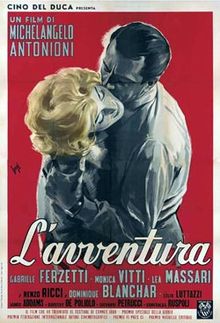 Looking at merely the first arc of the film—from the introduction of the characters, the wealthy upbringing, the passion shared by the characters, to the unexpected and mysterious loss of the seemingly primed major character Anna—it was beginning to look like any other film, since creating a conflict which would presumably be the center of the story. It is not the case in L’Avventura, however. The film is not about the search for a mysteriously missing woman. It is about the adventure.
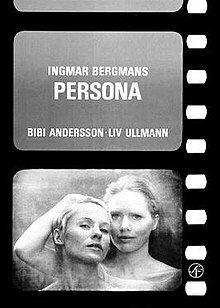 Most movies are usually created to satisfy people and for them to have a pleasurable experience while watching. However, some movies are intended to make the viewers feel uncomfortable, which is how Bergman’s film Persona was. After watching the film, I honestly felt bothered, confused, and disturbed as I left the room because I could not comprehend what I watched at first, and even when there were moments wherein I thought I was following the movie, I ended up being more and more confused as it went on.
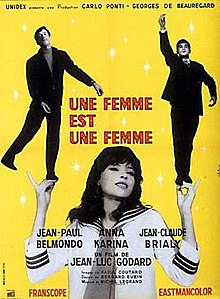 Coming into this course, I expected to watch films that are different and unique compared to those that I usually watch. To start the course, A Woman is a Woman was the perfect movie to set the mood and my expectations for the rest of the films that we will be watching throughout the semester. It was visually playful, weirdly different, and entertaining. It was visually playful despite being released in 1961 since I initially expected it to look like the usual old films. I would consider this film to be weirdly different because it was not the typical story that I see in movies. The use of music, the unusual way that the movie was shot, the dialogues, and the times that the characters acknowledged the presence of the camera were some of the things that made the film different. One of the things that was quite disturbing for me at the start was the bursts of music that also stopped abruptly, which was a bit confusing for me since I did not see the point in it. For instance, one of the scenes that highlighted the play on music was when the soundtrack stopped whenever the character sings, which was very contradictory but somehow, it works when you look at the entirety of the film. In addition, Godard was able to add a comedic element to the movie to keep the viewers engaged and intrigued by whatever was happening.
 European Film (2019)