Bonus: Skyfall

While Skyfall is “technically” a European film, I chose to write about it as it is one of the primary films of British cinema that has made itself a hallmark in the schema of the world, establishing itself as a global enterprise and brand while remaining distinctly British. Also, I chose this film because it is the first Bond film I’ve ever watched, and because prior to this class my knowledge of European cinema was quite limited (Which is, of course, not the case now. Thank you for the semester Sir!)

Skyfall, I later learned after watching the other Bond films, represented a departure from previous films in that as opposed to seeing the quip-ladden and witty and abjectly talented individual at his best, we are exposed to both his mental and physical vulnerability – a risk, considering viewers often want their heroes untouchable. But given the entire history and number of films in the enterprise, showing a weaker Bond in a sense even strengthened his character and character development, showing us a more human side of him – an ageing side of him.

A key element which has contributed to the continued success of the films is the adaptability of the storylines.  The villains and their methods have reflected the social and political times in which the films were released(e.g., the cold war weapons of Dr. No). Eva Mendes character represented a new type of villain in that while the themes of the film still relied on the formulaic approach of beautiful women, explosions, fast cars and easily-defined villainy, this was modified to show Mendes’ character as someone who works i the background, and in the shadows – just like Bond.

The use of music in this film is also extremely well-placed and orchestrated. The films titular “Skyfall” was penned and sung by the hit British artist Adele, keeping the film distinctly British in almost every aspect imaginable – characters, location, and now, music. The use of music to enhance different scenes by evoking specific emotions is greatly exemplified here, e.g., the impactful scene between Bond and Severine standing on the bow of Silva’s yacht as they approach his island hideout, wherein Bond is, at this point in the film, back in full form. Again, Newman’s sweeping orchestration in this scene, entitled “The Chimera” (the name of the yacht), increases the tension and hints at the dramatic turn of events that lies ahead.

Ultimately, what captures us in the bond enterprise despite it technically being an action film is that it is not merely an action film. Aside from the quite obvious fact that it is extremely well done, it plays into the concepts of humanity, fragility, unique villains, beautiful women, in a way wherein it simultanously sticks to formula while not seeming formulaic, and in a way that doesn’t seem repetitive. The film exudes class, and a world we would not otherwise ever be exposed to except through film. It plays on our fantasies of the underground of the world and plays it out onscreen in all its glory.

Film is, I believe, ultimately about the experience it gives its viewers. This film and the entire enterprise left its mark on the entire world, and on us – as with the films we watched in class. All of which imposed on us in their unique narrativity an experience unforgettable, evoking a multiplicity of emotions and playing with expectations – playing with us – in a way we don’t expect. Regardless of if it is an experience of excitement, or boredom, or confusion, European film has this distinct capacity to always, always,leave us with an experience we won’t ever forget.
Heavy Trip

HEAVY TRIP

European cinema can be fun, too.

The variety of films we’ve watched in this class has ranged from the slightly strange (A Woman is a Woman) to the absolutely absurd (Holy Motors). From films in the sixties to the more contemporary films – from films that don’t make sense (and aren’t meant to) to simply beautiful human stories exploring themes of love, family, and history, European cinema has expressed its range and versatility, and an ability to define itself in the universal cinematic universe by standing out in whatever way it deems appropriate. While Heavy Trip may initially seem to fall into the latter category of  film, premised on a simple story of a heavy metal brand trying to make its way in the musical world, it nonetheless retains characteristics other make it distinctly European, distinstly odd, and distinctly memorable. Despite retaining comedic themes rather comparable to its American counterparts such as Jackass or American Pie, Heavy Trip does so in a way that its comedy never becomes slapstick (not that slapstick films are wrong or unenjoyable). Despite a plethora of raunch-y or at times offensive jokes, the viewer still laughs because it’s funny – something I believe is underappreciated in comedic films. To be ostentatiously funny without being ratchet or offensive.

The characters in the film are all so distinct and unique in their own ways (binded solely by their love of metal music) that it is almost impossible for one not to be able to relate to at least one of the characters, or even to all of them as a collective. Though not a film driven by deep character development, all of them nonetheless have a story which we are exposed to, and allow us to further empathise with them. Finally, they are so distinctly lovable in their relationships with and towards one another, almost making their dark and death-heavy heavy metal physical appearance laughable. It is difficult to take them seriously, and yet we love them all the same – a critical aspect of many films, but one that makes it rather distinct from other European films.

As the film progresses into more and more absurd scenarios (digging up the dead drummer, the final ending sequence), its existence as a European film becomes more and more clear and distinct from its American counterparts or traditional cinema in general that always seeks to promote linearity and understandability in its plots and storylines. And yet at this point, it’s difficult to care. Heavy Trip is one of those movies directed in such a way that quite literally anything could happen – even the most absurd scenarios (perhaps, jumping off a cliff and living?) – and we would not question it. It is directed in such a way that we will continue watching, more than to know what happens next (I was late to my next class trying to finish this film, but no regrets!) but simply because of our utmost enjoyment of watching it. I was late to my next class trying to finish the film and yet I have absolutely no regrets.

Heavy Trip was the perfect film with which to end the semester – it reminds us to remember our passions, find them, work for them, but also not to take life too seriously and enjoy everything and anything that may come our way. Life, after all, can be ridiculous – let’s not forget to enjoy it.

Thank you for the semester Sir! I truly enjoyed it and learned so so sooo much!

Raw

Ironically, a film about cannibalism is hardly the weirdest film I have seen in this class thus far. Unironically, it was also the most interesting, captivating its audience all throughout with its simple yet compelling storyline, inciting conflict (at least in me) to watch more due to the nature of such carnal and raw scenes, making me want to look away but refusing to allow me to.

Raw is a film that beautifully encapsulates a young woman’s journey into becoming – almost like a coming-of-age film on steroids. The entry into college, where most of the youth are ultimately thought to learn of their identity by their integration into the entry point of the real world, highlighted by the initiation sequence the film revolves around, was a clever way to analogise the concept of the main character’s emerging discovery of her true nature. While the film begins with what simply looks like a college initiation, quickly turns to a film that thrives on keeping its viewers lured in through its gory scenes of animals and blood, and intimate, more sexual and abjectly explicit renderings of human and student interaction. The film explores themes of human sexuality and the awakening of previously repressed desires – the awakening of the most raw, carnal human being at its most animalistic. The main character quickly becomes almost primal in her desire for human flesh to simultaneously satisfy and carnal appetites. The films rendering of raw and intimate human moments (close-up scenes of kissing, sex, naked bodies, masturbation, and ultimately the devouring of actual flesh) all contribute to the central tone of the film as one that refuses to hold back, with no rendering for the concepts of taboo and without regard for the viewers’ feelings.

A lot of the scenes were obviously quite uncomfortable to watch, however the film excelled at keeping us locked in either way – a difficult task, all things considered.

A question the film raised was that of freedom – who is more free, Justine or Alexia? One who is free in the objective sense yet having to hide her identity, or Alexia, who is literally imprisoned, yet free and without restriction to embracing who she truly is? In this sense, I believe it is Alexia. In the few scenes we see of her at the end of the film in the facility, despite being physically imprisoned, she seemed not at all bothered by this – perhaps, it is not so far off to say that she actually seems happy.

Finally, I believe an important aspect of the film is the fact that it can be perceived as feminist film and empowerment. Women in the real world and in film have often regressed to the backdrop – in real life through the oppression of a system that inherently remains patriarchal, and in film as supporting characters, more often than not depicted as the “love interest”, of the brave male hero. Thus, it is exciting to see the how in these women’s control (the mother and the main character) or embracement (the sister) of their utmost carnal desire, there nonetheless remains the fact of their acknowledgement of it – and this has power. To portray a film that already goes against taboo, using the lead characters of women taking power over their individuality, is a powerful testament to the rest of the filmmaking world – not to mention a unique was of doing so.

It

The Edukators

Young individuals – the youth, essentially – fighting against an oppressive, unjust, and seemingly domineering economic structure is a concept that underlies a multiplicity of films under a variety of different genres. Rebellious youth can be found in a range of genres including Drama (Rebel Without a Cause), Drama-Comedy (The Breakfast Club), and even Science-Fiction (Star Wars). What I found interesting about The Edukators was that although the way it was shot was, in a way, very realistic, a brief foray into the characters themselves make it a little bit less so. The three main characters allow themselves to undergo so much risk for the mere act of making a statement – to break into a rich man’s house, risking getting caught, risking getting jail time, risking breaking into the house of a crazy man and getting caught – without any motivation of stealing (despite their obvious need for funds) or other common motivations for breaking in – indicative of the naivety of teen spirit.

The characters, then in a sense, may be said to be quite relatable, and thus is what ultimately drew me into the film. At some point in life, everyone wishes they could rebel, or simply do something about the society we live in and what we perceive to be fair or unfair. Furthermore, the film exemplified throughout its run the message it was trying to bring across regarding power, and the arrogrance and insensitivity of the ruling class. This is done in even the simplest and most minute and seemingly rather insignificant scenes – i.e., the scene where the restaurant guests order Julie to take back their drinks since they were placed in the wrong cup. A small action – a small scene – was able to evoke emotions of rage or at least disgust already inherent within us towards the obscenity of a ruling class that enjoy humiliating the lower people and asserting their power over them.

Furthermore, the introduction of a love triangle, while initially cheesy for me, ultimately sought to remind me that these people – these rebels who do things others normally would not – are ultimately just teenagers, and are human, too, making them all the more relatable despite the rather implausible concept of an otherwise highly-realistic and entirely plausible film. It allowed us to relate to the characters on a level that we could all relate to – of love, and relationships. While it does disgress from the main premise of the film, nonetheless it proves its purpose of reminding us of the characters’ humanity, and of their youth.

If I had one critique, it would be the rather awkward acting and music overlays (diagetic) in the final scenes of the film.

Extra Comments: Now that I understand what the relevance of the song used to distinguish between and show the relation between two significant moments in the film, perhaps it is not as misplaced as I initially thought. I do believe the song choice was still rather odd, although it is, admittedly, a brilliant song, especially in the brevity of using an English song for a European film. Perhaps it was the switch in language that initially bothered me. Nonetheless, given its intent, it was a smart decision from the director, especially considering song’s capacity to evoke feelings and relations within us.

Timecrimes – Sound and the Concept of Time Travel

Timecrimes has undoubtedly become my favorite film in this class so far. The premise and concept of time travel set is not a new concept, and extends over a variety of different genres – i.e., the action genre, as seen in Arnold Schwarzenneger’s Terminator (action), or even to that of drama and romance such as Rachel McAdam’s The Time Traveller’s Wife. Timecrimes, thus, delves into the thriller/mystery genre with respect to the central theme of time travel.

It was quite interesting to learn that Timecrimes is actually a low-budget film. It may be said that given its limited funding (approximately $2 million), the film delivered its intent – to create a thriller, to keep its viewers on the edge of their seats, to create a storyline that, while not the most original, still did not fail to garner interest and was distinctly unique in its own way. Even the rather simply-looking time machine – something conceived of as futuristic and implies the need for a higher budget – was integrated well into the storyline to explain its simplicity and also compensate for the lack of funding. Timecrimes is a testament to how an apparent incompatibility between a film’s budget with regards to its genre need not necessarily equate to a bad film. Another example of this is their use of a simple pink-tinged bandage for Hector 2 – a prop not in the least bit expensive, yet nonetheless creepy and rather frightening.

Furthermore, going into the more technical aspects, what I noticed in the film was its masterful background track and its use of music to further heighten and evoke specific feelings from viewers with regards to what is on screen – a start constrast from Trollhunters, which featured a distinct lack of non-diagetic sound. Both films are low budget, thus requiring them to rely quite heavily on other aspects of film in order to compensate for an apparent lack in another. Trollhunters used the found footage style film in order to equate for a lack of music (assuming a majority of the budget went to the CGI-animated trolls), while Timecrimes went the opposite direction, investing heavily on elaborate music and non-diagetic sound in order to compensate for a lack of stunning, high-technology, or even simply decent visuals that a film of its genre usually requires. I thoroughly enjoyed the film. The concept of time travel is so universally appealing – the idea of being able to go back in time, forward, or to reenact certain events – all dictate the human being’s desire to delve into the impossibilities of life. Film is a way for us to delve and experience vicariously the “What if’s” of life that real living will never be able to grant us.

Trollhunters

Found footage films have always been quite a favorite of mine – the authenticity they lend to a film has the capacity to evoke another level of fear in viewers, if done correctly. One has to appreciate the level of skill that goes into making an effective horror film found-footage style, and the variety of challenges directors and editors have to overcome as opposed to traditional horror films. One of the most important challenges would most likely be the lack of music or non-diagetic sound. Non-diagetic sounds and background music instrumentals play a pivotal role in films, especially in horror films, whether it be to compound the viewers’ anxiety, distorting and channeling normal sounds into music that has the capacity to evoke suspense, surprise, and the like. Found footage films, in order to lend to the authenticity, thus have to make do with diagetic sounds in order to evoke the same level of fear and anxiety in its viewers.

Another way the film compensated for the lack of normal horror movie techniques was the singular deep blue hue used all throughout that contributed both to the film’s authenticity and dictated the rather dreary tone for the entire movie.

Finally, an interesting contrast I found between this particular film and other found footage films is that in Trollhunters, the antagonist is not clearly depicted and shown on screen. In an attempt to presumably heighten the horror or mystery, and further evoke a first-person feeling of “being in the film” found footage celebrates (by only seeing what the protagonist sees or even less) many found footage films either do not show the antagonist or monster (e.g., The Blair Witch Project, Quarantine) or are shown rather briefly, depicted either as far in the background, against a backdrop of smoke, brief half-second glimpses (e.g., the 2008 monster film Cloverfield). Trollhunters clearly shows the trolls – the monsters – in the film, and through this was still able to convey heightened feelings maybe not of fear, rather, of suspense, more often found in action films. The scene with the troll chasing the car for example, brought out in me a feeling I often feel when playing video games and am being chased by whatever villain was in the game.

Overall, I quite enjoyed the film. Aside from the fact that I personally enjoy not just found footage films, Trollhunters managed to bring together two of my all time favorite genres – action/sci-fi, and comedy. It was interesting to see how the director managed to combine all these different genres (on top of the film already being found footage) without concocting a complete mess of a disarrayed film that did not know what it was doing. While at some times various scenes, sequences, or plot points seemed rather bizarre, overall it was a great amalgamation and reinterpretation of traditional found-footage horror, and a testament to how European cinema, despite delving into more mainstream Hollywood film concepts, still manages to surprise and add its own uniquely weird and untraditional twist that highlights European film director’s individuality, as well as the European film as a whole.

Extra Comments: Trollhunters may then be described as a more careful attempt at film making as compared to other found footage films, in the simple fact that the videos taken by thee characters are supposed to be a thesis. Furthermore, what separates found footage films in general from other films is that there is no suspense as to whether the main characters succeed – any found footage film, especially if there is a deliberate reason as to why it is found footage, is always about the failure of why they were shooting in the first place.

Holy Motors

Holy Motors is a film, to put it simply, not easily digestible.

However it can be once you see it as it is – as if from a child’s perspective seeing it for the first time. The film if taken in in with our scrutinization over every singular aspect renders it almost utterly incomprehensible. However, it is also in this taking apart that we finally realise what the film is about – not a mere bundle of random clips of ostentatious scenarios put together, but a film about performance, acting, and cinema itself.

Towards the end of the film, we see the main character, Oscar, speaking to his presumed boss (“What keeps you going?” “The beauty of the act”.) One of the things that make a film a film, and that which drives the plot forward, are the characters who bring the story to life and are essentially the moving force behind the continued progression of the plot. In Holy Motors, we see a multiplicity of fragmented plots and the film’s clever transitions between them, as well as its integration of multiple genres and types of movies – drama, a musical, a CGI-edited film.While all of the plots seem to have rather mainstream narratives – even the scene with Eva Mendes, which may be said to be indicative (if we look closely) of a more explicit rendering of the otherwise not uncommon Beauty and the Beast movie theme. Performance is an extremely rich area of cinematic expression (Spiedel, 2016). More often than not, actors portray their character intentions on screen actors’ through carious aspects and mannerism they intergrate within their performances. According to Speidel, performances and our decoding of them are shaped by our everyday shared understanding of human body language, which alerts us to the possibility that (ex.) the act of chewing a lip, for example, may signify anxiety.The main actor Denis Lavant may then be said to have succeeded immensely in his portrayal not just of one, but nine drastically different roles, some of which are not even human. The entire film was animated by acting – both of the entire cast and Lavant. The only thread of continuity was the Holy Motor – otherwise, the film is a fragmented set of various scenes, ranging from the normal (the father-daughter conversation, the bedside table scene)  to the obscure (the CGI simulated sex scene) and the absurd (Chimpanzee scene). The entire film, in that sense and from the perspective of the viewer, may simply be said to be a testament to the actor’s versatility and raw talent.

However, despite this, without a consistent narrative, a setting/situation to hold onto, without actions having consequences, how do we arrive at the character’s purpose? We know he’s an actor, and we come to expect these performances, and yet the expectation of seeing the “real life” underneath is sometimes teased but never really met. Hence we proceeded to an analysis of his performance itself, without still knowing the meaning of the film nor the intent behind these performances. In the realisation of the reality that there are an infinity of different interpretations of the film. And since it’s quite impossible to come to one, we realise:


The main question Leo Carax’s film begs its viewers, more important than what it means, or even more important than how we comprehend it, Is it possible to enjoy a film that lacks such a crucial filmic element – narrativity? Is it possible to enjoy a film that doesn’t allow you to orient yourself in it?is is it possible to enjoy a film you cannot understand? The answer is YES. Because of the unspoken element of film – experience, Specifically, the kind of film experience Holy Motors brings us.

While the film happens in a homogenous world (single diegesis, from day in to day out) it takes you to another world. Every film creates its own cosmos, its own universe, and Holy Motors creates many. The Experience of Watching the Film which constantly interrupts itself and doesn’t create a seamless experience renders it spontaneous and disorienting. The line between fact or fiction is so blurred until we don’t know what the hell is happening. And as soon as we think we know what’s happening, cars start talking.

While it may be the complexity and pure chaos of a confusing plot that initially reels our attention and makes us keep watching, continued by the captivating performances of the actors, the experience of the film draws us in and make us stay.

It’s a movie about the experience.

And if we are not meant to experience these movies, we can’t make works of art. And you can choose to leave the film artless, or you can appreciate the individual broken pieces – every singular element, every singular performance.

It’s not a film of glorious visuals, of heartwrenching morality, it’s a film of performance, it’s a film not just to be watched but to be experienced, that thus constitutes “The Beauty of the Act” – no matter how fleeting it may be.

Holy Motors has won and been nominated for dozens of prestigious awards. We love what we can’t understand. Let’s not ruin it by trying to.

The People of The Fall

Goodbye, Lenin! is a testament to how film can be creatively harnessed to encapsulate significant historical and political events in our current world in a way that both entertains its viewers, as well as reminds us of the significance and impact said events had on the people who lived through it – a balance of which, I believe, the film did perfectly.

Goodbye, Lenin! Was a film quite obviously premised on a tragedy, placed in the context of a major world event that wracked ambivalence on the world, and on the people of Germany. However, despite the films comedic and entertaining sequences that thus succeeded in entertaining its viewers, and that allowed it to be labelled a tragicomedy,  it did so without once making light of the actual, tangible consequences wrought about by the fall of the Berlin Wall.

One thing I noticed regarding films depicting major world events is the tendency to focus on human relationships, thus in a sense providing a more intimate perspective and look into global experiences otherwise unfathomable to us. By placing focus on specific relationships between families, lovers, etc., we as viewers are able to empathise with how these people felt. As individuals who are unable to experience these events firsthand, we get a sense of their impact on the people who did experience these events. For individuals watching who were actively present during the transpiration of events, viewing films about them may be a way to relive the experience from another person’s perspective. The impact of centering on specific characters in the context of huge social issues allow for the fathomability of drastic events in world and human history.

The ability and active desire for the film to allow viewer empathy for the characters is a stark contrast from the films prior discussed in the class. The film uses relatable characters to present an otherwise unrelatable scenario. Prior films such as A Woman is a Woman, on the other hand, present generally unreliable or difficult-to-relate to characters acting in regular everyday scenarios. La’Adventura seemed to go out of its way to create an assembly of characters the viewer lacks empathy for. While Goodbye, Lenin! Depicts a rather unique story in the midst of an actual event of our world’s history, the film nonetheless goes out of its way to create characters exhibiting emotions and actions relatable to any human person.

The human need to live in an extended period of temporality is something perhaps we can all relate to – the nostalgia and desire to live in the (presumably) less complicated past is a basic human instinct. The main character represents this to the extreme – hiding the fall of the Berlin Wall from his mother who is unaware of any of these events. The son’s actions are something which can also be attributed to another rather relatable human emotion – love and dedication for one’s mother. The family in the story are reminiscent of not uncommon family dynamics in society – the absentee father, the (rather) wayward sister, etc. All of these constitute aspects of human life we can somehow relate to, thus allowing us to empathise and relate and connect to these characters, as we try to understand why they do what they do in the context of a highly difficult scenario. Despite the fall of the Berlin Wall being the major historical situation depicted from which arise these events in the film’s story, the fall simply served as a means by which to emphasize the actual story – human dynamics, and family and romantic relationships, and human actors in a confluence of relationships, and how these relationships persevere in the context not just of the fall but of any rather disastrous event life humanity has been able to supercede.

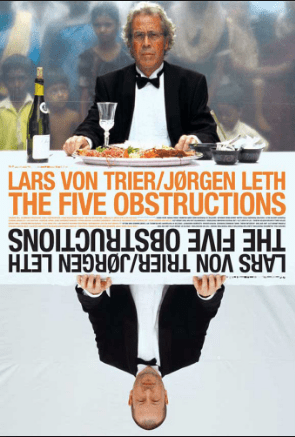
The Five Obstructions – Human Perfection in Camaraderie and Competition

European cinema is obsessed with toeing the line between traditional rules of film and art cinema. One of the primary differences between the two is that the former fully attempts to create an experience of immersion for its viewers, while the latter seeks to remind the viewer that we are, in fact and simply put, spectators of actors acting on screen. Documentaries then, may be said to be an exemplification of breaking this immersion into story, in its recording of acutely real events actually and perhaps even presently happening in the world. However even in traditional cinema, the illusion of reality – by fostering narrative transitivity in its creation of a story – is still attempted by its directors. The Five Obstructions, on the other hand, breaks this narrative transitivity and the illusion of reality to the absolute fullest.

At first sight, the documentary is quite obviously art cinema in its unique depiction not merely of films within a film, but film production and director correspondence in the creation of these films for the film, with both directors so acutely and actively engaged on screen and acting the premise of the film itself, in what I then perceive to be the ultimate exceeding and test of the limits of traditional documentaries. The first phrase that came to mind while viewing the film given this factors is that The Five Obstructions is the ultimate fourth wall break.

Despite the premise of the film being guised as a collaboration between two renowned directors (and the return of one from retirement), we quickly perceive an aura of competition over camaraderie between them, as Leth is consistently given more and more difficult challenges, never actively praised and yet also critiqued by Von Trier. The master-student relationship actively onscreen thus gives way to a reversal of initial roles. And yet despite the increasing difficulty and ridiculousness of the obstructions, Leth nonetheless responds to them to the fullest of his capacity – even creating an animation despite his lack of knowledge of it and inherent dislike.

The premise of camaraderie and competition and the roles of power in relationships is not something we have not seen before – this may be contrasted to Persona, wherein the film premises on interactions of two characters and the subsequent relationship formed. Persona is centered on the melding of two individuals and the continuous oneness of their characters, and the power each of them hold over another at different points in the film. The Five Obstructions displays outright competition and perhaps even guarded hostility.

It is also interesting to take note that in both films that display this underlying tension and competition, both main characters of the same sex. It brings into question whether the type of camaraderie-competition relationship would have had the same intended effect if the main actors have had been of the opposite sex (the main assumption being that it would not, e.g., A Woman is a Woman).

What may initially be perceived as the film’s depiction of a collaboration between two filmmakers further grounds itself in the aforementioned portrayal of a master-student relationship that, again, quickly evolves into a competition between two masters of crafts. The reversal of power, the constant one-upping, does not come without further repercussions and the entrance of further human factors – specifically, those of imperfection, competition, and the human drive for perfection in the face of it.

Imperfection may be seen in the films Leth himself creates. As the perfect human strives to do everything perfectly, we cannot help but notice that the films document precisely how he or she does everything imperfectly, or against a backdrop of imperfection (e.g., the Mumbai scene). Exemplified by this example, we realise human imperfection becomes noticeable at the fringes of our perception, and yet paradoxically, this imperfection may be said to be made more noticeable due to our human drive (exemplified by The Perfect Human’s title and thus, inherent goal) towards perfection, that we then are made more capable to take note of imperfections. Thus, Von Trier’s critiques of Leth’s films (although interestingly, Von Trier also gives credit to imperfections relevance to film creation, “the best gift is when an actor messes up”). Leth’s  drive towards perfection is fuelled by Von Trier’s critique, and the competition now deeply embedded in their consistent interactions.

Competition is animalistic. In attempting to recreate The Perfect Human, we wonder whether Von Trier is saying that the Perfect Human is one who pursues perfection, consistently and constantly in the face of imperfection, driven by the animalistic tendency of competition harbored by each and every human being. Is the perfect human then a bundle of imperfections striving towards perfection, or one who creates perfection from a multiplicity of imperfect variables? And is this perfection one that we seek inherently within ourselves, or is it exemplified and thus, made possible and perhaps even strengthened by factors of both camaraderie and competition – hence, that which defines Von Trier and Leth’s relationship.

Extra Comments: The relationship between Von Trier and Leth can be said to likewise be seen in Persona. The same underlying tension and competition between them is also seen in the two main characters – a relationship of camaraderie and competition. Aside from this, it is interesting to note how the outside world in both films have a tendency to intrude upon what is currently going on in the film. In Persona, we see films and pictures of the Vietnam War, and other events. There are references in both films to the world outside Europe, and I believe this is another thing worth exploring and thinking about. Similarities may also be seen with La’aventura in how both films seem to begin with one thing but is actually ends up being about another. Here, the beginning of the film portrays the documentary to one regarding filmmaking. At the end, we realise it is more about showing how the process of filmmaking is multifaceted.

L’Aaventura

Romantic movies never really appealed to me, new or old. Perhaps the only romantic films I’ve genuinely enjoyed have only ever been romantic stories in the context of a larger genre or theme – an action movie, a musical, etc. Furthermore, I’ve always had an aversion to movies that depict infidelity, as they often border on its glorification. Perhaps these prior personal opinions are what gave me my initial reservations throughout the course of the film.

Nonetheless, L’Aaventura embodied European Cinema at its finest once more – though it may not be as avant garde nor ostentatiously “weird” or “odd” as its counterparts e..g., the films we’ve seen in this class prior, it nonetheless portrayed, in a more subtle way, especially with regards to narrativity, and perhaps the slow pacing of the plot.

First and foremost, the film is, quite obviously, not an adventure about the search for Anna – she is barely mentioned. The adventure could be interpreted in a multiplicity of ways exploring a variety of different themes – is it the adventure in the progression of Sandro and Claudia’s relationship? An adventure into the exploration of the bastardry of cheating men and men in general? An adventure into the aftermath of Anna’s disappearance, an exploration into the relationships she has and how little it seems everyone seems to care about her – the shallowness of human relationships, the finite nature of commitment and fidelity to girlfriend, friend, or acquantace? Is it a testament to human shallowness and how easy it is for us to forget? The only person who seems to give a damn is her best friend Claudia. And yet even the strength of her commitment to Anna is tried, tested, and has its own perceivable flaws.

La’aventura is not exactly a love story, rather, a story of sexual desire. The storyline was both simple and simultaneously complicated in its ambiguity, rendering some viewers perhaps even frustrated at the lack of “huge” events or at least a single narrative that binds the entire story together. We initially are led to believe that the film is about Anna and “The Adventure” is about their search for her, but the character of Anna ultimately regresses into the background and we transition to the story of Sandro and Claudia, who intermittently mention Anna, with Claudia’s character finally coming into the foreground as she transitions from minor character to a character whose relationship with Sandro becomes the plot that creates the main storyline. It is important to note here that it seems like she is the sole person who still gives a damn, and this is perhaps what makes her character rather likeable as opposed to the others towards whom I personally felt no affliction or feeling. While we are introduced to Anna at the very beginning of the film, she disappears, and we never get any closure whatsoever as to her disappearance. What, then, is this story about?

Another break of expected plotlines here occurs in the location. Antonioni’s films have the quality of being rather languid, and slow. Here, there are so many things going on, and yet none of it occurs on the island where Anna disappears.

Nonetheless, the film is striking. It can be even be likened to a silent film. While there is no sense of closure, there is always something about the gestures of the characters, the smoothness of their movements and the transitions in their interactions, that speak volumes. There are even certain points in the film wherein we seem to be intruding upon the characters (e.g., the window scene) moments meant to be private and intimate are filmed in such a way that is seems like the director wants us to actively feel this as if we are imposing on an actual moment – as if we are intruders instead of film viewers.

Relating the film to A Woman is a Woman and Persona, the three are all classified as Art cinema, and yet are all so distinctly different. There is a need to focus on their narratives, and how these narratives are portrayed on screen, all of which offer a distinct type of viewing experience.

However, again European film and film does not rely solely on its story to project what it aims to portray and send out into the world – L’Aaventura was Art because it was untraditional in its on-screen portrayal and plotting. Despite its incongruity and moments of languidity that sometimes make it difficult to watch, the beauty of it is that it manages to keep your attention, and despite not feeling invested in any of the characters, and despite our propensity to hate them all, we continue watching. And watching. Despite the closure that never comes.