Volver: returning to how things should have been

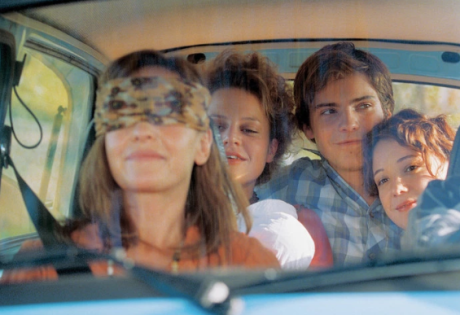
Volver is a film that takes me back to the time when I was an eleven year old girl, sitting in my kitchen, watching the latest Spanish teleserye on a miniature cable television set after school. Its familiar archetypal elements such as the evil stepfather, ghost of a grandmother, digging of a grave in the middle of the night, and some sort of a family confession and reunion at the end– these things lead me to forget that I was in some sort of European art film class because everything was so close to my cinematic knowledge.
03volv.1.650.jpg

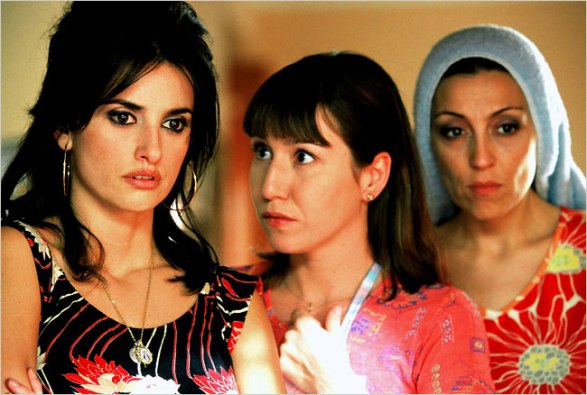
While Hollywood films usually cast women in roles that could be  complementary with men or soapy teenage chick flicks and romantic comedies, this film showcases a mix of natural realities and peculiar ones that middle class women in Spain go through. A close shot on the widows from the beginning of the film showcase the Hispanic culture of females having the responsibility to maintain and polish the tombs of their departed. This emphasizes the societal role of women as domestic. Moreover, it is seen in the film that the women were battling machismo. Sexual abuse was rampant in their very own homes and the female characters exhibited their courage and strength to face these trials. Irene talks about how the women in their family possessed really bad luck with men and they realized that they do not need them because all that matters is that they have each other.

Penélope Cruz, plays a great breadwinner carrying the weight of not just her own household but that of her sisters and cousins. Despite the hundred percent sensuality that she exhumes, given her appearance, the strength of her chacter showcases her defiance to sexuality, given that she gives pertinence to what truly matters which is her family’s everyday survival. Almodovar shows how women can possess both beauty and strength, not only in the exterior but most especially, intrisically.

images.jpg

Raw cultural elements were seen in the film, celebrating Hispanic traditions and close family ties. Moreover, the various characters show their way of evolving not just as women apart from their men but solely, as people in society that play a role in their neighborhood where they have contributions be it in a business perspective or in a relational view. 

Initially we see tensions building up between the characters as repressed angst have been going on throughout the years. As time passed in the plot, it is revealed that all of these characters have been yearning for the love that has been kept inside and the audience can give out a contented sigh as there is closure at the end of the film (a pro-mass ending similar to teleseryes that usually do not give ambiguous finalities)

Volver plays uniquely on the relations of these women, showcasing the values instilled within these women as pillars of strength, carrying the family and keeping it together, relaying a positive message that there is light and hope in familial togetherness and individualistic empowerment despite the challenging rein of masculinity in their environment. 

-161997-
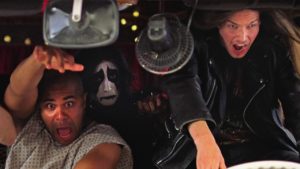


A Call to Arms

I just want to say that I am not a fan of heavy metal.

Never been.

Never thought I would.

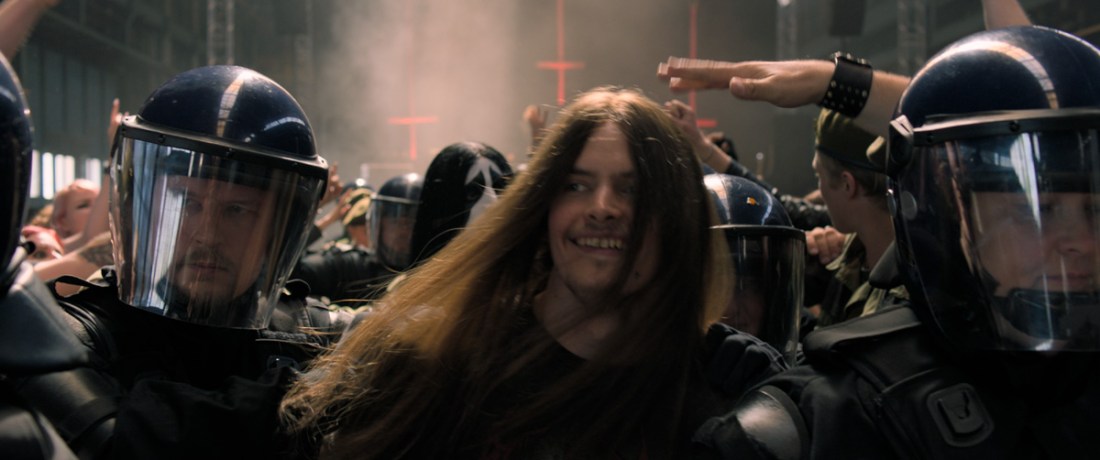
Watching Heavy Trip for the first time, made me willing to watch it again twenty times through because I never laughed that hard with a foreign film.

Everything about it was amusing– the characters, the setting, the costumes, the jokes and even the cliché plot twists.

In this film, we resonate within the bounds of metalheads that society stereotypes to be druggy crackbrains and spawns of satan who really have a way of disrupting the peace and order of neighborhoods with their pandemonic sounds.

Heavy-Trip-2-300x169

Other films would celebrate the rock & roll of it all, the glamorous and alluring road shows, with the fame, women and fortune-(e.g. Bohemian Rhapsody and Still Crazy)

Here we see, a group of men who still seem to act like they are still teenagers, dreaming but also fearful of materializing their crafts and having their own spotlight in the future. Futile with their livelihoods, outcasted by their neighborhood, solitary in their own homes with no ongoing relationships, even being labeled as Homo on the streets and criminals by the police— for them, music was the only thing that kept them going.

Lead singer Turo powerfully states, “This music is our thing. Other guys can play hockey and drive around chasing pussy. We play metal.”

A feel-good film, it derides the geeky band culture, the goofiness of it all, but at the same time celebrates its art and the undying passion of its members.

Co-directors Juuso Laatio and Jukka Vidgren brings into the film, a conjunction of both old and novel comedic elements that makes the film fresh but also keeps it classic. I don’t think you’ll see a film with a rock band crowd-surfing corpse or an aggressive mental patient suddenly becoming the greatest drummer in town.

From their accustomed frivolous band practices in a basement underneath a reindeer slaughtering factory, came a big break when the band bumps into the Norweigan Metal Festival director. With an ounce of hope and a sparkle in their eyes, the band members attempt to play their “Symphonic Post-Apocalyptic Reindeer-Grinding Christ-Abusing Extreme War Pagan Fennoscandian metal” music on the road for the first time after twelve years. With an iconic official band photo taken by a traffic speedcam, Impaled Rektum sets out their love for metal to the world. 

Heavy-Trip-02

Taking off in a stolen van, with their dead bandmate roped to the top, they enter the border of Sweden, witnessing a miniature civil war with drunken bachelor entrants wearing Jesus costumes with Norweigan troops. Having been mistaken for the best band in town, they had one shot of playing their sound. Despite lead singer Turo vomiting, the crowd went wild as they played their one and only reindeer-slaughtering demo.

This film, amusing in all aspects is a call to the underdogs, with a love for something that celebrates alienation from the outside but vitalizes togetherness with the people that share the same passion as theirs.

Really, really a must-watch if you just want to laugh your pants off while celebrating the music genre together with the characters of the film. Maybe somehow, you’ll get  inspired with materializing your own personal dreams, whether it is accepted by everyone around you or not.


–161997–

Raw and Real

Deemed to celebrate humanity’s greatest taboos– RAW is being critiqued as merely a showy coming-of-age cannibal film, but it truly deserves more credit for that. This film, as a matter of fact, can top your list of the most grotesque films that have ever been made. On the surface level, the scenes can be seen as plainly nasty and absurd. However, it is visceral and elegant in  its artful way of reflecting systemic conflicts that can occur in a daily life of a freshman on her first year of medical school. Julia Ducournau might have possibly utilized the indulgence of human meat as a metaphor for an adolescent’s sexual awakening but more than that, the evolution of identity and discovery of a sense of self is explored all throughout the film. Justine, an archetypal vegetarian virgin, a rookie in the vast complex extremities of the playing field, represents a huge percentage of teenagers who have established a set of values and principles, that are yet to be destroyed by the evils of the environment.

Growing up in a conservative, vegetarian and veterinarian family, Justine seeks to excel in school, putting other unsubstantial things aside. Initially resistant and repulsed by the disheveled chaos in medical school, she suddenly discovers how a tiny nibble of raw rabbit flesh can stir up something intrinsic in her- a hunger for something uncanny she never really acknowledged.

Momentarily, a significant scene is shown in the film where Adrien her roomate, finds her snudging into the refrigerator tearing into a raw chicken breast, preconditioning her indulgences in the near future. With the plot build-up, it can be divided into the various metamorphic stages of a creature turning into its most natural form, similarly to how a werewolf will first turn on its first full moon– this film showcased Justine on her way to becoming what she truly is.

Another perplexing but powerful scene was when Justine, slowly watched the blood trickle from her sister’s fingers on her hand, and her eyes were glistening as she knew what she wanted to do with it. The moment she gave into her desires, lead her to a lifestyle that is so drastically contradictory to the philosophy she was raised with. Here we see her character evolution, from a reserved girl who felt lost within herself, to a brazen young woman who has finally accepted herself and found her place.

Beguiled into her newfound lust for human flesh, Justine craves for someone to understand her, thinking that it was her sister who would help control her, it was surprisingly her homosexual roommate Adrien. Given that he was able to guide her and watch out for her and she actually felt safe with him– it was truly terrifying to find him lifeless at the end of the film. Suddenly the mood from being so terrifying became so heart-wrenching for quite a few minutes. This then shows a distressing fact that with her situation, the people close to her are bound to get hurt.

The element of relatability is evident in the film given lots of realities are portrayed. A concrete one which is the rookie initiation that is played out in the first scenes of the film, included buckets of blood, delirious parties, body paint carnality and forced feeding of raw animal parts. Tackling peer pressure, conformity to one’s environment and unending indulgence, Raw is intimate and analogous to an adolescent growing up. This realism leads Justine’s bloody rights of passage to go beyond callousness into something custom-built for the audience.


a reflection of who we are

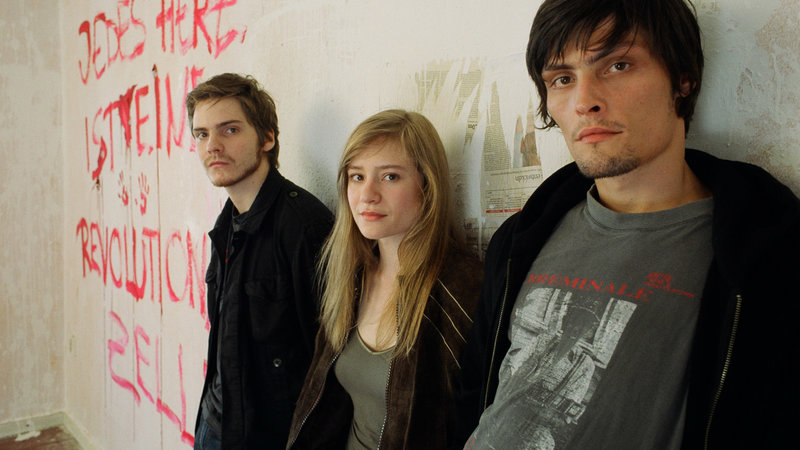
The Edukators touches on the history of post 90’s Germany very much like the film “Goodbye Lenin”. After the fall of Great Berlin wall, youngsters from both sides of Germany mobilized to seek new lifestyles. Most of them squatted in empty buildings given when rents had skyrocketed. Given the historical background, the film depicts underlying films of human reality as it tells a story about the degradation of humanity as globalisation dominated. As capitalism rose, the value of humans suddenly aligned with the money that they produced. With regards to the system, the proletariat seemed more hopeless than ever. This is evident in the main character Jule who is burdened with almost a hundred thousand worth of insurance debt that cannot be paid with her job as a waitress. Similar to Good bye Lenin, the film showcases an intense desire for political reform but instead of creating a microcosm of the old regime, The Edukators focuses on the art of revolution. Displayed in the two pranksters, Jan and Peter who break into homes of the bourgeois, not stealing anything but merely rearranging their furniture to threaten these capitalists regarding their privileged lifestyle. This is a novel way to attempt in destabilizing the status quo. It is a way of manifesting their passion for change into a form of art.

edukators-800-800-450-450-crop-fill.jpg

Another perspective is taken into account when the kidnapped businessman Hardenberg’s life is given attention. In the cabin, we go deeper into his past and discover that he was actually once like them– a rebel in the 1960s. The audience then witnesses a concrete example of how rebels evolve into conformists as they degenerate politically and adapt to the norms of society. Hardenberg gives a speech in the middle of the film regarding growing up. To bring forth change back in your 20’s is heroic but once you grow older, revolting against the socio-political norms is stupid.

edukators-4-300x170.jpg

It might seem depressing given that this is the society that we live in today however this film is just stating basic truth. All of us at the start, want to make a difference. But when we grow older, we realize that we all want a great home to live in, enough money to feed and take the kids to school, and to have those monthly vacations we desire. Radicals ending up as mere reactionaries is a normal human reality that we seem to decipher as “evil”.

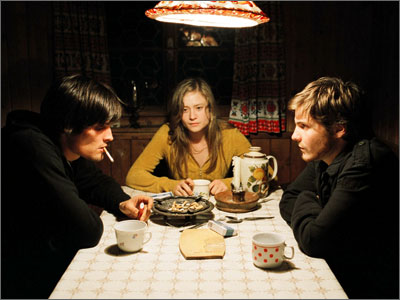
More than the capitalist conflict, the complex relationships of humans are delved into in the convoluted love triangle between Jule, Jan and Peter. There is the common conflict of temptation versus fidelity. It is truly hard to battle the overwhelming eagerness to be with someone who understands you even if that person is your boyfriend’s best friend. In this film, the plot takes a bold step in exhibiting the fundamental weakness of human beings, that of which is attraction. At the same time, we also see the noble strengths of man which is the ability to forgive despite betrayal.

edukators-1.jpg

With regards to the structure of the film, it is very organized but it is not strict with the way it is shot. The dialogue is very natural portraying a dramatic yet truthful reflection of the post-war German youth. The visuals are shot in broad daylight with the cameras following the actors, as to give freedom to them and to display some sort of lightness in film.


Enlightening, comical and at times frustrating, The Edukators mirror not only the way of life back in the 90’s but also, the never-ending, worsening human realities of the contemporary youth.


-161997-


Old themes. New Films.

There’s something in me that feels so lighthearted and giddy when I think of Time Travel films. It exhilarates the life out of me when I see the element of space-time continuum being warped to alter appreciable and significant events in a character’s lifetime.

This is because for me, it satisfies the human’s cravings for accomplishing their what-if’s and what-nots in life.

timecrimes3.jpgWhat if you go back to save the one you loved? What if you go back in time to see what had not happened if you did this and if you did that?

These are some of the typical questions we relate to time travelling. With regards to the childhood favorite,

Back to the Future, or the heart-wrenching Time Traveler’s Wife or maybe much more stellar sci fi classics such as Men In Black or Star Trek—  we see in these films how time travel is utilized to bring delight to the audience and to somehow add supplementary color and vitality to the plot.

However, one can see in TimeCrimes that the time travelling element in this film, somehow frustrates the audience and leaves them with unresolved conflict with regards to how the interminable loop of Hectors even started.

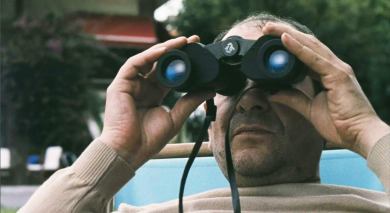
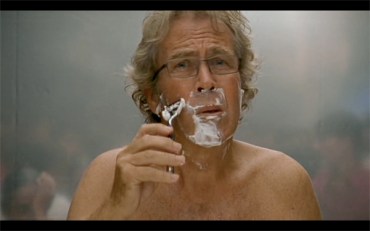
Beginning with such humane perversion from a normal husband-father figure with a big belly and binoculars– any middle-aged man would gain interest from the mysterious barren woman in the forest. It just so happens that the act of delving into it and recklessly desiring for more, lead him to an irrevocable shithole of physical pain, perplexing strategy-making, and indispensable violence.

1280_timecrimes.jpg

This then emphasizes the concept of adultery being something that could have been never intentional but more of a mere natural attraction to men. As the plot thickens, one would see how Hector is doing everything to cover his tracks, not just to kill the other Hectors but also to eradicate his now known precarious infidelity.

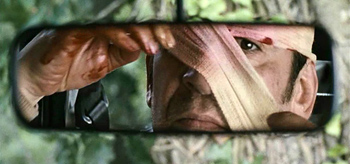
In this film, given that you have different versions of the same character, the audience would gain a variety of perspectives, therefore also having the power to switch from one film genre to another. At the start, my friends and I were literally stuck to each other, shaking and screaming as the bandaged man was first presented in the scene up until he was chasing Hector to the building. With the first few scenes, one would surely believe that this is a horror/thriller given the Friday the 13th aesthetics and all that. As it progresses, specifically when his face starts bleeding and he sees the bandage on his hand, it would surely make filmbuffs realize that Hector is the bandaged man. This would then switch the film into a mystery/suspense film where we get to solve clues as he tries to figure out what to do next. Action comes in third and last, as a lot of chasing, hitting and hiding were involved. With a little stint of comedy, you would realize that as a bandaged man, he was actually just trying to peep through the window to see what was happening inside the building but initially, the thought of seeing his bloody face at the start of the film really caused a jumpscare to the entire class.

timecrimes-trailer-tsrimg-v2.jpg

In light of all that has been mentioned, one thing that gave this film an edge was how he recycled the “hurt-one-woman-to-save-the-other” concept for adulterous conflicts by making it not seem so dramatic, rather showcasing the act of cutting the younger woman’s hair, one of his full blown compulsory decisions as a “faithful” husband to his wife. This blew the audience aghast regarding the liquidation of values of Hector who did not want to hurt his wife in the first place but ending up doing so, in the worst way possible.

My greatest admiration for TimeCrimes is how it showcased classic styles, dilapidated themes and overused elements but presented it in a nuanced and convoluted way like no other Time Travel film I have ever seen before. 

-161997-


Trolling alone

Having to watch Trollhunter, a 2010 Norweigan dark fantasy/black comedy mockumentary alone, I did not know what to expect from the film. I thought to myself, “Given that the central theme of this film would be about trolls, would other fairytale characters be included?” “Would this be pure CGI or would it be obvious that they used people with prosthetics?” “Would this actually be a scary one or would this be another banal fiasco?”

As I moved on to viewing the film, it caught my interest in an uncanny way. First, I loved how the “found footage” format was utilized because despite the film being fantastical and animated, it displayed some level of rawness to the film. The quirkiness and comical college students who played the main characters also added to the element of reality within the supernatural bounds of the film. Another element I took interest in, is the subtle celebration of Nordic culture and geography. With the footage, the audience can get a taste of the utmost beauty of the Norweigan scenery. Moreover, their national legends include those of trolls because their people actually believed that these creatures do reside in the forests and mountains. This mockumentary is a compelling way to show who they are, where they are from and what they believe in. The animal herds, the power lines, and the speech of the Prime Minister regarding trolls, showcase an ingenious possibility that maybe the government is actually tiptoeing around actual troll control. Additionally, the film reflects how only a minimal number of Norweigans actually involve themselves with religious affirmations.

trollhunterimage_1050_591_81_s_c1

Another enthralling feature is its magnificent sound editing. The transition from lighthearted dialogue to hearing sudden growls in the background and stalwart footsteps approaching the main characters will put you off your feet. With the use of night vision, it was way scarier than it should have normally been.

With its “found footage” format, one film I can relate this to is the 5 obstructions that was shot in documentary style. Other than that, its fantastical elements can somehow be attributed to that of Holy Motors, where one can not distinguish which reality is real and at the end of the day, you are forced to believe in what you have experienced.

A comment I can give is that it’s crafted with artistry, given it’s a new take on featuring a mythical creature. It may have some cliche, overused elements such as the “bite that didn’t seem to be anything but turns out to be fatal”, the “footage-that-remains-but-the people-who-filmed-it-cannot-be-found-anymore”, the “sudden-traitor-revelation (oops I am a Christian, sorry I didn’t say it before hand now we will all get in trouble)”, these can all discredit the authenticity of the film, however I believe these were all utilized for added entertainment to the audience.

Trollhunter, a bit bizzarre, is still a must watch for people who like to take a comfortable seat with a thick blanket to hold onto when the footsteps are getting faster and the screams of the main characters are getting louder. On your seat, you cross your fingers and hope your favorite character does not get killed off or eaten by the monster.


-161997-

A life of ambiguity

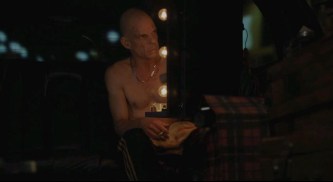
Encapsulating the entirety of the dazed human mind with its vivid patchwork of images, sounds and ideas, Holy Motors exercises its full time freedom to do whatever the hell it wants to do just because it can. The film begins with Director Leos Carax himself, entering a movie theater, stumbling blindly representing a direct commentary on how cinema can reflect the way of life. With its enigmatic and idiosyncratic vignettes, this film reflects how life can sometimes be both a dream and a nightmare, just like how cinema portrays it to be. Carax, the meteoric genius of the modern cinema, crafts a piece of art with film as its language but deeming it as more than just about an appreciation of film. This 2012 French-German fantasy plot showcases a man inhabiting several roles with no apparent cameras filming the man’s performances. Having several role assignments for the day and the pressure to carry each one out the best way he can– lead character Monsieur Oscar played by Denis Lavant, puts his heart and soul into everything, bearing the emotional transformations, losing and gaining identity for each scene he plays.

images

Acting and filmmaking are prominent themes as it showcased a variety of themes per vignette ranging from documentary to science fiction to drama to musical to thriller. Extravagant camera techniques accompanied the various genres in the scenes such as cinema verite, slow motion, quick cuts and melodramatic camera movements. These stories bursting onto the screen, projects the vast imagination of a director’s mind and projects it through the catastrophic sacrifice of the actor to give out everything he can to satisfy these cultivated imaginations. This can showcase the reality of how difficult an actor’s life can be at the same can represent the difficulties in human life as we all give out an immense amount of energy just to portray the multitude of roles we possess.

0_o3i-iiWOXBZf7RLD

One scene showed a man, presumably to be Monsieur Oscar’s boss or director, wherein they discussed about what makes actors carry on with their job. Monsieur Oscar discusses how cameras are now shrinking and the absence of it gives him less motivation to do his job. The absence of a visible camera can represent a message regarding how people nowadays, lose their purpose. An actor, having trouble believing in his own acting, given the absence of the camera can show how everything must have reached up to an ambiguous place now, where we do not even believe in ourselves because no one actually watches or guides us. The entire responsibiliy falls entirely on ourselves and every single day, we try to get as much energy to experience different roles and assignments, just to carry on through the day. We do things on a routine but we lose the intrinsic purpose of it. Carax puts Denis Lavant for quite a number of changes in character and the ambiguity itself posts a question to the audience regarding what really constitutes an identity and what constitutes a purpose. Or maybe, as alienated human beings, we actually do not even care about our identity nor our purpose. We just live to see everything through, one day, one role at a time.


-161997-


The Cat out of the Bag

With its expeditious time-lapses and speedy plot progression, Goodbye Lenin! showcases how a world can change in just one snap of a finger. Satirical of the ever so reserved communist state and its anguished sentimentality to what has been established for the past years, the film portrays both a dramaturgical and a historical account of what the republican democrats experienced after the collapse of the Berlin Wall. This film revolves around a conservative loyalist mother, Christiane, who falls into a coma and wakes up not knowing what the hell happened. Her son, Alex,  driving the plot action, did all that he can for her to not find out the truth.

On a micro perspective, this film paints a picture of a boy’s love for his mother and on a macro-level, these characters can represent a man’s love for his nation. In this film, one would see how far people can go to enact the necessary evils just to maintain a good, precious and preserved state of what and whom they love. Moreover, it celebrates the Machiavellian ideal that the ends justify the means, no matter how bad the process is.

Scenes show an overtone of the hailed “fall of communism”, welcoming the arrival of capitalism that brought good to East Germany. The characters treasured their new conveniences and freedom of expression but also wallowed away in their sentimentality of the past.

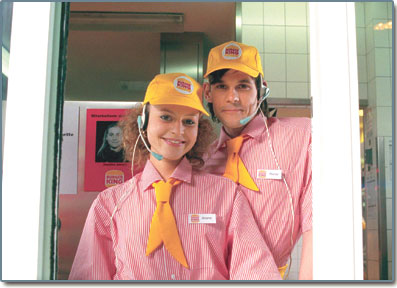
Screen Shot 2019-03-07 at 18.57.19.png Concretely shown in the renovation of Alex’s apartment that used to be a very hidebound, bland living space with dusty curtains to a retro finish with a sun tanning machine with his sister (turned from a scholar to a burger king employee) playing kinky Indian role play with her boyfriend. The movie does shed light on the complex (and sudden) transformation of German life that resulted from the fall of the Wall.

A significant scene for me was when the mother, Christiane accidentally glimpses a giant billboard for Coca-Cola and the whole audience would think the whole microcosm game was over but then Alex, proving himself to be a nuanced neurotic, control freak, loyalist, films his own phoney report, claiming that Coca-Cola is in fact a GDR invention and the East has already won its patent dispute with the deceitful west. With his work buddy who is into film editing, they join forces in doctoring random clips of the Wall’s collapse. Without a clue, Alex has provoked almost every agency of a commun

523d0d467d6b3.image.jpg

ist state, distorting the the news media, forcing people to remain in the same manner as they were before the wall collapsed, contradicting against their real natures and principles, bribing and blackmailing people to keep their shit for the sake of his mother’s health.. Sometimes in the movie, one might wonder if Alex was doing all these just for his mother or did he actually evolve into a loyalist as well, not because he believed in the regime but he also had a hard time adapting to the new. He loved how simple the way things were before just like his mother. But at the end of the film, he, along with his mother accepted the fact that nothing ever remains the same.

Goodbye Lenin! is compelling and enjoyable, as Alex goes through challenge by challenge in trying not to let the cat out of the bag.  This film can be considered a slapstick comedy, founded on fraud and lies: just like the old conservative regime with lots of manipulation for the “good” of the people. This film may bring out a variety of responses from the audiences- be it a pitiful retort for the loyalists who will never accept change or a slipshod laugh with the reality that capitalism has really taken over the world. One could get a kick out of Goodbye Lenin! because it is really worth your watch.


-161997-

Perfectly Human

Imagine a trailblazing filmmaker, named Jorgen Leth back in the 1960’s, now retired and settling for a peaceful, unobtrusive life in Haiti during present time. Then suddenly, a young menacing art film director named Lars Von Trier, decides to ruin his daily routine, challenging him to recreate his superb 12-minute black and white film “The Perfect Human” that he created way, way back with the whimsical rules and limitations of Von Trier’s own concoction.

fiveobstructions_02

And why is this so? Maybe Von Tier wanted to see if the rusty gears in Leth’s brilliant mind was still working, despite years of unpractice. Was his mentor still able to generate flabbergasting experimental films of dogma, perfection and splendor? Would all Leth’s future works still seem to be perfect?

Maybe he just wanted to see what Leth could still add up to the plate of art cinema.

And maybe it was not perfection he was looking for because he was already used to that.

Maybe Von Tier was looking for something more profound from Leth—something more natural.

Maybe something more human.

It is enthralling to witness camaraderie between two filmmakers, one master, one student, switching roles from one moment to another, bickering over the need to set creative boundaries when creating a film.

thefiveobstructionspic2In this film, one sees how a filmmaker works around the random conditions of the weather, the location, and the cultural situation of where, when and what they are shooting. The Five Obstructions is said to be a perverse game of one-upmanship given the various situations where both would display their mastery on their crafts.
Moreover, Von Tier projects the film with a raw and clean wisp of documentary style shooting with natural lighting, sounds and shakey camera movement, showing the reality of filmmaking which is disheveled, convoluted and frustrating.

[1] A 12 frame film, [2] a film shot in the worst place on Earth without showing its misery, [3] a free-style film contradictory to Leth’s filmmaking style, and [4] an animated film which really challenged Leth— Lars Von Trier frets that his master, Leth, is attempting to make the films too good. He grouses repeatedly, desiring to see the evolution of Leth from being too perfect to being human. Von Tier expressed how everything was structured to its ultimate refinement and there was no room for flaws in Leth’s craft.

This film raises awareness about Jorgen Leth’s legacy that is not as widely recognized like the other European films that has been well-respected all through out the years. Moreover, the 5th obstruction seems to be a film created by Von Tier himself, showcasing the entire journey of Leth, remaking his piece again and again with utmost craftsmanship. The showcase of Leth’s talent in a film recreated five times over shows how an artist evolves together with his art as time progresses. And given this documentation of raw and messy and exasperating filmmaking, comes the reality of what makes a filmmaker perfectly a filmmaker and what makes a human perfectly human.


-161997-


The Not-So-Adventure

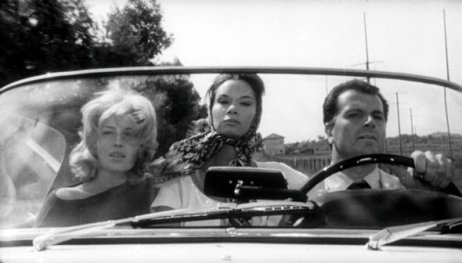
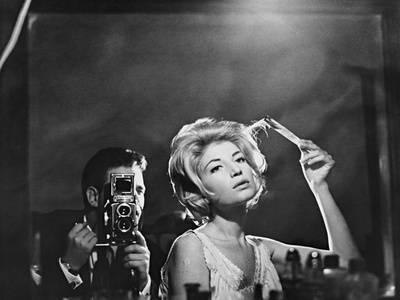
Honored at the 1960 Cannes International Film Festival for “a new movie language and the beauty of its images” – L’avventura by Michelangelo Antonioni is one of the most legendary films made in the 1960’s. A vast audience might say otherwise, given that it can be superficially perceived as merely just a film that reveled in stunning black and white images. Moreover, the film was populated by attractive actors, oozing in sex appeal, such as Gabriele Ferzetti, Monica Vitti, and Lea Massari. With its dazzling aesthetics, it can always be mistaken as just that.

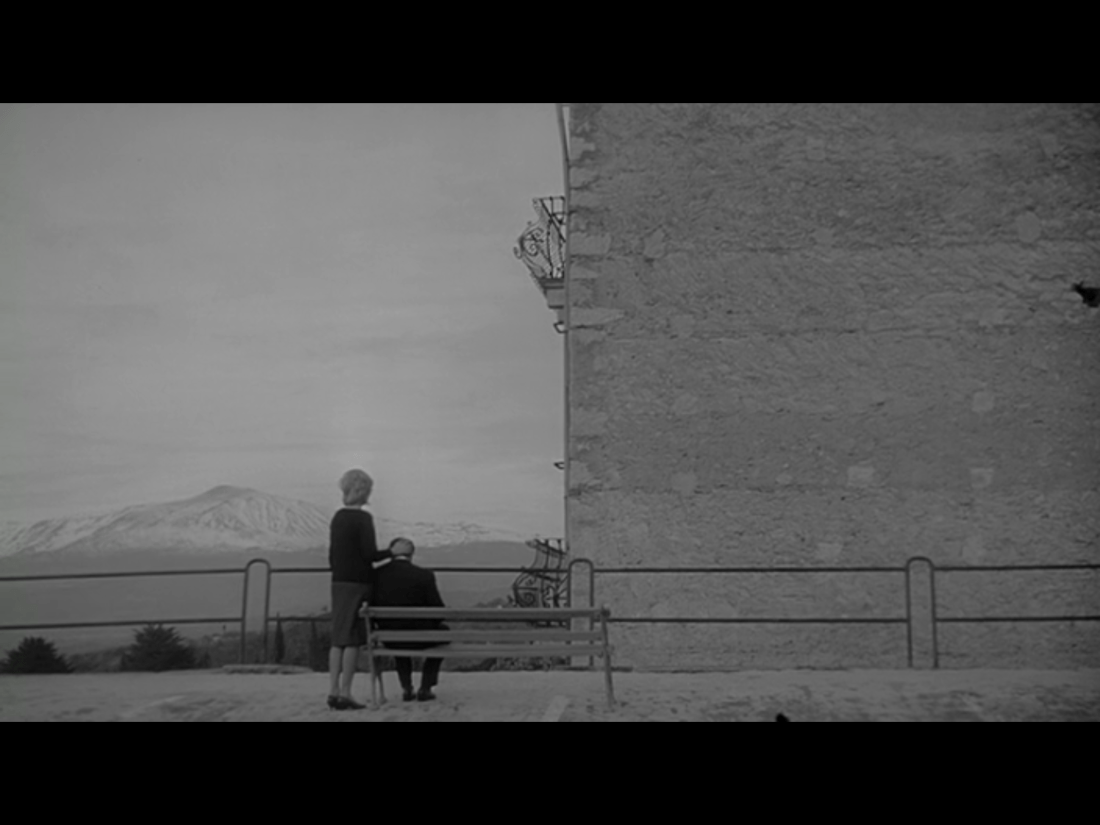
lavventura-end

With regards to the plot, it may seem as if things were left out in the open, unfinished and unresolved. This may have led to the audience’s frustration and disappointment because it is a usual element for films to have a closure and a clear path along a series of events. Critiques find the plot to be uneventful with very much a slow pacing. However, Antonioni, broke the rules of cinema’s standards so elegantly by establishing great scenes despite its unconventionality and downtempo.

One great feature in the film is its visuals as praised by many. It is rare to find such camera power to magnify the emotional sterility of the film and to capture the vast loneliness of the characters desperately searching for satisfaction in the wrong places.

l-avventura-1960-008-00n-w7g_590.jpg

The film potentializes the conflict to revolve around Anna’s disappearance leading people to think that there is a certain “something” to be solved. However, the film would later on show that there is no actual answer and instead, focuses on the other characters, leaving the mystery to remain a mystery until the end of screening. Given that there is actually nothing to wait for, this film might seem like a waste of time.

But once, one realizes that its nothingness- be it the shallowness of the elites, the emptiness of their hearts and souls and the desolate vacancy that desires to be occupied- one realizes that this is everything the film wants to deliver.

This would lead people to think- Was the disappearance of Anna really necessary to have catapulted the growing sexual tensions between Sandro and Claudia? – or was it just a random starting point to show that even in the most challenging times such a woman who happens to be a best friend and a lover, was missing in the island- that nothing would ever actually matter for wealthy, bored and spoiled elites? 

This film straightforwardly shoots its message right through the screen- that often times, pleasure is the one instrument that momentarily distracts people from the pernicious lassitude of their existence and it does not matter if their decisions hurt anybody because people are always too sorry for themselves to even be sorry for their actions.

u-g-Q10TUCL0

With nostalgic Sicilian strummings and nervewracking, edgy percussive beats, the film exhibits the rich unending landscape of both reality and fiction. With an absolutely contemporary setting, the film stands tenacious with its norm-defying openess and experimentation. With a plot consisting of nothingness rooted from the everythingness of contemporary internal issues of modern day elites, new generations of work has followed such directions, leading L’avventura to leave a mark in the post neorealist scene.


Continue reading “The Not-So-Adventure”