
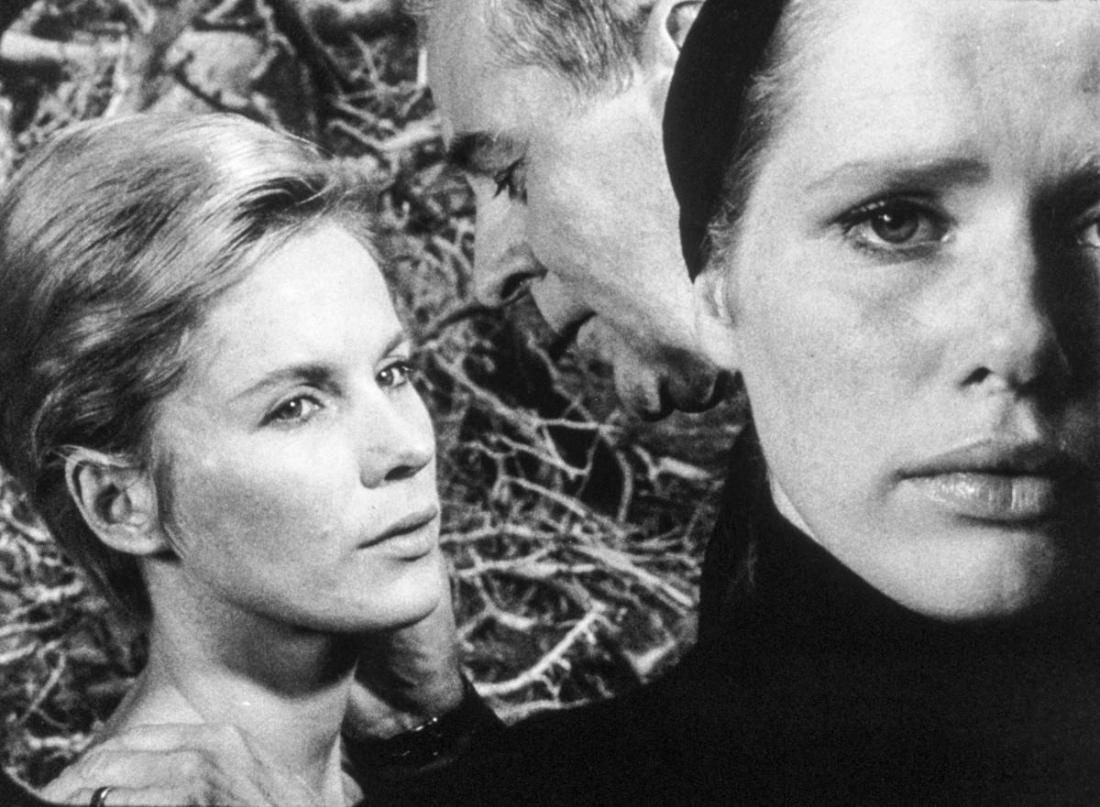
By definition, a persona is the aspect of someone’s character that is presented to or perceived by others. In literature, on the other hand, the persona is usually the person who is understood to be speaking to the reader. Given this, as the title of Ingmar Bergman’s 1988 film, Persona revolves arounda round the persona of Nurse Alma and an actress named Elizabeth. The film, unlike most movies which areproduced and designed to appeal to its viewers through hollywood-isk plots and cinematography, toys with the persona of the two main characters.
In the film. Elizabeth had portrayed at least three personas. First, as an actress, Elizabeth was used to creating illusionary personas of herself, and with her acting skills, she played the persona of a speech-impared, harmless patient. Second, as a friend to Nurse Alma. And third, as a successful actress and mother. What intrigued me, however, was, when she and Nurse Alma moved to the doctor’s beach house for a vacation, how Nurse Alma was always talking to her–telling her random stories of her (Nurse Alma’s) life. In this viewpoint, the persona would be Nurse Alma, and Elizabeth may be seen as the audience. It’s intriguing, because given that she is an actress and had played various personas throughout her acting career, it occured to me that she may be observing Nurse Alma. Furthermore, her not-being-able-to-talk act made me think that, by not being able to comment or discuss with Nurse Alma, she is portraying herself as the persona’s audience. Subsequently, Elizabeth did not want to create a persona for herself, as she wanted to be the audience or the reader–which cannot reply to the persona. In this scenario, the actress has become the audience.This, however, was concluded when Nurse Alma found her letter to her friend, which shattered Elizabeth’s persona of a psychologically speech-empared and loving friend.
On the other hand, Nurse Alma presented herself as a talkative and trusting character. However, she was also able to create a smart, violent, and untrusting persona. What’s interesting about Nurse Alma, however, is how the film distorts her persona with Elizabeth’s. There were two scenes where Elizabeth was confronted by Nurse Alma of her reservations for her child. The two scenes, however unchanged the dialogues are in both of them, portray different moods–depending on which character the camera is focusing on. When focused on Elizabeth’s face, there was a sense of dramatics as the aura of the scene. However, given the same dialogue, the scene which focuses on Nurse Alma’s face creates an interrogative and intimidating atmosphere. With this, it can be said that the mood of the scenes ultimately depend on the persona/s being presented.
The film also made me confused, for some its parts. As complex the film’s plot is, the start of the film was confusing. The start exhibits foreshadowing for the dramatics at the end of the film, which would not make sense at the start and would cause the audience to ponder over it until the latter part of the movie. Moreover, as artistic it may be through its black and white cinematography and they way Elizabeth’s child was wissfully looking at the screen, trying to touch the face of the woman it was projecting, and disturbing images such as a sheep being chopped off, the start immediately set a mood of mysteriousness and amibuity, which may make the audience uncomfortable, a bit disturbed, and confused. It also proved to set the mood for the whole film. Furthermore, the latter part of the film, starting with when Elizabeth’s husband mistook Nurse Alma as his wife was really confusing for me. My confusion continued until the last scene when Elizabeth’s child was exhibited again.
Conclusively, Persona is very artistic as it is dramatic, complex, and confusing. Its appeal stems from its dramatic plot and complex videography, and rather than following mainstream methods of cinematography with hollywood-isk plots and videographics to appeal to its viewers, its theatrical subjectivity, especially with its characters and cinematical viewpoints, tries to convey its disregard to pleasing film characteristics.
 European Film (2019)