Change in Persona

Admittedly, as someone who’s only been exposed to mainstream movies up to this point, Persona has to be one of the strangest films I’ve seen so far. I was not sure how to feel immediately after the film ended, but after pondering about film and its certain aspects later on, I realized how well thought-out Ingmar Bergman’s art was. Intending for the film to become a psychological drama, Bergman succeeded in his objective.

The film starts with the doctor relaying to the nurse, Alma, the new patient she has to take care of. The doctor explained how the patient, Elisabeth, was an actress that became mute after an incident in a performance. After knowing of the patient more and seeing her for the first time, Alma already showed signs of feeling eerie due to the oddness of Elisabeth’s context. Frankly, I could not help but feel the same way Alma did. Almost ninety-percent of speech in the film was done by a single person, something I definitely have not seen before in a film. Dumbfoundingly, even though that was the case, the film was still able to effectively show communication between the two women. As the film progressed, the relationship of the two women also developed. Since Elisabeth was always silent, an emotional Alma was always the one telling personal stories of herself while Elisabeth actively listened.

A scene that confused me a lot was when Elisabeth approached Alma after the nurse had just passed out due to alcohol. A few seconds later, it seemed as if Elisabeth was supernaturally trying to switch personas with Alma. At this point, I started rethinking whether the film was a horror film or not. When Alma woke up the following day, she had idea what happened the night before while Elisabeth lied about her strange actions.

As the days passed by, Alma found herself slowly transforming into the character of her patient. Alma was portrayed to have little-by-little changes in her personality compared to herself when the film just started. There was even a seen where Alma was having intimate interactions eith Elisabeth’s husband. Still without voice, Elisabeth was able to communicate to Alma with pure emotion. It seemed as if there was a dialogue even with only one person speaking.

To be frank, watching the film was a bit difficult as there were varying themes to the move depending on a specific scene. One moment it was drama, the next a thriller, so on and so forth. It was a interesting and beautiful play on showing character and emotions, whether through voices or the silence.

The Persona and The Audience

By definition, a persona is the aspect of someone’s character that is presented to or perceived by others. In literature, on the other hand, the persona is usually the person who is understood to be speaking to the reader. Given this, as the title of Ingmar Bergman’s 1988 film, Persona revolves arounda round the persona of Nurse Alma and an actress named Elizabeth. The film, unlike most movies which areproduced and designed to appeal to its viewers through hollywood-isk plots and cinematography, toys with the persona of the two main characters.

In the film. Elizabeth had portrayed at least three personas. First, as an actress, Elizabeth was used to creating illusionary personas of herself, and with her acting skills, she played the persona of a speech-impared, harmless patient. Second, as a friend to Nurse Alma. And third, as a successful actress and mother. What intrigued me, however, was, when she and Nurse Alma moved to the doctor’s beach house for a vacation, how Nurse Alma was always talking to her–telling her random stories of her (Nurse Alma’s) life. In this viewpoint, the persona would be Nurse Alma, and Elizabeth may be seen as the audience. It’s intriguing, because given that she is an actress and had played various personas throughout her acting career, it occured to me that she may be observing Nurse Alma. Furthermore, her not-being-able-to-talk act made me think that, by not being able to comment or discuss with Nurse Alma, she is portraying herself as the persona’s audience. Subsequently, Elizabeth did not want to create a persona for herself, as she wanted to be the audience or the reader–which cannot reply to the persona. In this scenario, the actress has become the audience.This, however, was concluded when Nurse Alma found her letter to her friend, which shattered Elizabeth’s persona of a psychologically speech-empared and loving friend.

On the other hand, Nurse Alma presented herself as a talkative and trusting character. However, she was also able to create a smart, violent, and untrusting persona. What’s interesting about Nurse Alma, however, is how the film distorts her persona with Elizabeth’s. There were two scenes where Elizabeth was confronted by Nurse Alma of her reservations for her child. The two scenes, however unchanged the dialogues are in both of them, portray different moods–depending on which character the camera is focusing on. When focused on Elizabeth’s face, there was a sense of dramatics as the aura of the scene. However, given the same dialogue, the scene which focuses on Nurse Alma’s face creates an interrogative and intimidating atmosphere. With this, it can be said that the mood of the scenes ultimately depend on the persona/s being presented.

The film also made me confused, for some its parts. As complex the film’s plot is, the start of the film was confusing. The start exhibits foreshadowing for the dramatics at the end of the film, which would not make sense at the start and would cause the audience to ponder over it until the latter part of the movie. Moreover, as artistic it may be through its black and white cinematography and they way Elizabeth’s child was wissfully looking at the screen, trying to touch the face of the woman it was projecting, and disturbing images such as a sheep being chopped off, the start immediately set a mood of mysteriousness and amibuity, which may make the audience uncomfortable, a bit disturbed, and confused. It also proved to set the mood for the whole film. Furthermore, the latter part of the film, starting with when Elizabeth’s husband mistook Nurse Alma as his wife was really confusing for me. My confusion continued until the last scene when Elizabeth’s child was exhibited again.

Conclusively, Persona is very artistic as it is dramatic, complex, and confusing. Its appeal stems from its dramatic plot and complex videography, and rather than following mainstream methods of cinematography with hollywood-isk plots and videographics to appeal to its viewers, its theatrical subjectivity, especially with its characters and cinematical viewpoints, tries to convey its disregard to pleasing film characteristics.

Persona- review

For an unknown reason, Elizabeth the actress, stops speaking in the middle of her theater performance and hasn’t muttered a word ever since. The only time she mutters a word during the entire film is when Alma, her newly assigned nurse, threatens to throw boiling water at her face.

The film Persona is a film that needs to be watched more than a couple of times, not only for its use of colors and sensible imagery, but also in hopes to understand the meanings behind the ever confusing film. The first time I watched it in class, I spent half the time confused and the other half wandering if what I was understanding was correct. I tried a second time through online streaming, and unfortunately did not have much success in grasping the meaning behind the film. However, looking back on it now, instead of trying to derive meaning out of a piece of art I do not understand, it may be best to take the literal road in understanding it. That is – to take it in literally as it is.

Elizabeth stops speaking in the middle of her theater performance, as if she had suddenly realized the vanity in speaking, she seems determined not to ever mutter a word again. Through the recommendation of a psychiatrist, Elizabeth spends the summer at the doctor’s summer house with her nurse Elizabeth. Naturally, spending the summer together, the two women seem to establish a bond and Alma begins to open up about her life to Elizabeth. Elizabeth says nothing, and Alma talks and talks, confessing her plans and her fears, and eventually, in a great and daring monologue, confessing an erotic episode during which she was, for a time, completely happy.

An element I found amusing in this film was the reverse in the roles of the characters. Elizabeth, the supposed patient, seemed stronger than Alma, the nurse that was assigned to take care of her. The scene where Alma lays down a sharp shard of glass on the floor for Elizabeth to step on to is an example of this. Elizabeth cuts her food and gets hurt, but it is in fact Alma that has abandoned her duty as a nurse and a caretaker.

This film also delves with our fear in facing the challenges in our lives and in the world around us. In the earlier segment of the film, the film shows a scene of a Buddhist monk burning himself in the street as protest for the injustice in Vietnam, later, there are photographs from the Warsaw ghetto, of Jews being rounded up; the film lingers on the face of a small boy. Perhaps the tragic horrors of this world is what has made Elizabeth to stop talking. Because no matter how we try to rephrase our opinions, we’re always bound to hurt someone’s feelings. For Alma, these horrors seem to be somewhere closer to home. She is uncertain of the man that she is planning to marry, afraid of being incompetent as a nurse, and her lack of ability to help Elizabeth. .

persona

Persona by Ingmar Bergman tells a story of a theater actress turned psychiatric patient named Elisabet who suddenly became mute after a performance where she unexpectedly stood blankly in silence, and her nurse Alma who was assigned to live with and take care of her in a summer house.

Watching this film was an unsettling experience that left me confused and puzzled. To begin with, the movie started with a montage of disturbingly eerie clips of a spider, a lamb being drained of its blood, a bleeding hand being nailed, and some old people who were either sleeping or dead, to name a few. Some of these clips appear again in the middle of the film. I assume there’s a meaning behind the addition of these random snippets, perhaps a foreshadowing of some sort in relation to the events in the characters’ lives, but I couldn’t quite get the connection. That, or I was too focused on feeling uncomfortable. There were also other parts of the plot that I had difficulty in trying to interpret: the growing attraction between Alma and Elisabet, Alma sleeping with Elisabet’s husband while Elisabet let it happen, the repetition of Alma’s narration of Elisabet’s attempted abortion story, Elisabet biting Alma, and even the quick appearance of the cameramen at the end. I think the vagueness of it all is Bergman’s way of leaving the film open to the audience’s own interpretation. Although initially it seems as though the plot is simple and straightforward, it develops to become a complex one that begs you to wonder. It’s a type of film that doesn’t give you the complete story right away and leaves you with unanswered questions. I believe it’s creatively brilliant to an extent, but it can also be confusing for some who are watching films made by Bergman for the first time. In terms of the film’s audiovisual presentation, I enjoyed its use of a monochromatic style as an added dramatic tool to emphasize the strong emotions in the film. The use and choice of music also helps heighten the film’s touch of horror and intensity.

Overall, despite it being a perplexing unorthodox type of film that left me feeling uneasy, I believe it is still captivating in its own way.

Second

Persona by Ingmar Berman

A nurse and an actress. Different fields of work yet brought together by the same need for escape and peace. At the core of it, they are both just human. Just as the first shots show, watching the beginning of the of Persona, I started off with a lot of questions, the random string of images; A penis, guts spilling out, a hand being nailed, and a view of a spider from below. What would any of these have in common? How are these images connected to the movie itself? I was very confused with everything and I could not really understand why it unsettled me so much. Although it did remind me of the movie Fight Club when the penis appeared and how Tyler Durden places it in the middle of the film slices as to confuse and disturb viewers. After these images, the entire movie (which was presented in black and white) created an environment that both gave an avenue for great performances from both actresses who played the principle roles who were named Anna and Elisabeth. I think it would not have the same effect if it were not in black and white because somehow it could present to us the contrast of these characters but are both colors are needed to create the story, Together hand in hand.

Anna being the nurse portrayed a typical care taker towards Elisabeth. Elisabeth on the other hand after her sudden and abrupt change in attitude, of her not wanting to speak was a great contrast to the fact she is an actress who is supposed to be known for her expressions and emotions tried to avoid the one thing she is supposed to do. As the movie progressed I continued asking more questions, what does it mean to be a person? To have to be your own unique self and be free to have your own story? Once both of them were isolated in the beach house, away from modernity, we find ourselves somewhat disturbed and trapped by the conversations and images presented by the movie and its characters. What was once supposed to be freeing was then a spiral into the craziness of the human psyche. Not much action is needed with Anna’s intense dialogues with Elisabeth (that become monologues instead). There is beauty in the silence as well but every line is calculated, presenting the slow madness that consumes the both of them

The film confused me especially during the last few minutes. It was as if Anna and Elisabeth were suddenly becoming one. Just as in the posters of the movie itself, the characters seem to have merged together or to be two connected pieces to that one puzzle. Overall, this was quite an enjoyable movie and something I would watch again. The way it was all kinds of disturbing and for me is what films should be, to be molded into becoming art pieces in each frame. It leaves you confused yet at the same time wanting more, to delve deeper into each character and their stories.

A woman is A Woman – the review


The movie “A woman Is a Woman” is by far the most bizarre movie that I have watched in recent years. Sudden starts and cuts to background music, the dialogue between the characters, and the plot all contributed to the uniqueness of this movie. As bizarre as the movie was however, it sent across several socio-political messages to the audience which were a pleasant surprise amidst the spectrum of colors, and music.

Angela, the female character who works as an exotic dancer at what seems to be a 60’s strip club, desires to bear a child with her lover Emile. Emile however, is not as keen on the idea of being a father as he feels that he isn’t quite ready to take on the responsibilities. Angela is depicted as a character with great conviction and the capabilities to push through with her decisions, which is something quite outstanding given the sociopolitical atmosphere of the 1960s in France. The growing conflict of interest serves as the basis of the plot; at one point they decide to stop communication with one another and instead point to the titles of the books for their means of communication. This was one of the more interesting parts of the film for a couple of reasons. Firstly it reminded me of Chaplin’s silent comedies where he uses various settings and environments to communicate and get across to the audience. The second reason is a little more political, for it sent the message that Knowledge was Power. In the silent argument between the couple, Angela was able to continue communicating her anger across to Emile through the titles of her collection of novels. It not only deepened her character as a witty and clever woman, but also an empowering figure of the feminist movement in the 1960s in France.

The second element that I really enjoyed identifying in the film was Angela’s inquisitive characteristics. She questioned everything around her from the existence of herself to inequality (“why is it always women that suffer?“). This set the broader theme of the movie for me, while the film was labeled as a comedy, it certainly sent across the message of the need to question the status quo of not just regarding one’s individual identity, but also the social injustices and inequalities that were present in those times.

Mischief was the third element which contributed to the weirdness of this film. Unlike the social norms of the 60s in France, Angela was quite the mischievous individual. Her actions were often comedic and motives were at times hard to understand. This element may be connected to her inquisitive characteristics as she decides to defy the norms of society and push the boundaries of what is accepted as normal. As the conflict between Emile intensifies, Angela resorts to an alternative reason to achieve what she desires – to sleep with Emile’s best friend, Alfred. While infidelity is not necessarily an important component in bringing equality within out societies, it showed that women were also capable of pushing through with their convictions. It was truly an interesting turn of events as it
reminded me that not all people’s priorities were aligned and that some people would simply to whatever is required to get something done.


Persona and Portrayal

Who is who? Whose mind am I in? Is this reality or one character’s fantasy?

Persona blurred the lines between reality and dream, while also somehow making it excruciatingly clear what was which with the use of visuals and music that merited particularly dreamlike sequences, and the silence that accompanied real life interactions. However, once you think you understand and know what you are seeing, the film shifts once more, such as when at the end we see a camera crew filming the character of Alma, and we are once again left to ponder reality.

Before going into the intricacies of the film’s story, the film in itself is a work of art – a disturbing one, to say the least. The very first sequence of black and white scenes showed scenes that begged its viewers to be uncomfortable – the nailing of the hand, the lamb slaughter, and the close up images of photographs and videos in history Elisabeth examines later on in the film. In hindsight, the scenes that left me most uncomfortable were perhaps the ones shared between the two characters.

A paradox I experienced while watching was that, initially, I believe this film is multiply diagetic – many times it reminded me that what I was watching was a film, and I was merely a viewer. And yet all throughout the film I felt discomfort at the intimacy I was experiencing with the characters – many times I felt I was intruding, that I was so connected to these two characters, real characters, living real moments of intimacy that I shouldn’t be watching. Perhaps this was due to the exceedingly close up visuals the two characters, the consistent lack of space shared between them, the scene wherein Alma watched and smelled Elisabeth in her sleep. Furthermore, all throughout the film, as the two women seemingly merged into one, this is made clearer to us both through imagery and the narrative.

Story-wise, as Elisabeth remains quiet and Alma speaks at length about her life, we may come to the conclusion that the premise of the story seems to seek to imply that as the two women spend more and more time together – one in silence and one in awe and admiration of the other – the lines between the two women blur. More tangentially, that Elisabet is a representation of the persona we portray to others at first sight in our apparate unknowability, while Alma represents the chaos and range of stories and emotions that actually comprise our person – throughout the entirety of the film, Alma portrays a range of emotions – some straightforward, such as anger, frustration, drunken joy, guilt at her abortion. Other times, she reflects a multiplicity of conflicting emotions (re: the climactic scene at the end wherein she is chasing after Elisabet and alternates between cursing her and crying on the ground.

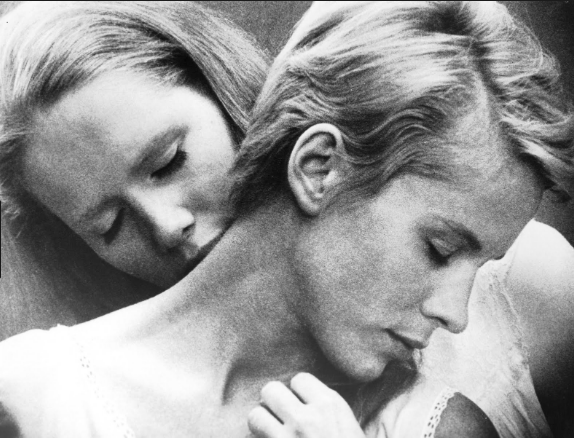
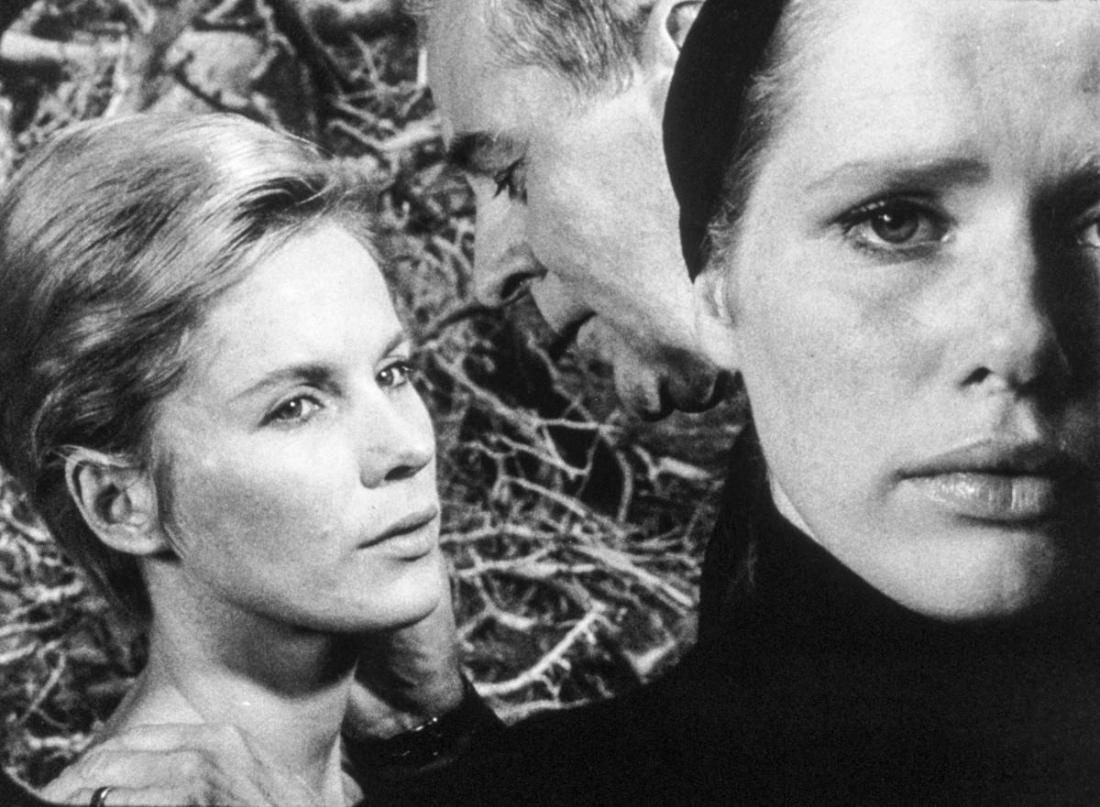
However, this insight is made only clearer through the use of visuals in the story – the picture of the two women merged as one, the entirety of the scene with Elisabet’s husband, the scenes of the two women when Elisabet places her hand on Alma’s forehead and they look towards the side. Persona asks more questions than it answers, and the beauty of the film is the multiplicity of ways we can interpret it depending on who we are and where we are in our lives.  Is this a story that shows two women merging into one? A story that highlights how strikingly similar they already were to begin with, bonding over the guilt of postpartum depression? A story of the chasm between who you are to others and to yourself? Or is it about none of those, and rather a simple story about an actress who refuses to talk, her nurse, living in a house together for a time, interacting and spending time with each other, before going their separate ways? Are the assumptions of merging and other things we may draw only a figment of our overactive imaginations based on how their simple story is portrayed on-screen? What astounded me in Persona was that it made me realise how cinema has the capacity to make simple stories come alive – to make us feel things such as fear, a sense of eeriness, a sense of discomfort; to make us draw conclusions about life and reality and the characters and their story, simply from how their story is portrayed and plotted – the visuals, the music, etc.

The lack of proper closure at the end of the film when the two women part, though feeling like a betrayal, could also be interpreted in in a variety of ways – it could be a reflection of our reality in that in real life, closure is not always guaranteed, and some things merely end as is. It could be a testament to Art Cinema and its rebellion against Hollywood’s desire for a proper ending. The latter would be further justified by the scene showing the cameramen at the end, as it further shatters our immersion in the story. But then again, it could be an artistic display pertaining to the idea of how, as Alma leaves the set, she is no longer connected to Elisabet, the woman she was becoming, the woman represented her and all Personas. I left the film with more questions than answers, feeling a multiplicity of emotions I hadn’t felt prior to viewing – merely by watching two women spending time with one another. Simply talking, simply living.

No in betweens

CnV7sFyXEAARNOi.jpgIf I were to describe Persona in one word, it would be “majestic.”
Majestic in a sense that it is so impressively done given the mélange of filmic nightmare aesthetics and the gravity of the natural but brilliant acting done by Liv Ulmann and Bibi Andersson.

Deemed as an experimental Swedish psychological film by Ingmar Bergman, Persona could either silently creep into your veins or lead you to spiral down the rabbit hole- there is no in between.

The film focuses on two main characters, one constantly yearning to communicate and one constantly silent all throughout. Despite the film showcasing mostly lengthy conversations between the two mains, the film goes way beyond it, given the way it is presented.

The beginning of the film is very intricate and unorthodox, starting with film rolls and camera equipment being adjusted and then later on, showcasing a projection of various dark and bold images. One might get puzzled regarding what all of this is about and even at the end of the film, there would always be various interpretations regarding Bergman utilizing these montages.

The whole film is presented in an eerie manner, but the plot draws the audience to a familiar experience of finding difficulty in one’s own constructed identity. I personally felt Alma’s frustration towards Elisabet as she sought for security and reassurance given that she has grown attached to her patient to a deeper and more complex level.

In this film, one would not be able to guess what would happen next. I can say the suspense makes you either desire to leave the movie house or stay glued to the seat.

Again, there is no in between.

The plot starts out with a very direct presentation of the conflict which is about an actress who developed a speech problem and a nurse who would be assigned to take care of her. It was the most common hospital relationship one would see, specifically in the scene, where Alma just turns on the radio and leaves Elisabet, her patient to have a good night’s sleep.

Later on, they would be picking flowers in the garden, laughing in a beach house, staying there together for the actress’ recovery. More minutes in the movie, the two women would be a few centimeters away from having any physical contact and the camera would linger on the sexual tension building up between the two. More minutes in, there would be chasing in the sand, slapping, nose bleeding, bizarre sensual dreams, direct monologues displayed in two takes, with different camera angles and many many more. 

With the variety of elements and play on score that builds up the intensity of the film, Bergman smudges the lines between fact & figment, always leaving clues but never really gives out the answer to the puzzle, leaving the audience with distorted perspectives on whether it was all just a dream or an illusion brought about the reality regarding the two women’s identical internal crisis within themselves despite externally being very very different. 


Persona: An Unpleasurable Art Cinema Classic

220px-Persona_Poster.jpgMost movies are usually created to satisfy people and for them to have a pleasurable experience while watching. However, some movies are intended to make the viewers feel uncomfortable, which is how Bergman’s film Persona was. After watching the film, I honestly felt bothered, confused, and disturbed as I left the room because I could not comprehend what I watched at first, and even when there were moments wherein I thought I was following the movie, I ended up being more and more confused as it went on.

The beginning of the film showed disturbing images that set the mood of the film from the very start as it is a psychological drama. Accompanied by a musical score which was haunting that contributed to the overall experience of the movie, images such as an impaled hand and the killing of a lamb were shown before the film started to focus on the two main characters, Elisabet and Alma. Elisabet is an actress who decided to stop talking despite being perfectly healthy, and Alma was her nurse. Since Elisabet could not speak, the film focused on showing her facial expressions, body gestures, and how she was really attentive in listening to the stories Alma shared about her life. This became ironic as Elisabet became the one comforting Alma because of her troubled past that she cannot seem to let go of. The series of disturbing videos were repeated as transitions again in the film that did not really make sense for me but then it signified that something was about to happen. This was used when Alma confronted Elisabet about the letter that she wrote, which included the stories that Alma shared. This was an important scene in the film as when Alma was about to pour boiling water at Elisabet, she finally breaks her silence saying, “No, don’t.” This was not actually the first time that she spoke but it was the only time that Alma was certain since she also whispered to her before.

The confusion continues as the characters seem to have had similar experiences and as the film went on, they seem to become more and more identical. They both experienced trying to abort their babies but Elisabet failed and this resulted to her hating her son. There was also a scene where Elisabet’s husband appears and sees Alma as his wife and they end up making love to each other while showing how Elizabet reacted. This shows how the film’s plot can be confusing because it did not really explain everything and left it to the viewers on how to interpret what was happening. There is also a sense of uncertainty whether some of the scenes actually happened and if not, whose imagination was being shown? Another instance of this is when Alma confronts Elisabet about her child was repeated, which I interpreted as giving emphasis on the importance of this scene to the movie. In this scene, Alma rattles on about how Elisabet just played the part of a happy mother and how she looks at his child with disgust since she really did not want to have the child. The ending was very puzzling for me as Alma proclaims that she is nothing like Elisabet but it also includes showing previous shots of them together and their faces overlapping, as if they are the same person.

Persona was a very complex film despite its supposedly simple plot, but the different elements along with the fitting musical score and uneasy feeling that were inflicted on the viewers did not really make the viewing experience a pleasurable one. Despite the complexity and confusion, I got how this movie is considered as an art cinema classic.

Identity Crisis

The Swedish Psychological horror film Persona which was directed by Ingmar Bergman is a great and interesting film because of its execution and how it leaves the audience wondering and thinking about the many plot points. I found it a great film because of its use of film conventions to help bring more meaning to the story. One thing I liked is the music and sound effects because it helped bring the right atmosphere and emphasis to the scary scenes. This can be seen even at the start of the film, when it is a black screen and then two lights start appearing. During this scene there is a piercing sound which starts softly and then becomes louder. This music and imagery evokes a feeling of uneasiness and uncertainty as to what is happening in the scene. Another example is during the scene when it shows both of Alma and Elisabet’s faces together in one face and the music became loud and piercing. It gave a feeling of urgency and terror because she was starting to lose her identity as Alma to the character Elisabet. The film used camera angles and costumes to greatly emphasise the theme of identity. During the time in the cottage, we can see that both actresses are wearing an identical white dress to sleep. There is also another scene which is when Alma was interrogating Elisabet about his son whom she did not love and tried to abort, and both Alma and Elisabet are wearing black. By showing these two characters wearing the same clothes in one scene, it makes the audience feel like they are both the same person, and this supports how Alma is slowly becoming Elisabet. There are also many scenes wherein the camera angles put Alma and Elisabet’s face very close together, and this helped emphasise how similar they are becoming. One example was when Elisabet stood behind her and held her forehead, and then their heads moved to opposite sides as if to show they are becoming one.

The film’s plot is also very interesting because of how it does not explain everything and it makes the audience reflect and think more on the interpretation of the film. This can be seen at the start of the film because of how it shows a goat bleeding and a young boy trying to touch a picture of a woman’s face. The film does not explicitly explain who the boy is or the connection of the goat to the story, but after watching the film I believe that the boy is Elisabet’s son whom she tried to abort. I think it is her son because the woman’s face appears to be Elisabet and the boy is trying to reach out to her out of love. Alma states near the end of the film that Elisabet despises her son while the son loves her immensely. The invisible wall that the boy is touching can be the barrier that Elisabet put between them to distance herself from him. This was another different film for me but I enjoyed the story and execution of it because of how it shows rather than tells the audience as to what is going on.