silent, eerie, and lost

persona pic.jpg

After watching Ingmar Bergman’s Persona, I could understand why many critics would describe the film as either a psychological horror or psychological drama. Yet, as I tried to explain the plot of Persona to my friend who hasn’t watched it, I realized it was hard to encapsulate the horror or thriller aspect of the story, because when you think about it, there was nothing particularly scary about it. I ended up just telling my friend, “basta… it was just such a strange movie…” And I don’t think I was completely wrong.

Persona starts off with a montage of disturbing footages, which were often obscure, hard to make out images, and sometimes sexually explicit. A boy waking up in a morgue walks up to a giant screen and sees the blurred image of two women. The film proceeds with the rest of the movie, revolving around Alma, a nurse, and Elisabet, an actress who suddenly went silent. On the surface level, the film was minimalist, with two, maybe three, characters in the whole film, but it’s acting, lighting, script, and other elements made it much more complex and mysterious. As I mentioned earlier, there was nothing particularly scary about Persona, but it also became a perfect example of a horror movie—without the cheap scares and jump shots, with no over-the-top blood-gushing-out-of-wounds scenes, no serial killers, ghosts, nor monsters. Just the frightening loss of one’s own identity—which is arguably one of the scariest things that could happen to a human.

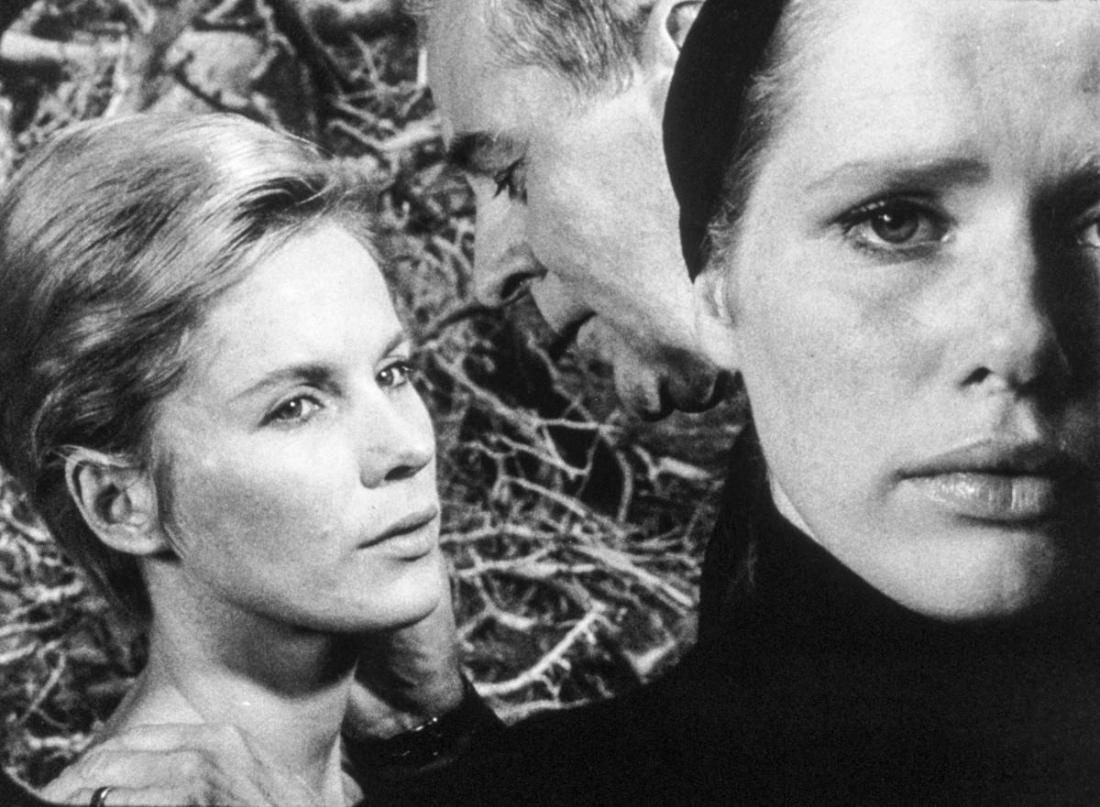
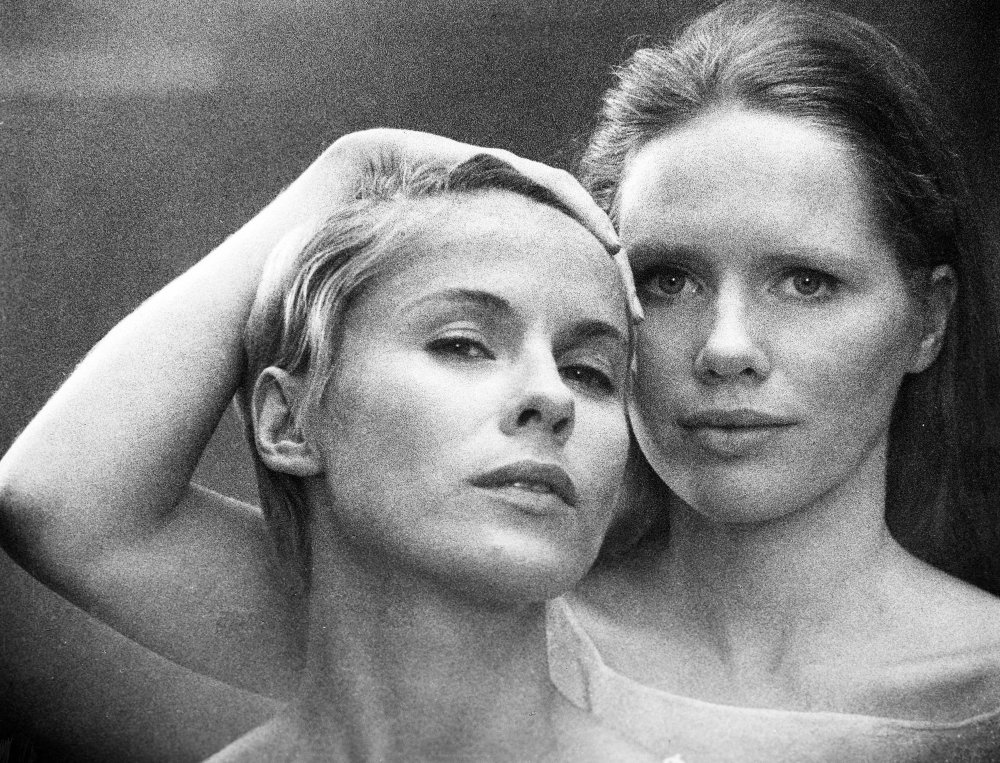
It was a story of two seemingly different women, one a nurse and one a silent patient, who come together in a household and grow so close together that their identities blur and merge. This central theme was foreshadowed constantly, from Alma telling Elisabet how much they look alike and if she tried hard enough, she could be Elisabet, to Alma sleeping with Elisabet’s husband who mistakes her as his wife. In a quite literal take, the scene where Bergman would combine half of each other’s faces or superimpose the two faces, morphing them into one, showed this same loss of identity—of Alma becoming Elisabet.

It was another silent-esque film. The dialogue was almost non-existent, but the communication was there, just manifested differently through facial expressions, body language, and the score. Alma’s storytelling was so strong and raw; offering a different view on motherhood as a burden. The film was eerie, tense, and charged with so much emotions—fear, anger, love, and grief. Even as I’m writing this post, I’m still not entirely sure what was real in the film and what was not. The film remains a mystery to me, but it also leaves me wanting more. Persona is considered by some as one of the greatest films ever made, and it’s evident that it inspired many future film makers. Overall, Persona was a film that moved you. Shook you. Disturbed you. Which is essentially what a film is meant to do, to move the audience, either positively or negatively.
Art as a Story

Dubbed as the “Mount Everest” of cinematic analysis, it is no doubt that Ingmar Bergman’s Persona will twist one’s head with the genius of its screenplay and cinematography. This movie will leave one confused and frustrated with so many questions left unanswered. Personally, all the questions I would begin to ask at the start of the film only became more complicated the more the movie serves me its story. It felt like I was being force fed with symbolisms and allegories; and although the feeling was disorienting, in some ways it was satisfying. I may have experienced many modern movies, to which I began feeling tired of, but never have I experienced such a movie as Persona.

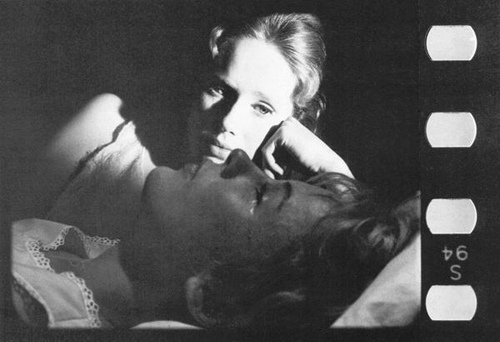
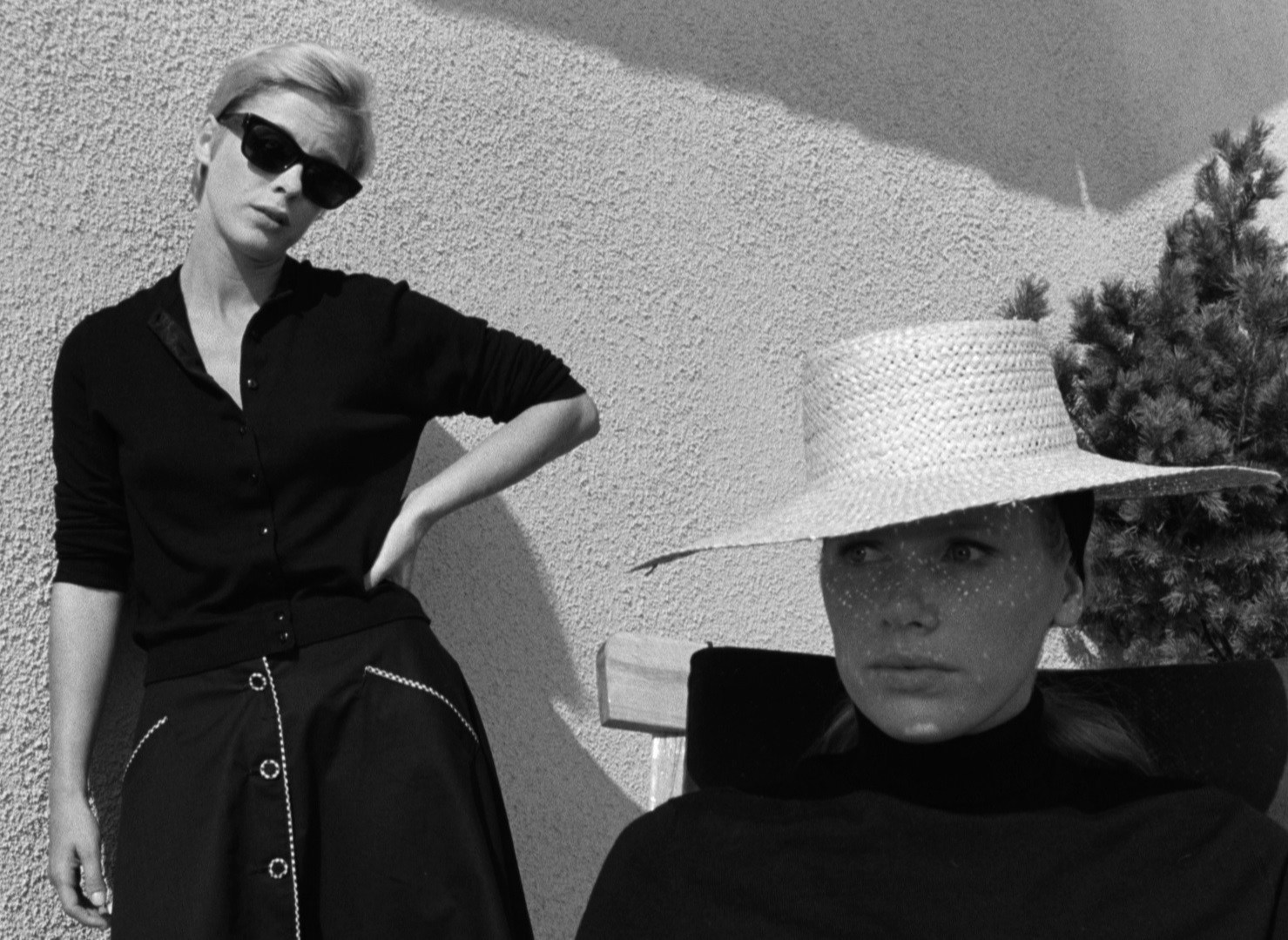
One of the things that really caught my attention about the movie is the way the cinematography was presented. It felt like each scene was a piece of a professionally done photo. As seen through the film, the way the light divides the characters’ faces on close ups really highlighted the impact of the scene. The elements of the image were divided and placed equally in the frame, like in the scene where Elisabet Vogler watches Alma sleep after sharing her intimate story. Although the scene was silent at most, much of its impact was presented through Elisabet’s expressions, which despite being in the background of the frame, was greatly highlighted by the intense light. Even if Alma’s face occupied a big portion of the frame, the audience is drawn to Elisabet’s face, which eerily looks over Alma’s peaceful, yet very distressed expression. A lot of Elisabet’s scenes are often presented this way. It’s almost as if the character purposely hovers over Alma, studying her every expression. And this is exactly what Alma discovers in the story.

I have noticed that after discovering (or at least assuming as this was never really confirmed by the movie) Elisabet’s intention of studying Alma through her letter to a friend, the roles of observant and observee are switched. Yet, we’re still drawn to Elisabet despite her being the one being observed. Maybe because now we have Alma’s commentary to guide us on what to observe about Elisabet. Whereas previously, we were only given Elisabet’s expressions as she looks over Alma, which served as our only clues to figure out what she thinks of her subject. In the two cases, I have always been drawn to Elisabet. It might be that the movie is showing us that despite Elisabet escaping her life as an actress, she still manages to draw her audience in, a skill that an actor must master. However, one thing is certain and that is Elisabet’s use of her facial expressions to communicate her character’s dilemma. What is amazing about this is that scenes that show a close up of her face looks like a different image per frame. Even the slightest movement of her lips evoke a different kind of expression. I often wonder in scenes like this what Elisabet is truly feeling.

Many observations and questions arise the more one watches Persona, as stated by many, including renowned film critics. I offer one observation which may be contradicted by another. Yet, both observations may equally be true as declared by critic Peter Cowie. Despite the confusion on the true meaning of Persona, it is in it’s art and cinematography that one may be given the satisfaction Persona seems to be depriving us from. Perhaps, its true meaning may be hidden among the frames the movie presents to us.

The Persona and The Audience

By definition, a persona is the aspect of someone’s character that is presented to or perceived by others. In literature, on the other hand, the persona is usually the person who is understood to be speaking to the reader. Given this, as the title of Ingmar Bergman’s 1988 film, Persona revolves arounda round the persona of Nurse Alma and an actress named Elizabeth. The film, unlike most movies which areproduced and designed to appeal to its viewers through hollywood-isk plots and cinematography, toys with the persona of the two main characters.

In the film. Elizabeth had portrayed at least three personas. First, as an actress, Elizabeth was used to creating illusionary personas of herself, and with her acting skills, she played the persona of a speech-impared, harmless patient. Second, as a friend to Nurse Alma. And third, as a successful actress and mother. What intrigued me, however, was, when she and Nurse Alma moved to the doctor’s beach house for a vacation, how Nurse Alma was always talking to her–telling her random stories of her (Nurse Alma’s) life. In this viewpoint, the persona would be Nurse Alma, and Elizabeth may be seen as the audience. It’s intriguing, because given that she is an actress and had played various personas throughout her acting career, it occured to me that she may be observing Nurse Alma. Furthermore, her not-being-able-to-talk act made me think that, by not being able to comment or discuss with Nurse Alma, she is portraying herself as the persona’s audience. Subsequently, Elizabeth did not want to create a persona for herself, as she wanted to be the audience or the reader–which cannot reply to the persona. In this scenario, the actress has become the audience.This, however, was concluded when Nurse Alma found her letter to her friend, which shattered Elizabeth’s persona of a psychologically speech-empared and loving friend.

On the other hand, Nurse Alma presented herself as a talkative and trusting character. However, she was also able to create a smart, violent, and untrusting persona. What’s interesting about Nurse Alma, however, is how the film distorts her persona with Elizabeth’s. There were two scenes where Elizabeth was confronted by Nurse Alma of her reservations for her child. The two scenes, however unchanged the dialogues are in both of them, portray different moods–depending on which character the camera is focusing on. When focused on Elizabeth’s face, there was a sense of dramatics as the aura of the scene. However, given the same dialogue, the scene which focuses on Nurse Alma’s face creates an interrogative and intimidating atmosphere. With this, it can be said that the mood of the scenes ultimately depend on the persona/s being presented.

The film also made me confused, for some its parts. As complex the film’s plot is, the start of the film was confusing. The start exhibits foreshadowing for the dramatics at the end of the film, which would not make sense at the start and would cause the audience to ponder over it until the latter part of the movie. Moreover, as artistic it may be through its black and white cinematography and they way Elizabeth’s child was wissfully looking at the screen, trying to touch the face of the woman it was projecting, and disturbing images such as a sheep being chopped off, the start immediately set a mood of mysteriousness and amibuity, which may make the audience uncomfortable, a bit disturbed, and confused. It also proved to set the mood for the whole film. Furthermore, the latter part of the film, starting with when Elizabeth’s husband mistook Nurse Alma as his wife was really confusing for me. My confusion continued until the last scene when Elizabeth’s child was exhibited again.

Conclusively, Persona is very artistic as it is dramatic, complex, and confusing. Its appeal stems from its dramatic plot and complex videography, and rather than following mainstream methods of cinematography with hollywood-isk plots and videographics to appeal to its viewers, its theatrical subjectivity, especially with its characters and cinematical viewpoints, tries to convey its disregard to pleasing film characteristics.

Second

Persona by Ingmar Berman

A nurse and an actress. Different fields of work yet brought together by the same need for escape and peace. At the core of it, they are both just human. Just as the first shots show, watching the beginning of the of Persona, I started off with a lot of questions, the random string of images; A penis, guts spilling out, a hand being nailed, and a view of a spider from below. What would any of these have in common? How are these images connected to the movie itself? I was very confused with everything and I could not really understand why it unsettled me so much. Although it did remind me of the movie Fight Club when the penis appeared and how Tyler Durden places it in the middle of the film slices as to confuse and disturb viewers. After these images, the entire movie (which was presented in black and white) created an environment that both gave an avenue for great performances from both actresses who played the principle roles who were named Anna and Elisabeth. I think it would not have the same effect if it were not in black and white because somehow it could present to us the contrast of these characters but are both colors are needed to create the story, Together hand in hand.

Anna being the nurse portrayed a typical care taker towards Elisabeth. Elisabeth on the other hand after her sudden and abrupt change in attitude, of her not wanting to speak was a great contrast to the fact she is an actress who is supposed to be known for her expressions and emotions tried to avoid the one thing she is supposed to do. As the movie progressed I continued asking more questions, what does it mean to be a person? To have to be your own unique self and be free to have your own story? Once both of them were isolated in the beach house, away from modernity, we find ourselves somewhat disturbed and trapped by the conversations and images presented by the movie and its characters. What was once supposed to be freeing was then a spiral into the craziness of the human psyche. Not much action is needed with Anna’s intense dialogues with Elisabeth (that become monologues instead). There is beauty in the silence as well but every line is calculated, presenting the slow madness that consumes the both of them

The film confused me especially during the last few minutes. It was as if Anna and Elisabeth were suddenly becoming one. Just as in the posters of the movie itself, the characters seem to have merged together or to be two connected pieces to that one puzzle. Overall, this was quite an enjoyable movie and something I would watch again. The way it was all kinds of disturbing and for me is what films should be, to be molded into becoming art pieces in each frame. It leaves you confused yet at the same time wanting more, to delve deeper into each character and their stories.

Persona: An Unpleasurable Art Cinema Classic

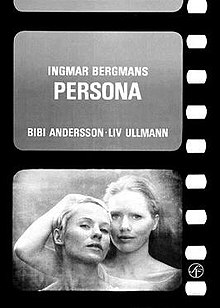
220px-Persona_Poster.jpgMost movies are usually created to satisfy people and for them to have a pleasurable experience while watching. However, some movies are intended to make the viewers feel uncomfortable, which is how Bergman’s film Persona was. After watching the film, I honestly felt bothered, confused, and disturbed as I left the room because I could not comprehend what I watched at first, and even when there were moments wherein I thought I was following the movie, I ended up being more and more confused as it went on.

The beginning of the film showed disturbing images that set the mood of the film from the very start as it is a psychological drama. Accompanied by a musical score which was haunting that contributed to the overall experience of the movie, images such as an impaled hand and the killing of a lamb were shown before the film started to focus on the two main characters, Elisabet and Alma. Elisabet is an actress who decided to stop talking despite being perfectly healthy, and Alma was her nurse. Since Elisabet could not speak, the film focused on showing her facial expressions, body gestures, and how she was really attentive in listening to the stories Alma shared about her life. This became ironic as Elisabet became the one comforting Alma because of her troubled past that she cannot seem to let go of. The series of disturbing videos were repeated as transitions again in the film that did not really make sense for me but then it signified that something was about to happen. This was used when Alma confronted Elisabet about the letter that she wrote, which included the stories that Alma shared. This was an important scene in the film as when Alma was about to pour boiling water at Elisabet, she finally breaks her silence saying, “No, don’t.” This was not actually the first time that she spoke but it was the only time that Alma was certain since she also whispered to her before.

The confusion continues as the characters seem to have had similar experiences and as the film went on, they seem to become more and more identical. They both experienced trying to abort their babies but Elisabet failed and this resulted to her hating her son. There was also a scene where Elisabet’s husband appears and sees Alma as his wife and they end up making love to each other while showing how Elizabet reacted. This shows how the film’s plot can be confusing because it did not really explain everything and left it to the viewers on how to interpret what was happening. There is also a sense of uncertainty whether some of the scenes actually happened and if not, whose imagination was being shown? Another instance of this is when Alma confronts Elisabet about her child was repeated, which I interpreted as giving emphasis on the importance of this scene to the movie. In this scene, Alma rattles on about how Elisabet just played the part of a happy mother and how she looks at his child with disgust since she really did not want to have the child. The ending was very puzzling for me as Alma proclaims that she is nothing like Elisabet but it also includes showing previous shots of them together and their faces overlapping, as if they are the same person.

Persona was a very complex film despite its supposedly simple plot, but the different elements along with the fitting musical score and uneasy feeling that were inflicted on the viewers did not really make the viewing experience a pleasurable one. Despite the complexity and confusion, I got how this movie is considered as an art cinema classic.

Identity Crisis

The Swedish Psychological horror film Persona which was directed by Ingmar Bergman is a great and interesting film because of its execution and how it leaves the audience wondering and thinking about the many plot points. I found it a great film because of its use of film conventions to help bring more meaning to the story. One thing I liked is the music and sound effects because it helped bring the right atmosphere and emphasis to the scary scenes. This can be seen even at the start of the film, when it is a black screen and then two lights start appearing. During this scene there is a piercing sound which starts softly and then becomes louder. This music and imagery evokes a feeling of uneasiness and uncertainty as to what is happening in the scene. Another example is during the scene when it shows both of Alma and Elisabet’s faces together in one face and the music became loud and piercing. It gave a feeling of urgency and terror because she was starting to lose her identity as Alma to the character Elisabet. The film used camera angles and costumes to greatly emphasise the theme of identity. During the time in the cottage, we can see that both actresses are wearing an identical white dress to sleep. There is also another scene which is when Alma was interrogating Elisabet about his son whom she did not love and tried to abort, and both Alma and Elisabet are wearing black. By showing these two characters wearing the same clothes in one scene, it makes the audience feel like they are both the same person, and this supports how Alma is slowly becoming Elisabet. There are also many scenes wherein the camera angles put Alma and Elisabet’s face very close together, and this helped emphasise how similar they are becoming. One example was when Elisabet stood behind her and held her forehead, and then their heads moved to opposite sides as if to show they are becoming one.

The film’s plot is also very interesting because of how it does not explain everything and it makes the audience reflect and think more on the interpretation of the film. This can be seen at the start of the film because of how it shows a goat bleeding and a young boy trying to touch a picture of a woman’s face. The film does not explicitly explain who the boy is or the connection of the goat to the story, but after watching the film I believe that the boy is Elisabet’s son whom she tried to abort. I think it is her son because the woman’s face appears to be Elisabet and the boy is trying to reach out to her out of love. Alma states near the end of the film that Elisabet despises her son while the son loves her immensely. The invisible wall that the boy is touching can be the barrier that Elisabet put between them to distance herself from him. This was another different film for me but I enjoyed the story and execution of it because of how it shows rather than tells the audience as to what is going on.

A Suspicious Identical Twist

Persona was a movie that seemed to revolve around two different characters with identical and parallel experiences. I believe these two people resonate with one another, which is why Alma developed an attachment towards Elizabeth. On the other hand, Elizabeth would claim to “enjoy” studying her. Some of the scenes that show their similarities is through their history. Alma was in love with a man named Karl-Henrik, however despite this, she still joined the sexual activity by her friend Katarina with two other men. In effect to this, Alma became pregnant and decided to abort the baby. This was somehow parallel to the experience of Elizabeth. The latter was an actress who became unintentionally pregnant. In order to continue acting, she decided to abort the baby. However, she was unsuccessful as she shows hatred for her son. This could be seen how she saw a picture of a boy and tore it apart. This was all exposed when Alma confronted Elizabeth, which was a scene that repeated twice. I thought this was a way to place emphasis on this dramatic scene. 

Another way their lives were similar was in relation to the sexual experience. In a particular scene, a man appears out of nowhere and it seemed to be the husband of Elizabeth. However in a surprising way, which caught me off-guard, the husband addresses Alma as Elizabeth. Afterwards, they started to make out and even decide to make love to each other. The unusual part in this scene is the reaction of Elizabeth. She doesn’t seem to do anything rash about it and just acts as a spectator in this scene. 

It also caught my attention on how there are various scenes where Elizabeth and Alma would usually be together in mirrors, as if they are a part of one another. In fact, Elizabeth caresses the hair of Alma and in the concluding scene, Alma stares in the mirror without Elizabeth but caresses her hair in the same manner. I really think that both characters seem to have a lot of regrets, and can’t seem to forgive their past. Because of this, they can’t seem to move forward and face life with loneliness and anger. This could be seen on how Alma easily confesses to Elizabeth her personal stories, which I believe was ironic. Alma was playing the role of the nurse and yet, it became Elizabeth who served as the one comforting her troubled past.  On the other hand, Elizabeth can’t seem to move herself forward. At the start of the movie, she didn’t even move and chose to not speak in almost the entirety of the movie. In fact, in order to cure her, she was forced to live near the ocean with Alma watching over her as the nurse. It was like she did not even want to exert any more effort, a manifestation of this is how she never responds to Alma’s anger with exception to the part she almost throws a pot of boiling water at the actress. When Elizabeth was confronted with a picture of a boy, she expressed a great amount of rage. Both characters are greatly identical but I believe it’s anger, one-sided love, and troubled past that sets the tension between their relationship. 

The Inner Workings of Silence

Persona (d. Ingmar Bergman, 1966)

Persona by Ingmar Bergman is certainly a movie to say the least. Watching it, I felt multiple emotions (mainly disturbed), but considering how the film is classified on the internet as a “psychological drama”, I feel like that was precisely the point. Persona has a horrifying opening scene that has bizarre elements such as internal organs, an old film projector cracking, a cartoonish vampire, and even an erect penis, followed by a bizarre sequence of a child awakening from sleep and reaching out to an enormous screen showing the two protagonists of the film. This opening scene is only amplified in its unnerving and terrifying nature by a film score that seems to exist to do just that.

In fact, the score is precisely what makes Persona a disturbing experience. The film plays with sound to amplify the conflicts of its plot and the style of its directing to make a weird and unnerving experience. Even the smallest thing such as the central two characters being comforting towards each other are treated in an unnatural way and even flashed back to at the end of the film with the help of the ominous score.

The score existing to be as unnerving as it is is precisely what makes the film even more nerve-wracking – the story is about a woman named Elisabet who randomly took a vow of silence and her nurse named Alma who accompanies her to a cottage to help her recuperate. It is a simple premise, and yet the score compliments the element of insanity that one might naturally encounter when having nothing but another human being with you that refuses to talk and only you and your thoughts to accompany you for hours on end.

When the film was introduced to us in class, the main thing told to us was that the film “is about two women talking to each other”. And honestly, while that does sum up the film’s basic premise, it seems to gradually devolve from two women talking to each other to another slowly losing her mind as she appears to become the other. This is very clear near the end of the film, where Elisabet’s husband arrives and sees Alma as his wife, seemingly oblivious to Alma claiming otherwise. At the same time, Alma herself also seems to accept slowly becoming Elisabet, as she even sleeps with her husband.

It is actually at the exact ending sequence of the film where Alma fully realizing she has become Elisabet is shown. After a lengthy monologue shown from Elisabet’s perspective where Alma deduces Elisabet’s life that led to her forced vow of silence, the film repeats it again, this time from Alma’s perspective. Immediately after, Alma wounds herself, has Elisabet drink her blood, reaffirms her identity as herself before forcing Elisabet to say the word ‘nothing’ and running away from the cottage she spent her last few days in, followed by a film crew. In this scene, I think it really showed that while Alma may believe that she has not turned into Elisabet, the mere fact that she attempts to hide Elisabet and run away with a camera crew capturing her shows otherwise. She may try to escape it all she wants, but she has effectively turned herself into Elisabet. And that, I think, is the terrifying impact of the film – how ‘nothing’ (Elisabet and her vow of silence) can eventually result into ‘something’ (Alma turning into Elisabet), despite ‘something’ being unwilling to do so.

Ultimately, Persona is a weird, disturbing, and unnerving film, and yet it is memorable enough to serve as a unique look into one’s psyche.