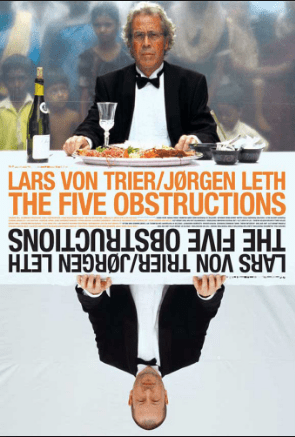
The Five Obstructions: A Peek Into the Filmmaker’s Mind

If there was one thing that The Five Obstructions taught me, it was that art is ever-changing. It is not a still life portrait that will forever be the same, even if it was recreated multitudes of times and by the same artist. Jorgen Leth challenges himself in this documentary by trying to recreate his short film The Perfect Human five times, but each time with a twist given by Lars von Trier. What seemed to be a fun game at first turned out to be a very gruesome and tiring experience for the director, as von Trier’s requests become more and more absurd throughout the documentary.

His first obstruction, which was that it must be set in Cuba without a studio and only twelve frames per shot. A regular viewer such as I found this very challenging, but Leth came out successful with an interesting remake, although quite dizzying to watch. It was fun to see the process behind the filmmaking, such as the film crew’s travel to Cuba, their process of picking the actors, and watching Leth direct. Once von Trier sees it though, he is unsatisfied and wants to test the director even further. The second obstruction was to film in the worst place in the world but not show it onscreen, and, additionally, Leth must play the main character.

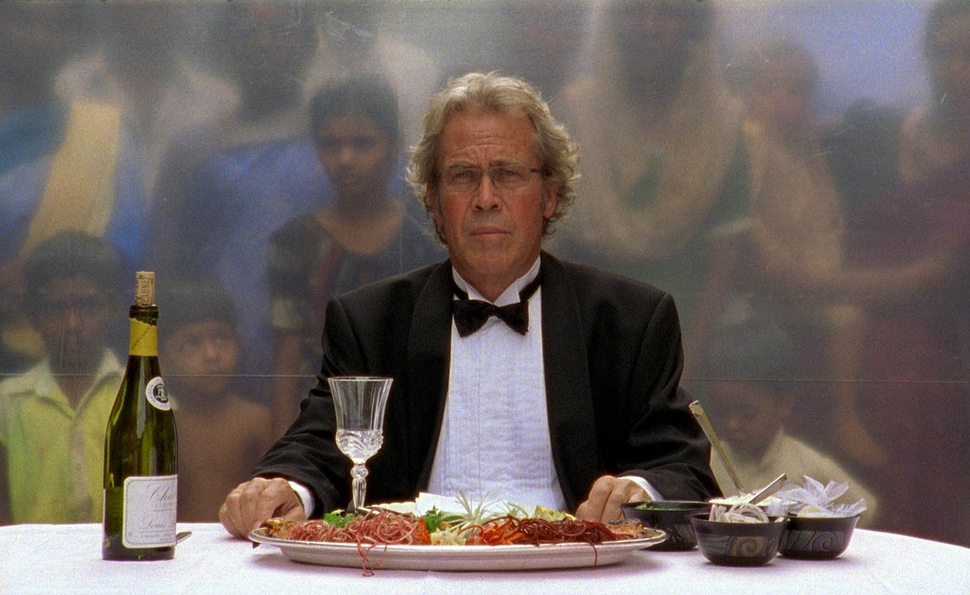
Hearing “the worst place in the world” would already appear to be daunting for some, but the director quickly attributed the prompt to his experience in the red light district of Mumbai, where he encountered the slum area. Before they even reached their destination, it was disheartening to see a mother carrying her child asking for alms and food outside of Leth’s vehicle. Out of all of the obstructions, this was the most disturbing to watch since you could see the faces of the children as they saw Leth eat a fancy meal with a straight face right in front of them.

Upon seeing the second remake, von Trier says that Leth failed the task and wants him to go back to redo it as he wished. This is where the tension between the two starts to rise, since the latter says that it is too inhumane and he wouldn’t do it again. With his morals compromised, he decides to go with the other equally difficult option: to recreate his film in any way he chooses. As someone who also does art, it was frightening to have complete freedom over your art. Maybe it’s the external expectation, or the internal one that it should be better than the last, that affected Leth the most. Yet he was able to recreate it beautifully once again through a split-screen effect. Leth almost even breezed through the fourth obstruction, which was to make his film into a cartoon—a genre that both he and von Trier hate. He exceeded the audience’s expectations by creating one of the more beautiful masterpieces throughout the whole documentary, with the help of a professional animator.

The fifth and final obstruction was ironically the one that needed the least effort from Leth’s: that it would be made by von Trier but will be credited as the former’s work. It was unsettling to think that was possible to give so much power to someone over a film, but the output was interesting nonetheless. Overall, the documentary makes viewers think what it means to be a filmmaker and what is needed to make a good film. It relies on many things such as cinematography, editing, directing, acting, and the like, but also does not. What we learn from both von Trier and Leth is that films evoke emotions and thoughts from its audience, no matter the time, place and age, but one should still have fun in the process.

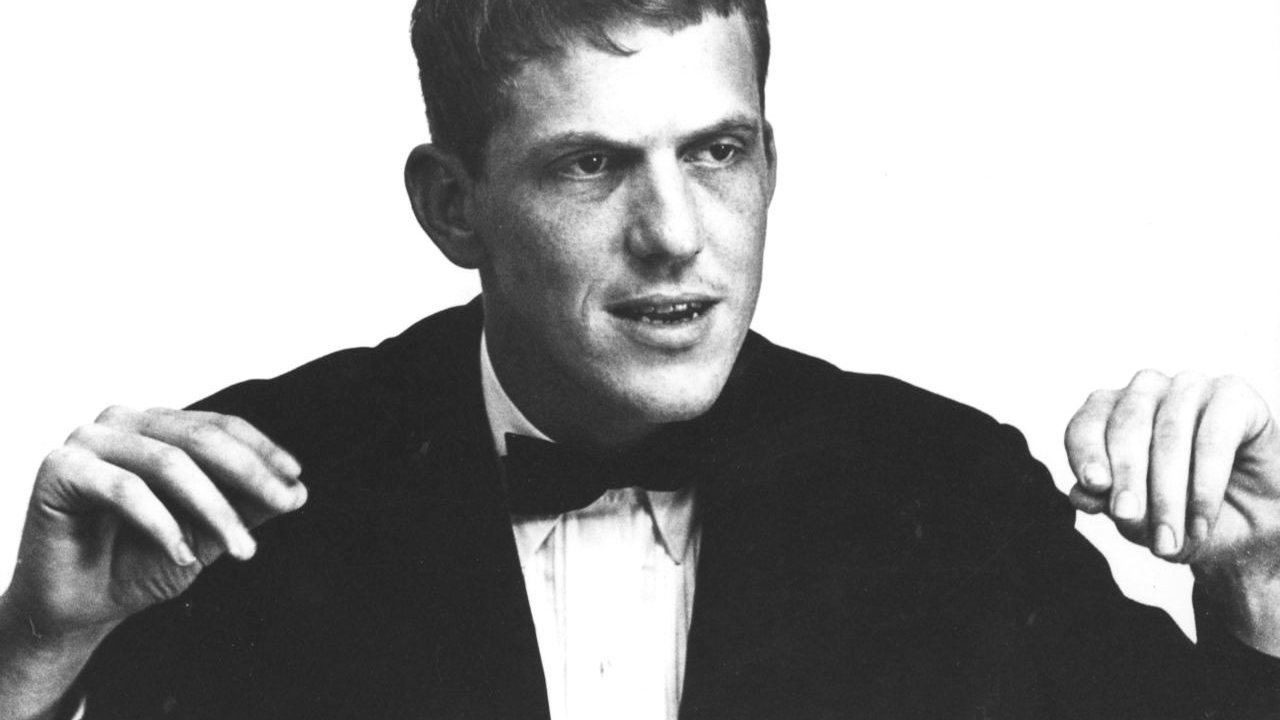
The 5 Obstructions: New Take, Old Film

273598-11200-clp-950image-w1280

The Five Obstructions is a documentary showing the director Jorgen Leth faced with five peculiar challenges in film-making. Jorgen Leth was tasked to recreate his 1968 film, The Perfect Man in different styles and creative instructions determined by his fellow director Lars von Trier. These instructions ranged from keeping each shot 12 frames, having a particular background or backdrop in the scene, to even a fully animated recreation of The Perfect Man. This task of creating new renditions of his older film gave Jorgen Leth a personal drive to show off his caliber and talent in creating film and screenplay, as well as proving himself to be capable in Lars von Trier’s eyes. This film went to show the experiences, joys, and frustrations of creating art through film.fiveobstructions

The story follows Jorgen’s journey following the specific instructions given to him to how he will create a revision of his old film. Though challenging, he sees an interesting way of doing these challenges – which motivate him to push with these and create beautiful works of film to present to his peer Lars von Trier. What’s interesting, in my opinion, is how Jorgen undertakes this challenge (something that was created to be difficult and taxing to him and his filmmaking abilities) and still finds a way to create works of art that not only impresses us as the audience but the challenge-giver himself. Reviving a film from the 1960s with new contemporary ideas and perspectives, Jorgen can be a representative of the newer movement and approach to the slower and more arthouse style of European Cinema. This is shown in how despite the challenges he faced, Jorgen finds time to smile and find joy in his work as a director, actor, and storyteller in cinema – shown in the private shots where he talked endlessly about his plans for every obstruction. The Five Obstructions really shows that you can teach an old dog some new tricks, as the saying goes.

 One of the obstructions given to Jorgen that piqued my interest was the (3) complete freedom or go back and redo challenge. It’s interesting to see how much of a challenge Jorgen saw in this challenge, even contemplating redoing his second film. The idea of complete freedom with absolutely no restriction, he thought, was a tough task, and I still am baffled to why he would think that. Does the ide of having certain limitations leave him with more material to work with, or is the idea of freedom a daunting gift (or curse)? In the end, I find it curious to see his work of creative freedom more difficult compared with the other tasks given to him.

This film feels like a callback to the older European films watched in our lectures, as the older concepts in the European film of when are given a new perspective or turn in Jorgen’s reviving of them. Given the challenge of not only recreating Jorgen’s old film of The Perfect Human but also added restrictions and obstructions onto its production, you would think these would create a lackluster film out of this aged director. Instead, we see how an aged and clever director finds a creative spin to not only meet the requirements given to him, but create a film that can stand on its own, producing a new approach to European cinema in general.

the perfect human x5

When I heard that we were going to watch a movie actually made in the 21st century, I was excited—I felt like the best films I could relate to and understand were more modern films. The Five Obstructions is a documentary film directed by Lars von Trier and Jørgen Leth. It follows the two directors as von Trier challenges Leth to remake his own famous short film, the 1967 The Perfect Human. Each remake, however, was accompanied by an obstruction or obstacle set by von Trier. Though many people have viewed The Five Obstructions as a game of one-upmanship, I chose to view it as a film that examined the friendship of the two directors. One that showed how one friend challenges another to better his skill and widen his own way of thinking. The roles between a mentor and his protégé have suddenly switched—von Trier was now guiding Leth as he starts his film anew.

I think that the challenges were something that they both enjoyed doing. It was an opportunity for something different than the typical, almost routine films they would normally do. Leth did it not because he had to, but maybe because he wanted to. He needed a challenge. We can tell from the original film that Leth had a style of filming: classical, simple, and rather minimalist. But von Trier challenges this through his obstructions with a different cinematography, with a loud, disorderly, and almost uncontrollable setting, with Leth in front of the camera rather than behind it, and with Leth using a new and modern technology, which he had no experience with at all. Even von Trier was evidently not giving Leth these obstructions just for fun—he was critical of them, as we can see when he fails Leth in the second obstruction. Von Trier knew what he wanted from Leth without giving it away. We know that these challenges work when, after completing the first obstruction, Leth was grateful for the obstruction, stating: “the 12 frames were like a gift.” The two brilliant filmmakers knew that there was always more to improve or change about any project, for even a film called ‘The Perfect Human’ was no perfect film.

The Five Obstructions was definitely a more modern film compared to what we have been watching, but we can still use the things we have seen in this film to understand the older films in terms of what goes on behind the camera, or rather, in the head of a filmmaker. Long, silent shots, similar to the ones used from The Perfect Human, seem to be common in many of the 60s films we have watched in class. The Perfect Human even reminded me of the style of Persona, with its black and white film, and silent and strange aura. The documentary also used a lot of dialogue, which I enjoyed. Although, the film was a bit repetitive, I didn’t mind so much because there was also something new and different with every remake.

Overall, the film was a challenge of creativity. A challenge to test our own limits, and to go beyond our first impression. The film was a literal work of art, with how it showed the process and thinking that went behind making a film. The result of the fourth obstruction was my favorite. It turned The Perfect Human into a contemporary piece of art. Leth was a perfect example of one of the greatest challenges of filmmaking: working with what you have and making it better than what was expected.

The Five Obstructions – Review

The film “The Five Obstructions” shows the making and the breaking of works of art, as the producer von Trier challenges eccentric documentary filmmaker Jorgen Leth to remake his 1967 12-minute short “The Perfect Human” five times. With each remake, von Trier imposes seemingly arbitrary sets of conditions on the filmmaker, the “five obstructions” of the title. For one project, Leth is sent to Cuba to make a film with (among other constraints) no sets and no shot longer than 12 frames. For another, von Trier sends him to “the most miserable place on Earth” and orders him not to show it on screen, to put Leth’s “ethics to the test.”

Part documentary and part high-concept art project, “The Five Obstructions” follows the yearlong experiment as von Trier tries to stump Leth. “The trouble is everything I give to you inspires you,” smiles von Trier devilishly as he watches one finished project. “I can’t help it,” apologizes Leth as he transforms constraints into possibilities.

The documentary portion of the film, ostensibly about the creative process, is dominated by the personality of self-satisfied prankster muse von Trier. It all feels like a performance for the camera: von Trier as madman producer taunting the elder filmmaker. Leth is the modest, restrained artist, unfazed by von Trier in their production meetings but given to moments of creative panic on location while he struggles with the rules.

Leth lets his work speak for him, and the glimpses we see are so rich, so inventive and so intriguing that we want to see more. That’s the film’s big weakness: we only see bits and pieces of each film as the filmmakers choose different sequences to contrast each remake to the original. “The Five Obstructions” may never really engage with the creative process — we see little of Leth’s working method — but it is full of vivid examples of the finished product that even von Trier can’t help but fall in love with.

The Revival of Creativity: A Discussion on The Five Obstructions

Jørgen Leth in The Five Obstructions

After watching three drama from the 1960s, it felt like a breath of fresh air to stumble upon Lars Von Trier’s The Five Obstructions. Here, he challenges fellow filmmaker Jørgen Leth to remake his short film, A Perfect Human in five different ways. They opted for a documentary style, which enhances the viewing experience since we get to see the work that goes into filmmaking. The development of the characters and their styles become more apparent because we believe we are watching the reality, as opposed following the lives of fictional characters.

Aside from the medium, Von Trier’s playfulness made the film exciting, making the viewers anticipate what other tricks he has up his sleeve. In the beginning, we are quite unsure why Von Trier came up with the obstructions for his mentor. We ask, “What’s the point of the film?” or “Why choose those particular obstructions?” The film asks us to reflect as it presents Leth’s new films. Towards the middle, it becomes clear that the emotional connection between Von Trier and Leth was crucial in pushing the latter to reject his old habits and techniques that prevented him from maximizing his creativity. It was interesting to see how the student taught and criticized the mentor during the challenges. Ironically, the obstructions meant to hinder Leth’s progress or force him to produce a bad film, resulted to compelling, clever new films that he would not have produced were it not for Von Trier. Leth, himself was astonished, and you can see his development throughout the film. He began to smile more by the time they watched his animated film, in contrast to his controlled, stoic demeanor in the beginning of the documentary. 

At the end of the film, we realize that European cinema is truly an avenue for a variety of techniques for filmmaking and storytelling. Oftentimes, we believe European films are daring, eccentric, and difficult to understand since we are more familiar with Hollywood films. However, considering the documentary style of The Five Obstructions that is similar to Hollywood conventions, we get to see that it is not just about the aesthetic. For instance, Von Trier shows us the ethics behind filmmaking when he asked Leth to remake the film in the worst place in the world without showing the place. The exercise required empathy, but Leth refused to listen and stuck to his old practice of capturing provoking images. Aside from this, Von Trier also taught his mentor to remake the films without any rules and as a cartoon, as the third and fourth obstructions, respectively — which he hated. Despite his struggles, Leth came up with some of the best films and offers the audience not just one, but a total of six films in The Five Obstructions alone. This film-within-a-film technique satisfies the thirst of many creative professionals, allowing us to understand how we can constantly improve ourselves if we escape the comfortable box we built. Although Von Trier felt that he failed with his mission, we clearly see how he paved the way for his mentor, Leth, to nurture his film art once more.

The Five Obstructions – Human Perfection in Camaraderie and Competition

European cinema is obsessed with toeing the line between traditional rules of film and art cinema. One of the primary differences between the two is that the former fully attempts to create an experience of immersion for its viewers, while the latter seeks to remind the viewer that we are, in fact and simply put, spectators of actors acting on screen. Documentaries then, may be said to be an exemplification of breaking this immersion into story, in its recording of acutely real events actually and perhaps even presently happening in the world. However even in traditional cinema, the illusion of reality – by fostering narrative transitivity in its creation of a story – is still attempted by its directors. The Five Obstructions, on the other hand, breaks this narrative transitivity and the illusion of reality to the absolute fullest.

At first sight, the documentary is quite obviously art cinema in its unique depiction not merely of films within a film, but film production and director correspondence in the creation of these films for the film, with both directors so acutely and actively engaged on screen and acting the premise of the film itself, in what I then perceive to be the ultimate exceeding and test of the limits of traditional documentaries. The first phrase that came to mind while viewing the film given this factors is that The Five Obstructions is the ultimate fourth wall break.

Despite the premise of the film being guised as a collaboration between two renowned directors (and the return of one from retirement), we quickly perceive an aura of competition over camaraderie between them, as Leth is consistently given more and more difficult challenges, never actively praised and yet also critiqued by Von Trier. The master-student relationship actively onscreen thus gives way to a reversal of initial roles. And yet despite the increasing difficulty and ridiculousness of the obstructions, Leth nonetheless responds to them to the fullest of his capacity – even creating an animation despite his lack of knowledge of it and inherent dislike.

The premise of camaraderie and competition and the roles of power in relationships is not something we have not seen before – this may be contrasted to Persona, wherein the film premises on interactions of two characters and the subsequent relationship formed. Persona is centered on the melding of two individuals and the continuous oneness of their characters, and the power each of them hold over another at different points in the film. The Five Obstructions displays outright competition and perhaps even guarded hostility.

It is also interesting to take note that in both films that display this underlying tension and competition, both main characters of the same sex. It brings into question whether the type of camaraderie-competition relationship would have had the same intended effect if the main actors have had been of the opposite sex (the main assumption being that it would not, e.g., A Woman is a Woman).

What may initially be perceived as the film’s depiction of a collaboration between two filmmakers further grounds itself in the aforementioned portrayal of a master-student relationship that, again, quickly evolves into a competition between two masters of crafts. The reversal of power, the constant one-upping, does not come without further repercussions and the entrance of further human factors – specifically, those of imperfection, competition, and the human drive for perfection in the face of it.

Imperfection may be seen in the films Leth himself creates. As the perfect human strives to do everything perfectly, we cannot help but notice that the films document precisely how he or she does everything imperfectly, or against a backdrop of imperfection (e.g., the Mumbai scene). Exemplified by this example, we realise human imperfection becomes noticeable at the fringes of our perception, and yet paradoxically, this imperfection may be said to be made more noticeable due to our human drive (exemplified by The Perfect Human’s title and thus, inherent goal) towards perfection, that we then are made more capable to take note of imperfections. Thus, Von Trier’s critiques of Leth’s films (although interestingly, Von Trier also gives credit to imperfections relevance to film creation, “the best gift is when an actor messes up”). Leth’s  drive towards perfection is fuelled by Von Trier’s critique, and the competition now deeply embedded in their consistent interactions.

Competition is animalistic. In attempting to recreate The Perfect Human, we wonder whether Von Trier is saying that the Perfect Human is one who pursues perfection, consistently and constantly in the face of imperfection, driven by the animalistic tendency of competition harbored by each and every human being. Is the perfect human then a bundle of imperfections striving towards perfection, or one who creates perfection from a multiplicity of imperfect variables? And is this perfection one that we seek inherently within ourselves, or is it exemplified and thus, made possible and perhaps even strengthened by factors of both camaraderie and competition – hence, that which defines Von Trier and Leth’s relationship.

Extra Comments: The relationship between Von Trier and Leth can be said to likewise be seen in Persona. The same underlying tension and competition between them is also seen in the two main characters – a relationship of camaraderie and competition. Aside from this, it is interesting to note how the outside world in both films have a tendency to intrude upon what is currently going on in the film. In Persona, we see films and pictures of the Vietnam War, and other events. There are references in both films to the world outside Europe, and I believe this is another thing worth exploring and thinking about. Similarities may also be seen with La’aventura in how both films seem to begin with one thing but is actually ends up being about another. Here, the beginning of the film portrays the documentary to one regarding filmmaking. At the end, we realise it is more about showing how the process of filmmaking is multifaceted.

Perfection? I Don’t Know Her.

The Five Obstructions (2003) is my personal favorite of all the movies we have watched in our European film class so far. It’s challenging, insightful, and heartfelt all at the same time. Beyond giving us a look at the trappings of film-making, it provided us some powerful insights on the volatility of art. I couldn’t get my eyes off of the screen as Lars von Trier and Jorgen Leth embark on an artistic journey to reinterpret Leth’s short film The Perfect Human.

An underlying theme in the film is how the obstructions were geared towards reducing perfection and challenging perfection to its limits. It was as if the Perfect in The Perfect Human was being distilled off in order to arrive at the Human. It felt like von Trier was invested in seeing his idol fail–but in his failure, arrive at something human. Despite von Trier’s obstructions, Leth pulls off these masterful reinterpretations of his original work that von Trier can’t help but gush over. The back-and-forth between the two directors added to the charm of the movie. I especially enjoyed how demanding the tone von Trier used when he was giving out the obstructions.

The first obstruction was pretty standard and straightforward an obstruction. It was a matter of execution and the technical workings behind the film. Location, editing, script–these are all things directors could edit, manipulate, and ultimately pull off. It’s sort of a surface level attempt at imperfection, like what would happen to a car if it didn’t get washed for a month. The finished product felt familiar and had the markings of the original. I particularly enjoyed the result of von Trier’s 12-frame imposition.

The second obstruction was a little more difficult to pull off because it immediately involved the director. Leth is assigned to recreate his short film in a place he considers a personal hell, and the final product should reflect what he experienced without it being visible in the recreation. Would perfection remain unscathed if the artist undergoes something tragic, something horrible? I think Leth’s experience is comparable to writing a paper on poverty, going on immersion in the poorest places of Manila, and being forced to rewrite the same paper. The finished product was up to von Trier’s standards, but he did not appreciate Leth’s genius technique of using a translucent material to partially cover the people of Bombay around him.

The third obstruction, as a punishment for Leth’s violation in the previous obstruction, was no obstructions at all. Now I understand Leth’s apprehension towards this obstruction. Perfection is defined by the parameters upon which the work is evaluated. But what happens if there are no parameters? What becomes of perfection then? Without challenges to overcome and rules to follow, could art still hold meaning and beauty?

The fourth obstruction is my favorite. I think at this point, von Trier has made his intentions of arriving at something messy and as human as possible exceedingly clear. So using a medium such as cartoon animation in which everything is calculable and manipulable to create and convey something imperfect is a very intelligent move on our challenger’s part. I thought the sequence of events leading to this imposition was ironic because von Trier was talking about how beautiful moments can be captured in the spontaneity and unpredictability of human acting, and then he proceeds to assign this obstruction. Leth comes up with a gorgeous animation which von Trier just gobbles up and showers in praises.

The fifth obstruction was so sickeningly sweet and it’s just a nice way to wrap up such a great film. It was von Trier’s love letter to his idol, still retaining that cockiness he had throughout the film with him putting words in Leth’s mouth. Here he addresses his intentions in starting this little project with Leth. It’s great to see this side of von Trier. Having watched some of his films and having a sense of how his mind operates, it’s kind of adorable to know that he is capable of having actual human feelings.

However masterful all the reimaginations of The Perfect Human were, we see how the sense of perfection in the original is reduced and reinterpreted in so many different ways. Although I must admit that these revamps of the original were kind of confusing in a sense that I didn’t know what they were trying to convey, witnessing the process of challenging and creating art makes the movie a really great watch for me. I have a feeling I will be thinking about this film for a while.

The Five Obstructions: Film as a Form of Art

Image result for five obstructionsMovies usually work in different ways, each having their own structures, narratives, and variations from the usual practices. This can be seen in the first three movies that we watched, as each film had something new to bring despite being released in a span of just a few years. Our latest film, The Five Obstructions, by Lars von Trier, was also completely different as it deviates from the usual film structure.

The Five Obstructions was sort of like a documentary, with how the shots were filmed and how it was constructed but it was also sort of like an anthology in the sense that different variations of the same film were shown, each having a different twist to it. It serves as a post script for Jørgen Leth’s “The Perfect Human,” released in 1967, as the film revolves around the challenges given by Jørgen Leth to Lars von Trier in reconstructing what he deemed as a masterpiece and a perfect film.

The film was a bit confusing for me because of how the shots were made and how the transitions were done. It was made of different variations of the same film and behind the scenes shots, which included the thoughts of the directors, the discussions about the film, and processes that they went through. The Five Obstructions allowed the viewers to see the process of the film-making to the end product through the perspective of the directors. It included the exchange of thoughts and arguments that unwinded how the finished versions came about.

After watching the movie, I appreciated the love that they showed for what they do and how Lars von Trier was willing to step out of his comfort zone just to give respect and recreate The Perfect Human, despite the difficulties that he encountered. One of the things that I think could have made the viewing experience better was highlighting The Perfect Human first, since it was the basis of the recreations and I personally have never heard of it before. I also think that the film could have been more enjoyable if we watched The Perfect Human prior to it without the thoughts of the directors. There were also parts that were too slow and dragging, especially some of the conversations that were shown.

The visuals used in the movie definitely caught my attention and left me intrigued as to why Lars Von Trier kept going despite the difficulties that he had to endure. One of the things that I realized was how the film focuses on their love for film-making. Given the challenges proposed by Jørgen Leth, it allowed him and the viewers to see the different perspectives of how the film could have been made. In this way, they are able to portray film as a form of art. When it comes to art, there are no limitations, given the limitless ways that The Perfect Human could have been remade. There are also different interpretations to art, represented by the recreations of Lars von Trier, which also give viewers a better appreciation of the film.

The five obstructions

When I heard that the film, The Five Obstructions, would be set in more recent times, I thought this film would be easier to understand compared to the past films, but it still proved a bit of a challenge to interpret. The story is narrated in a straightforward manner but the content of the film is what confused me. The character Lars asks Jorgen to remake his old short film The Perfect Human five times with different rules and restrictions. When I saw parts of The Perfect Human I was very confused as to what the goal or the driving force of it was because it just shows a man and woman performing various actions and a person narrating what they are doing and asking why they are performing those actions. The would also repeat himself, and the camera angles would sometimes just pause at the person’s face or body part. After researching a bit to understand the point of Jorgen’s old film, I learned that it was meant to understand the human person and how his mind works because of how it would observe the man and woman as if they were test subjects. This helped me understand better the context of the story of the current film.

I believe that the whole film can be one big remake of The Perfect Human because of how it allows the audience to see and understand the minds of two great filmmakers. Lars sets boundaries for the remakes such as having no set, shot in Cuba, and many more, and these rules can make filming a good movie seem impossible. Then next we see Jorgen adapt to these rules and express his creativity in successfully remaking his old film. I enjoyed the cartoon remake the most because it was a very different approach compared to the past remakes. Even though Lars and Jorgen both stated that they hate cartoons, I believe that the art of the cartoons helped bring beautiful visuals to his old film, and it brought a fresh perspective to me. I also found interesting the second obstruction because one restriction was to not show the place in the film. I was confused at first because I wondered how would he not show the place. Will he put up a blank wall behind him as he ate? Then when he began filming the second obstruction he had placed a transparent wall behind him, and I was impressed with his creativity even though he did not follow the rule to the letter. The film not only showed the creativity of great filmmakers, but it also showed the conditions and processes that filmmakers have to go through. For the first and second obstructions, Jorgen had to fly to Cuba and Bombay, set up the place, and look for actors to join the film. The fourth obstruction needed to be a cartoon, and Jorgen needed the aid of Bob to film because cartoons are not his specialty. The goal of this documentary is to inform and show the audience what creativity in filmmaking can achieve, because his old film was remade five times and yet it gives the audience a fresh perspective.

Persona: Two Persons Two Faces


In the story of Persona (1966), directed by Imgmar Bergman, the details whether the character of Elisabeth Vogler, who experiences a life-changing moment which stops her from socializing and living a normal life, recovers from her own dilemma. Though the focal point of the film narratively should be how Elisabeth recovers with her personal issues, the direction soon shifts the vocal and very empathetic character of Elisabeth’s caretaker or private nurse, Alma. The relationship between patient and nurse shows off the tension of each other’s relationship regarding their own lives, where they find themselves comfortable with one another at times then later on frustrated with even the most trivial things. Through shown as two separate characters in the narrative, the film pushes scenes where their likeness and personalities resemble each other, to even editing their faces side-by-side. Though their character traits and where they came from are different ways, their meeting up show a similarity displayed only in the medium of film. Persona is a play of two women characters and their interaction with one another.

On a literary definition of the word “persona,” it means “the aspect of someone’s character that is presented to or perceived by others.” I would like to make the distinction in how the passage selects the term, a perceived character by others, when during a majority of the film, these two characters of Alma and Elisabeth spend every waking hour with each other’s company. Some of the more tender and emotional scenes contain their conversations with one another. For example, in the scene where Alma shared her story on the beach, you can see the interest and compatibility they have with one another – listening intently to their stories and feelings. There’s a certain charm and curiosity they have for one another, when Alma shows her respect of Elisabeth as an actor and Elisabeth shows her respect for Alma’s care. Since their seclusion at a cottage, where all they have are themselves, the external pressures of society and their peers don’t come into play when they kept each other’s company. Telling this tell is such an intimate level, there’s this appearance of reality of what the people or persona of Elisabeth and Alma are, especially in how Alma grows a very personal and sincere relationship with Elisabeth. Since Elisabeth’s condition won’t allow her to speak, Alma becomes more open to telling her deepest thoughts and desires with Elisabeth, from her upmost respect for Elisabeth to the naughty tale when she was at the beach with her friend. There’s this certain merging of these characters due to their likenesses and intimacy with another that happens in this character-driven film – and it’s an effective and creative telling of the two characters and their time alone.persona-screenshot-1170x713

Later in the film, one scene that striked me was when Alma had a monologue with Elisabeth, venting her frustrations with her silence and this current situation, then suddenly shows their faces as one. It goes to show how much they know about each other, and the relationship that developed after days spending so much time with one another. Parts of the film show Alma saying that both of them look so similar in shape, hinting to the imagery where their faces would be editing to make up one complete face. The character of both Alma and Elisabeth will be forever affected in their intimate exchanges with one another. It is really unexpected to see their character congregate in this way, but I see and appreciate the director’s choice in putting Alma and Elisabeth onto one face, as it shows the change a person may experience when they encounter a certain person, or when they spend a lot of precious time with that certain person. The film struck at me with a character-study and tells a tale how one would experience a person – showing how transformative people can be to ones own person.