Review on L’avventura

L’avventura, or The Adventure in English, discusses in its extensive runtime the disappearance and search that ensues in search of Anna. However, as if to trick moviegoers, L’avventura completely lacks a sense of excitement and rush one would expect from a film entitled the adventure. For majority of the film, we are placed at the mercy of Anna, Sandro, and their other wealthy friends who continuously go on and on about their rich problems. It is worth mentioning though that despite the black and white treatment of the film, the Mediterranean setting in the film is still beautiful to take in. Perhaps, rather than presenting a compelling narrative that one would assumed to discuss the main conflict L’avventura opted to focus on constructing its shots to fully convey the kind of reality wealthy individuals operate in.

To the dismay of many, the initial distress caused by the disappearance of Anna soon dissolves into nothing. Even Sandro, the partner of Anna, begins to immediately show interest to Claudia, who is one of her friends, despite of Anna’s disappearance being still fresh. What becomes apparent throughout the film from this point onwards is how elaborately discussed the kind of lifestyle that the wealthy possess. Seemingly typical just like how the characters in The Great Gatsby are said to easily swap partners from time to time during their outrageous parties, two of the people dearest to Anna begin dating and soon forget that she is even missing. The focus then shifts to the somewhat boresome game that Claudia and Sandro play with each other, either one not willing to give into the other’s desires so easily. Soon enough, it is revealed that Claudia is the one who is the being played by Sandro. At one point of the film, both parties have finally agreed that they are to be each others lovers (while still ignoring the fact that Anna has not returned) but Sandro still sleeps with a prostitute.

Put simply, L’avventura featured all the traits that one would assume the rich would have. Their aloofness from the realities of life and even from their immediate reality blinds them into a habit of extreme self-indulgence. Love and other formalities stand no chance in the face of individuals similar to Sandro and Claudia, for their privilege allows them put their self-interests come first.
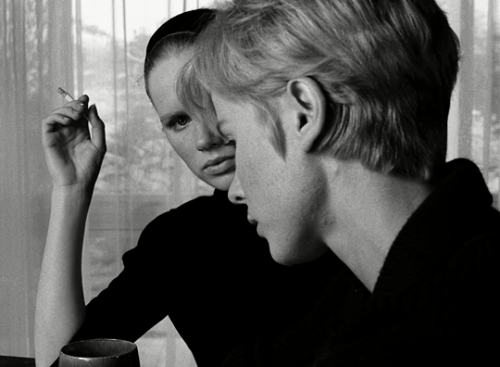
An Inquiry Into Identity: Review of Ingmar Bergman’s Persona

persona bergman.png

At the mere mention of how Ingmar Bergman’s Persona would be a more challenging watch than Godard’s Une Femme est Une Femme, one would assume how it would be a complete deep dive into art cinema. Indeed, the manner in which the narrative of Persona was relayed was quite bizarre. Opening shots seemingly consisted of random and cryptic visuals was unnerving, especially given the context that the film would simply focus on two women. Yet, as the film progresses, one recognizes the inherent genius that Bergman is. These seemingly random shots are a reflection of the events of the film—an individual’s slow descent into disillusionment over the loss of identity.

The audience is introduced to Elisabet Vogler (Liv Ullmann), a well-known actress who has suddenly decided to stop speaking and currently resides in a hospital. In order to help her regain her voice, Sister Alma (Bibi Andersson) is assigned to be her caretaker. The first few minutes of the film seem light as Elisabet and Alma begin to live together in the hospital director’s summer house near the sea. Alma divulges truths to Elisabet that she herself has not fully understood and shared to those closest to her. From this seemingly innocuous beginning of a friendship, the film descends into chaos.

Tasked to deliver Elisabet’s letters, Alma decides to read through one meant for the hospital director. This sparks a change in Alma as she feels betrayed and used due to how Elisabet takes her suffering lightly and finds amusement in it. This further escalates due to Elisabet’s commitment to silence leaving no response at all to Alma’s vitriol.

Unable to reconcile her rage and need for company, Alma shifts violently from begging Elisabet to forgive her and threatening to kill her. From here on, the manner in which the film is shot are convoluted and messy—aptly reflecting the disillusionment that has come upon Alma. Scenes being abruptly interrupted by unrelated footage or cutting to a new scene without context are proof of this. Little by little, the lines between what distinguish Alma and Elisabet blur. First through their similar clothing then gradually turning into scenes where the audience is unable to tell who is who. The scene sure to be engraved in the minds of the audience is the one nearest the ending, where Alma and Elisabet repeat the same lines. This heralds the complete blurring of the two identities, leaving the audience questioning whose story is being told through the lines. As if to confirm this, the scene ends with a merging of the faces of Elisabet and Alma respectively. Only at this point does the viewer realize how unsettling both Elisabet and Alma look alike.

Beautifully shot and evocative, Persona rightfully claims its reputation as an art film classic. The audience is given a surreal experience and is placed as a spectator to this tragic and disturbing story of how a woman slowly descends into madness. Bergman is able to masterfully give form to what it feels to lose one’s identity and does it in a manner that is hauntingly beautiful.

2/17/19 Bautista

A Review of Godard’s Une Femme est Une Femme

femme-est-une-femme-blu-ray-movie-title

In the minds of the contemporary movie-goer, the word ‘musical’ would easily bring forth memories of movies such as La La Land, Les Miserables, or Mamma Mia. Common among all these three are the extensive use of song numbers across the different scenes throughout the movie. Sometimes aided with dance numbers, musicals have gained a reputation for themselves of being able to masterfully relay a story with the use of songs combined with an excellent soundtrack.

However, it was to my surprise that the word ‘musical’ could potentially have had a different connotation back in 1961. This was the immediate thought that came to my mind as the first few minutes of Jean-Luc Godard’s A Woman is a Woman was being shown. At the mere mention that A Woman is a Woman was going to be a musical, I began to anticipate and imagine the kind of song and dance numbers they had during the 60s. Yet, several minutes into the movie, there was an undeniable lack of song and dance numbers. What I noticed instead was how the soundtrack was being erratically changed from one scene to another. It was only after 10 minutes that I came to realize that perhaps A Woman is a Woman’s classification as a musical referred to the manner in which the music and the soundtrack were utilized in the movie.

Despite the surprise, A Woman is a Woman still proved to be an interesting watch. What struck me at the onset was the abrupt and seemingly unexplained silences that occurred early in the film. Frankly, I thought that the DVD copy that we had could have been damaged but it was at its second occurrence that I realized that these mute scenes were done intentionally. These silences were used in the scene where Angela (Anna Karina), the lead star of the movie, was strolling through the city and was headed towards her workplace, the cabaret. The shift of camera angles, from up close shots of Angela to an overview of her walking in the city, is where these abrupt silences were placed in between the music. What got me thinking was that these silences appeared to be placed randomly. Unlike the masterful use of silence in Anna’s performance at the cabaret, the silences in these scenes seemed unwarranted. The shot was a simple as it is—it showcased a woman walking through what most normal cities look like. It remains a point of interest to me for the scene held no particular importance for it to be given the distinction of silence.

Fortunately, Godard compensates with other aspects of the movie from this small, albeit conspicuous, oddity. The use of color and what can be presumed to be its calculated use throughout the film is laudable. Interlaced from scene to scene, the colors red, blue, green and its plethora of blends are used against a plain background. Angela’s performance at the cabaret is a testament to this. The rotation of colors simply pops out of the screen and distinguishes Angela’s character amongst everyone else.

Overall, A Woman is a Woman can be said to be a movie one can enjoy given its easily digestible plot and interesting use of techniques.

2/7/19 Bautista