
Hallelujah! A movie that I was able to understand! Goodbye, Lenin was, by far, the most interesting movie for me since it was both entertaining yet still very informative about European Culture. Alex, the main character of the film, thought that the only way to prevent his mother from getting ill once again was to pretend that they were still living in a capitalistic government in East Germany. However, the western type of government already took over. This movie was both fun and peculiar at the same time since the manner of how they controlled their mother’s situation was out of the ordinary.
The Five Obstructions [to perfection]
Documented to feel like episodes, “The Five Obstructions” took the experience of watching films to an almost cathartic level. Albeit a documentary film, the movie has shown an evident experimentation with the way it was created and to be consumed. Jorgen Leth was posed with challenging obstructions given by Lars von Trier. As a viewer, I did not know where the film was leading. At first it seemed like an endless cycle of von Trier giving obstructions, Leth creating an above average version of his original work—seemingly to the disappointment of von Trier. I knew von Trier had some goal in kind in pushing Leth to his limits, as was indicated per episode. I, however, didn’t expect that this was going to be more than just filmmaking and that the film would affect me this much. I was rattled, abruptly snapped out of my immersion into the length of the film. As von Trier revealed through a phone call that his challenges were for Leth to realize it’s fine to not always make a perfect, flawless version of his work, I realized that this is true for all of us. I found myself empathizing with Leth in his difficulty because I too, often crave perfection. “The Five Obstructions” was a fresh offering as it not only broke the conventional way of making film, it also had an element of unpredictability to it since it is up to Leth to decide how the narrative will be wrapped up. It takes patience to watch such films but since it was filmed as if from a spectator point of view, it is inevitable to find interesting points and angles to talk about.
Fifth
Good Bye, Lenin! by Wolfgang Becker
A story where in familial love trumps all. A story where in you realize you must do anything for you loved ones and protect them from the harsh realities of life no matter how mundane it may be to the viewer. This movie made me laugh and was enjoyable from start to end.
Unlike the past few movies that we watched this was not as heavy in plot as the others. It was not confusing, the characters were dynamic and their relationships were fun to watch as they interacted and grew together. At the beginning learning that this was a story about a Socialist East German mother who falls into a coma after seeing her son rallying against the Socialist Party and waking up after the fall of the Berlin Wall was quite funny. Random, quite quirky but as I watched the film, I could see it was more than just Alex trying to avoid his mother from learning the truth about the German Unification but did it in a place of love as the doctor said that if she knew about the present situation, her illness may worsen.
In a situation of life and death, I would have done what Alex had done. To just keep my mother at a mindset that makes her comfortable and happy. The ways in which he tried to protect her were both hilarious and really had no bounds. From creating his own news broadcasts to asking his long time idol astronaut (which may actually just be a look-a-like) to become the new leader of East Germany. Inter cut with this story of Alex and his mother, we must never forget that this was actually history. The harsh realities of police brutality and heavy censorship during these times for Germany before its unification and in the fall of the Berlin Wall, an integration of a more capitalistic and democratic society. We realize that change is difficult, it may not be for everyone but it may not always be a bad thing. The movie subtly shows these changes in history through scenes such as when Alex and his sister Ariane must exchange their old money to the new currency but the bank denied this request. From the removal of his mother’s favorite kind of pickles as this has now been changed with a new brand from another country as Germany has now allowed the import from other markets
All this change would have been difficult for the mother but in the movie, all it took was time. Alex’s girlfriend finally told her without Alex’s knowledge but she did not have a heart attack right away, she was even able to see Alex’s final news broadcast with a smile on her face realizing that this was done by Alex just to protect her from these realities never mentioning to her son that she knew. I would like to believe she died happy, able to have lived a full life doing what she believed in and surrounded by those that she loved.
The Change in our Lives: A Discussion on Good Bye, Lenin!

Change represents progress yet so often, we find ourselves struggling to accept the changes in our lives and the world around us. Imagine waking up one day, only to see your whole ideology crumbling down. This is what one of the main characters in the 2003 comedy film Good Bye, Lenin! experiences in the film, albeit in more grave circumstances. Unlike the difficult films we previously watched in European Cinema class such as Bergman’s Persona and Godard’s A Woman is a Woman, Wolfgang Becker’s film was refreshing, interesting, and clever. Set in East Berlin, the film revolves around Alex who tries to hide the fall of the Berlin Wall from his mother, who is a hardcore socialist and just woke up from a coma.
What made the film interesting is the focus on the effect of national issues on common people and their lives. When discussing the Berlin Wall, more emphasis is given on the political issues or the violence that transpired. By shifting the focus on the reality for the people at that time, Good Bye Lenin! succeeds in attempting to show the true face of the world, aligned with Peter Wollen’s essay on Godard and Counter-Cinema: Vent d’Est. Most people were overjoyed with the Fall of the Berlin Wall, but the film shows that there are some people who had a a different ideology and in turn, the issue affected them differently. German reunification, then, is viewed as a personal experience. It was also remarkable to see Alex’s efforts to keep communism very much alive for his bed-ridden mother. By highlighting the love of a family, the film becomes more realistic and touching. Thus, the most poignant scene in the film was when Alex’s mother walks out of their apartment and sees the reunified Germany for the first time. The scoring, performances, and pacing were all done beautifully that the audience cannot help but feel the confusion of the mother and the panic of her children. You feel the urge to run towards the screen and hide the mother just so she will be protected from seeing her ideology crumbling down. Because of this, I believe that Good Bye Lenin! presents the authenticity of the characters and their situation effectively.
In the end, the film encourages us to inspect the German reunification from multiple perspectives and re-examine the narratives that may have fabricated, similar to what Alex did for his mother. He redecorated her room, repackages her favorite pickles, and created news reels to convince her of the continued existence of East Germany. By presenting a different perspective on the reunification of Germany, the film allows us to see that it was not as simple as the West winning over the East, or capitalism winning over socialism. Rather, Good Bye Lenin! invites us to examine the narratives of a nation and effects on the people, and provokes us into thinking that perhaps their reunification did not go as smoothly as we thought. They are still struggling to find their identity, just like how Alex’s mother found it difficult to accept the change.
Good Bye, Lenin!
Not knowing about the exact history of a certain country, Good Bye, Lenin! is an interesting tragicomedy as well as great history lesson about Germany. Since the movie is in German, it is understood that the primary target audience are supposed to be people from their country, but it also gives a great message for the others that have seen it.
The first thing I liked about the film was that Good Bye, Lenin! shows the dynamics of family and country. Initially, it shows how conflict may arise because of those two factors. The film starts of introducing the siblings Alex and Ariane, along with their mother, Christiane, who is an advocate of the socialist cause in East Berlin. As they grew older, the siblings we not fond of the socialism whereas their mother continued to fully support it. One day, Alex decided to join a rally fighting against socialism and his mother witnessed it, causing her to have a heart attack, leading to a coma that would last for eight months.
That tragic event, together with societal change, caused a huge shift in the lives of all in the family. During those eight months, East Berlin transformed into a capitalist state, having drastic changes to the lifestyle of the people. When Christiane finally woke up, the doctor said that any form of shock could potentially lead to her death. Alex accepted the challenge of doing everything to make his mother believe that they were still in the same country they were eight months ago. There was now a need to compromise. Alex was willing to sacrifice set aside his beliefs in exchange for his mother having a longer life. It was also shown how a family was rebuilt despite the challenges through the addition of Rainer, Ariane’s husband, and Lara, Alex’s girlfriend.
In addition, the director, Wolfgang Becker, was able to present to the world the state Germany was in during the 1990s. Despite being in the background of the family’s story, the change Germany underwent throughout the film was surely felt. It symbolized the transition of an arguably fragmented country, different fractions finally uniting as one. It gives a heartwarming message to the viewers that change is inevitable and necessary at time s for the overall improvement of the collective. Honestly, I have always had a bad view of Germany due to the holocaust being attached to its name. However, this film made me realize that drastic change may still arise from seemed to be a hopeless situation.
The People of The Fall
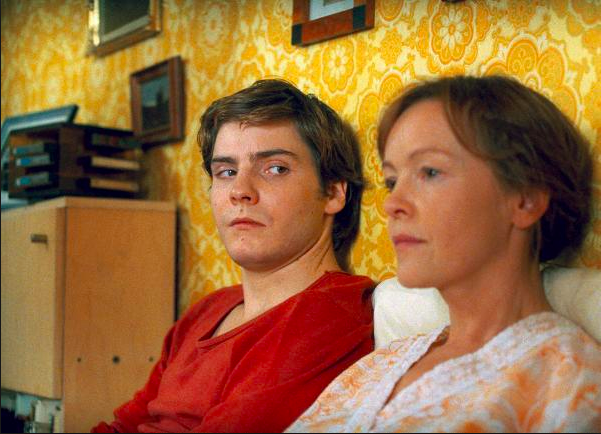
Goodbye, Lenin! is a testament to how film can be creatively harnessed to encapsulate significant historical and political events in our current world in a way that both entertains its viewers, as well as reminds us of the significance and impact said events had on the people who lived through it – a balance of which, I believe, the film did perfectly.
Goodbye, Lenin! Was a film quite obviously premised on a tragedy, placed in the context of a major world event that wracked ambivalence on the world, and on the people of Germany. However, despite the films comedic and entertaining sequences that thus succeeded in entertaining its viewers, and that allowed it to be labelled a tragicomedy, it did so without once making light of the actual, tangible consequences wrought about by the fall of the Berlin Wall.
One thing I noticed regarding films depicting major world events is the tendency to focus on human relationships, thus in a sense providing a more intimate perspective and look into global experiences otherwise unfathomable to us. By placing focus on specific relationships between families, lovers, etc., we as viewers are able to empathise with how these people felt. As individuals who are unable to experience these events firsthand, we get a sense of their impact on the people who did experience these events. For individuals watching who were actively present during the transpiration of events, viewing films about them may be a way to relive the experience from another person’s perspective. The impact of centering on specific characters in the context of huge social issues allow for the fathomability of drastic events in world and human history.
The ability and active desire for the film to allow viewer empathy for the characters is a stark contrast from the films prior discussed in the class. The film uses relatable characters to present an otherwise unrelatable scenario. Prior films such as A Woman is a Woman, on the other hand, present generally unreliable or difficult-to-relate to characters acting in regular everyday scenarios. La’Adventura seemed to go out of its way to create an assembly of characters the viewer lacks empathy for. While Goodbye, Lenin! Depicts a rather unique story in the midst of an actual event of our world’s history, the film nonetheless goes out of its way to create characters exhibiting emotions and actions relatable to any human person.
The human need to live in an extended period of temporality is something perhaps we can all relate to – the nostalgia and desire to live in the (presumably) less complicated past is a basic human instinct. The main character represents this to the extreme – hiding the fall of the Berlin Wall from his mother who is unaware of any of these events. The son’s actions are something which can also be attributed to another rather relatable human emotion – love and dedication for one’s mother. The family in the story are reminiscent of not uncommon family dynamics in society – the absentee father, the (rather) wayward sister, etc. All of these constitute aspects of human life we can somehow relate to, thus allowing us to empathise and relate and connect to these characters, as we try to understand why they do what they do in the context of a highly difficult scenario. Despite the fall of the Berlin Wall being the major historical situation depicted from which arise these events in the film’s story, the fall simply served as a means by which to emphasize the actual story – human dynamics, and family and romantic relationships, and human actors in a confluence of relationships, and how these relationships persevere in the context not just of the fall but of any rather disastrous event life humanity has been able to supercede.
Good Bye, Lenin!: Lies Out of Love
 Given the first few films that we watched in this course, Good Bye, Lenin! was the movie that I enjoyed watching the most because it was so much easier to follow and it was more relatable. Having studied the context of history when the film was set, the events were already familiar with how the situation was in Germany at that time and the film was able to incorporate different elements, being a tragicomedy film, to make it even more interesting to watch.
Just by watching the opening sequence, I could already tell that the movie will be about family as the montage of Alex’s family was shown that set the mood and expectations of the viewers. It provided the basic information needed to give a background of the story, which was something that was lacking in the previous films that we watched in the course. After seeing Alex being arrested during a no violence protest, Christiane, Alex’s mother, collapses and falls into a coma. She slept through the different events that happened in Germany such as the fall of the Berlin wall and the transition to a capitalist society. Being an activist herself, she wakes up still fatally ill as any form of excitement or heightened emotions can be dangerous for her. Alex goes as far as watching old news to hide what was actually happening and it was touching for me to see the extents that Alex was willing to go to just to keep her mother safe. Despite trying hard to hide the truth, Christiane finds out about the truth and even reveals the truth about their father.
The film revolves around Alex’s love for her mother, making sure that from her mother’s perspective, nothing has changed. The plot itself was very interesting for me as it shows the situation in Germany from the perspective of Alex’s family given their mother’s situation. It speaks of the untold stories that might happen in times of crisis that is not usually tackled in films since most give importance to the events themselves. It also showcases a part of their culture of still giving importance to family given everything that was happening in their country. The film tackles a lot of aspects and also showcases the development and the struggles that the characters went through. For instance, Ariane, Alex’s sister, always longed to see her father, who abandoned them. Her conflict is somehow resolved as Christiane reveals the truth about the father, which was ironic as she reveals the truth after she figures out what was actually happening in Germany.
What I also liked about the film was the comedic aspect that was incorporated—from Alex’s search for the pickle jars and the fake telecasts made by Alex’s friend. These details also reflect the reality of capitalism in Germany and how even Alex was longing for things to go back to how they were before. Overall, the film was very enjoyable and touching, unlike the confusion and frustration that the previous films made viewers feel.
Good Bye, Lenin!: Hello Entertainment.
Maaaaaaan, this movie is by far the most entertaining movie we’ve watched in class so far, let me explain…
So the movie itself had a lot of comedic elements, which is why it made this movie the most entertaining movie we’ve watched in class so far. There were a lot of jokes that dealt with the time period that the movie is set in, that being right after the fall of the Berlin Wall with the reunification of East and West Germany. My favorite joke was when the mother saw an ad for Coca-Cola being put up in the building across from theirs. It was particularly funny because Coca-Cola was a symbol of Capitalism and the West, but the mom was a firm believer in socialism and East Germany.
Although the joke was funny to me, I think it was only because I understood the context of what was going on. Many of the jokes required some sort of knowledge of what was going on in the world at the time. The assumptions of the writers relied heavily on a learning curve that the audience had to adjust to. That learning curve being that the audience knows the background of the film, like what was going on in the world at that time.
I’m not faulting the writers too much because the film was released in 2003, about 14 years after the fall of the Berlin Wall. So at the the time fo the release, the main target audience would’ve been alive to witness it happen. For future viewers of Good Bye, Lenin!, need to have prior knowledge of the background in order to enjoy it fully. Since the film doesn’t age too well, but that didn’t stop me from enjoying it.
L’Avventura: Sandro’s Toxic Masculinity
The film was very artistic in the way that the scenes made use of beautiful images. The film was also black and white, which added to the dramatic effect of the film.


It can also be said that the film can teach its viewers a lesson or two about life. First and foremost, closure is important. The film starts by showing the love story of Sandro and Anna. But then, Anna goes missing. In Sandro and Claudia’s (Anna’s best friend) attempts to find her, they fall into a love affair with each other and somehow forget that Anna is missing. This made me feel so uneasy and uncomfortable the whole time because I was just waiting for Anna to reappear again or maybe for the characters to talk about her again because it felt like the character and the situation just suddenly vanished. Had they given the viewers some kind of explanation as to how Anna disappeared and suggestions that they would not continue the quest for her anymore, then maybe I would have enjoyed the movie more. But, this teaches us that we don’t get everything we want and are expecting. Just like in real life, there are some things that we just do not know the answer to. Some mysteries remain mysteries until the end of time.

For me, the movie reflects toxic masculinity. I was bothered by the way Sandro just kept changing partners not long after his lover went missing. The image where Sandro was sitting down on the bench while the woman was standing up beside him when it was clear that they could both be sitting down on the spacious bench, shows that men are superior over women in the film. There was no sign of chivalry at all. Sandro played with women and used them as a distraction for Anna’s disappearance. Sandro gave up searching for his supposed significant other. He lost interest and patience so quickly in finding her. It may be sad to say that Sandro reflects an aspect of our life that we cannot control. Sometimes, we lose interest and passion in something that we thought we’d always love forever. Sandro proves that for some people, it is very easy to replace relationships and find new things to care for. Sandro proves that in a relationship between two people, there is always someone who gives more and receives more. In the movie, it seems like Sandro was the one who took Anna for granted, maybe that’s why she chose to disappear.
The only thing that I like about the movie is that it teaches us to learn how to move on and be comfortable with being uncomfortable. It is inevitable that there are questions that we would never know the answers to no matter how hard we try. I also learned that there are some irrational and unreasonable people who we will encounter in our life, but it’s best to accept this because life goes on. Some people try to be unapologetic because they think it’s okay to broken, since everyone is broken in their own way anyway. But personally, I think we should avoid the likes of Sandro. We must always try to be the best versions of ourselves and face life with a deep sense of ownership and responsibility.
Leaving Comfort, Embracing Change

Charming and poignant, Wolfgang Becker’s 2003 film, Good Bye, Lenin! showcased messages straight to the point. Lenin is reference to Vladimir Lenin, a revolutionary having been the leader of the world’s first communist state and who, therefore, represents socialism. In face value, the film revolves around Alex Kerner in his attempt to keep the fall of the GDR a secret from his socialist mother, Christiane Kerner, for as long as possible. This is with knowing that the slightest shock would cause a heart attack for Christiane, which could prove fatal for her health. This, however, becomes a problem when Christiane starts to feel better and proves herself able to get up and roam around again. However, digging a bit deeper and in my interpretation, Good Bye, Lenin! mainly revolves around how while older “East” Germans resist the change as they try to grasp on the memories of the past and the remnants of the socialist society they had before the fall of the Berlin wall, while the youth lets go of communism in “East Germany” and embraces capitalism.
Out of the five unconventional and uniquely-styled films that we have watched until the next, I could say that I liked watching Good Bye, Lenin! most. This is not to say that I had enjoyed it the most, as it is without question that that is A Woman is A Woman. But with Good Bye, Lenin!, I was familiar with the way the plot was designed and, therefore, comfortable with watching it. Good Bye, Lenin! focuses on embracing change, trying new things and experiences, and leaving our comfort zones. However, given that, I found that there is an irony in watching it, because, on one hand, the kind of film that Good Bye, Lenin! is is what I am comfortable watching – mainly due to its contemporariness in effects, dramatics, and plot. On the other hand, the films that we have watched beforehand, with regard to their uniqueness in plots and differences in cinematic styles, gave us a chance to embrace the wide range of films that the film industry, specifically the European film industry, has, with regard to the differences in decades and geography, and, thus, culture. In other words, due to the familiarity of Good Bye, Lenin!, as compared to the films we have watched beforehand, I can say that I was in my comfort zone when I was watching it whereas I was able to embrace changes in film aspects from the other four, which is really ironic, as Good Bye, Lenin! emphasizes how one steps out of his/her comfort zone.
Conclusively, for me, it felt comforting to watch Good Bye, Lenin!, because contemporary films usually portray subtle dramatics and would tend to lean towards comedic dramatizations. Furthermore, it is a common theme in 2000’s films to exhibit characters with difficulties in grasping change and would tend to showcase the lingering nostalgia (which in the film, specifically, is nostalgia for the “East Germany” that no longer exists). This is also relatable in real life, as some people who have been used to living in conservative societies would tend to be like the adult characters shown in the film – unaccepting and radically forcing conservatism, something most, especially the youth, feels constricted with.
 European Film (2019)