Holy Motors: So Which Parts Made Sense?

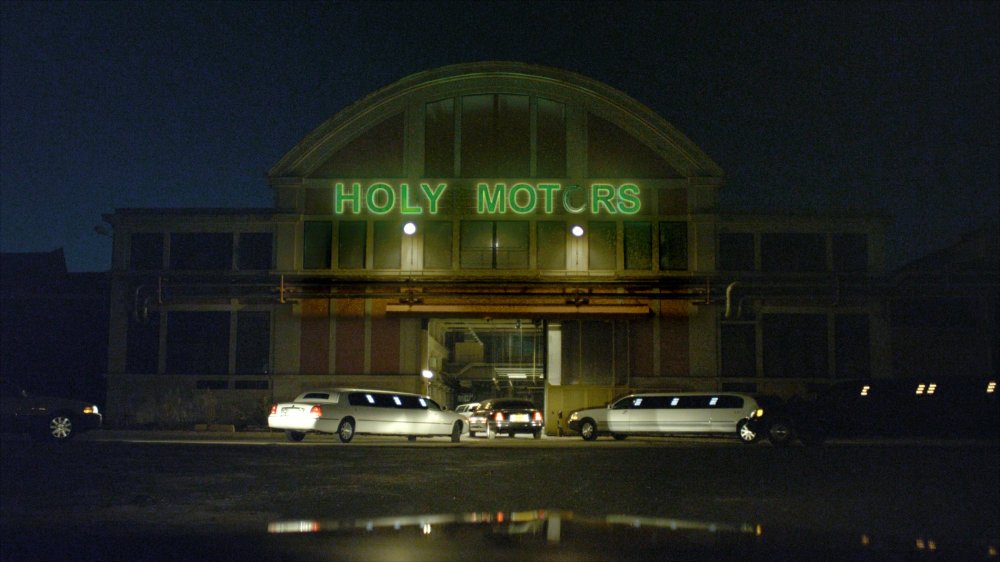
Image result for holy motorsAfter a quick break from the confusing and unusual movies that we watched in the course through Goodbye Lenin!, we are back to the strange and challenging movies but on a whole other level through Leos Carax’s Holy Motors. Looking at the film itself, it was very hard to comprehend. It was different and frustrating, but it was not boring at all because of how it is animated and constructed. Instead of the usual reaction to a movie wherein you ask questions about what you do not understand after watching it, I found myself focusing on the few things that I understood and made sense of. Although confusing, I quickly realized that the film’s focus was not about understanding the movie. It did not have a classical narrative and instead, it focused on the experience and the reactions of watching the movie.

Focusing on the character of Oscar, who goes through different appointments throughout the day, portraying different roles that really showed his commitment to what he was doing. I found myself intrigued after each role and portrayal as it seemed like a completely different person every time he went out of the limousine. As his job was to completely replicate the character depicted in the envelopes for his appointments, it was amusing to see how he was so passionate but at the same time, it seemed as though he was also getting tired from the different roles that he had to play. At the end of the movie, it seemed as though his real identity was never shown since the scenes that seemed realistic such as when he picked up his daughter from the party, was also part of his acting.

One of the interesting things that I the structure of the film was somehow operatic. The use of music was also intriguing for me such as when Kylie Minogue’s character suddenly sang and when Oscar played the accordion with a bunch of random people that appeared out of nowhere in a church. These sequences did not seem to have a connection but it still worked. After the film, I also had a lot of questions because of the inconsistencies that were presented. One of the things that the film portrayed was how death seemed reversible in how Oscar was suddenly cured whenever the scene cuts back to the limousine. However, Kylie Minogue’s character who also had the same job as him seemed to be dead when she jumped off the building—so was she really dead?

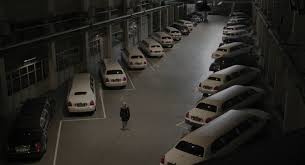
There were a lot of things that I completely do not understand about the movie—why the limousines were talking at the end of the movie, why the family that he went home to at the end of the film were chimpanzees, what his actual job was and why some of the characters that he interacted with were also doing the same job, and a lot more. This made me reflect on what the movie was really intended for and that it was simply for the pure sense of gesture. Despite the movie not being clear and coherent, I still found myself appreciating Holy Motors for how it was. As a fan of videography and cinematography, I appreciated how the movie was shot and it was definitely visually appealing. The film tackles the different roles that we have to play as a part of our life and how we present ourselves vary depending on the different situations that we find ourselves in. Watching Holy Motors was a completely different viewing experience to say the least, but it really shows the complexity of cinema, art, and creativity.
Holy Motors: a Metaphor of Life

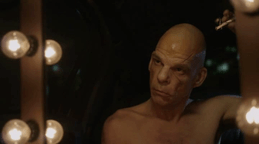
260px-Holy_MotorsTo say that Leos Carax’s film, Holy Motors, is a very memorable movie to watch is quite an understatement. I found myself still reflecting on the movie minutes before I went to sleep. The movie is truly a unique one. Of course, as all European films we have watched in class, the movie was weird and confusing. Despite my confusion, I enjoyed watching the film. The movie was marvelous, vibrant, witty, different, and puzzling. Personally, there was not a dragging moment. I was always looking forward to the next role he would play every time he gets in the limousine.
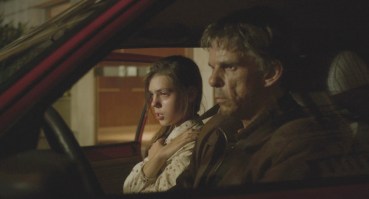
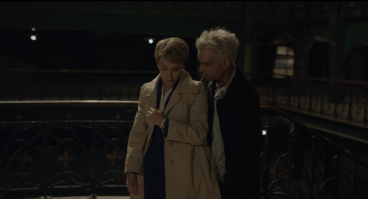
2029023565Screen-Shot-2012-10-22-at-3.42.06-PMI felt excited for every role that he had to play. I want to be an actor myself once I step out of college, but if to be an actor means that I’ll be subjected to terrifying roles that involve biting a production assistant’s fingers off, among others, I think I would rather not work at all. But if it means that I get to live in Paris as well and be driven around in a white limousine, then maybe I’ll think about it. All jokes aside, Monsieur Oscar had a really challenging job. He proves that to be an actor in his world, one must really have the passion and the guts for it. It must really be tiring to pretend to be someone who you are not every day of your life. I think this poses a threat to one’s identity, especially in the film, where it felt like Oscar did not have a real identity. I wasn’t able to distinguish right away whether he was playing a role or being his real self. For example, I thought that was his real identity when he picked up his daughter from the party. It turns out he was also just acting in that scene. I was also confused when he saw his lover, if they were really acting or not. Above all, I was confused by how the limousines started talking at the end of the movie.

the-woods1

images

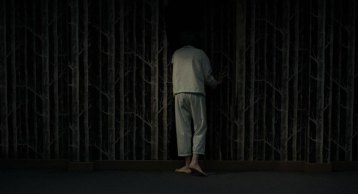
The movie is a work of art. Even more so because many of the scenes in the movie are references to other works of art. For example, the scene wherein Carax opened a door in his bedroom which looked like a dense forest was a reference to Dante’s Inferno. Meanwhile, the scene where the limousines started talking to one another was a reference to Pixar’s Cars. The film used cinema as a metaphor for the journey of life. And it can be said that watching the movie immersed us into Carax’s movie-educated-eyes, his journey on filmmaking and using other films as inspiration (French, 2012).

Given that the movie was used as a metaphor for the journey of life made me realize that playing different roles and having different tasks to complete every single day really do reflect life. Our daily routines and the choices we make reflect our identity—our purpose. Despite the many challenges that we face, like Oscar slowly losing his passion for acting, we must always remind ourselves to keep true to our goal. We may have to play different roles, one by one, to bring us to the ultimate role that we want to play in our life. I can only imagine that Oscar is working as an actor and doing all those silly, mind-boggling, roles so that he can be the father that he wants to be and to provide for his real family.

French, P. (2012). Holy Motors – review. Retrieved from: https://www.theguardian.com/film/2012/sep/30/holy-motors-philip-french-review


Pretention and Reality

Starring Denis Lavant and Edith Scob, Leos Carax’ 2012 French-German fantasy drama film, Holy Motors, encompasses the blurred line between fiction and reality. For me, Holy Motors was a strange yet fascinating film to watch. At first, I was confused with why his job revolved around “impersonating” different characters and “freeing” these characters into the real world, where they become real and act like how they act. For instance, the weired imp he portrayed bit the finger of a producer’s assistant and kidnapped the model the media group was taking pictures of. At first, I thought it was a publicity stunt –  that Oscar was paid to create a scandal for publicity purposes of the media group. I also thought it was weird that the model he “kidnapped” did what he wanted her to do, but as I rationalized it, I thought that maybe she was scared of not following him or whatnot. However, going through the film, especially until Oscar’s boss appeared in his limousine, I realized that Oscar’s job is really to create a “reality” that people would believe in – although as his boss stated, people are starting to stop believing in their acts. Furthermore, their “gigs” were appointments, which in that moment started implying to the viewers that they were scheduled and that anything out of that timeframe did not consists of dramatics. This is where I thought it was unscripted or not pre-determined. When Oscar saw Eva when their limousines accidentally bumped into each other as they were going to their next appointments, I thought what they had was candid and real – they even talked about their next “appointments” and their child together. However, when Eva seemingly jumped with her “partner” and Oscar saw it, I realized that what was portrayed in the film about the two were, in fact, also fake – much like everything else. This leaves me to attach myself to the family that Oscar seemingly had at the start of the movie, hoping that he would go back to his “real” family, as I thought.

The film started with Oscar seemingly leaving his family and their big house to go to work. We could hear his child telling him, “Have fun! Work hard!” as he goes to his fancy limousine, with his driver waiting for him. As part of the audience, the said scene became my anchor throughout the film. For about two hours, I was awaiting for the moment he goes home to said family, from his strange work that seemed so weird and fascinating for me. I was waiting for the moment he would have that normalcy that I thought he had with his family. Imagine my surprise at the end of the film when he was appointed to another family – chimpanzees as his daughter and his wife in fact – implying that the family he had at the start of the film was also fake!

Conclusively, Holy Motors (for me) mainly focused on its existentialistic art by blurring the lines between real and fake. The actors do not have normal, stable lives, portraying different people with different lives in one day. They don’t have real families – or any physical and emotional connection to the world, really. The only thing they have connections with is their passion for their dramatics, which portrays anti-sentimentality in anything. In Holy Motors, nothing was ever as it seems. Heck, even the limousines were alive at the end of the film. However, I thought the limousine was very fascinating, and although it was as confusing as the other ones (with the exclusion of Good Bye, Lenin!), I can honestly say that I like this the best as of now – more than I liked A Woman is A Woman.

“And if there’s no more beholder?”: Holy Motors (2012)

dir. Leos Carax

Holy Motors is a movie that made me realize how much of cinema there really is that I haven’t seen. I consider myself a bit of a cinephile, albeit not having seen all of the ‘essentials’, on the basis that I watch more movies than the casual viewer. I’d like to think that I’ve seen some of the best that the industry has to offer, but Holy Motors has somehow destroyed that way of thinking. I knew even back then that there’s still so much that I have to learn when it comes to movies (that’s why I’m in this class in the first place), but now it feels like I have to go back to the very start.

The movie opens with a surreal dreamlike sequence. The director, starring in his own movie just for this one scene and making it somewhat meta, uses his fingers as a key and opens a passageway that leads to a movie theatre. He stumbles slowly inside and sees a black and white film projected onscreen. throughout the ongoing action and the loud sounds coming from the projector, a shot of the audience reveals that they have their eyes closed. We then move forward with the actual story.

There doesn’t seem to be a clear goal in terms of Holy Motors’ narrative. We have Monsieur Oscar, played by Denis Lavant, who bounces from one appointment to another in order to fulfill several roles in short periods of time. It’s most definitely an acting exercise for the lead actor.

We don’t know who these performances are for because as far as we know, he just does them. Seemingly, he starts off that day as a rich man playing the role of monsters. However as the movie ends and he goes home to a household comprised of monkeys, we wonder whether he has any identity at all.

“It’s you?”

“I think so.”

I do agree with the sentiment that there is a performative element even in being ourselves. This movie, for me, talks about how we perform in different relationships. There is the tendency to project a different version of yourself to every person you meet, even if you don’t notice it. After all, we’re all just simply playing a role in other people’s lives. But is it possible to become a slave to these interactions? To move from one relationship to the next, one identity to another, to the point that we don’t fully understand who we actually are?

This movie has no answers. Only talking limousines.

Even though the movie was apparently written within the span of two weeks, it conveys an interesting premise combined with amazing in universe details. For example, the URLS on the tombstones are subtle but definitely add to the world building. It was also really nice to hear Kylie Minogue’s music blasting in a party, only to find out later on that she has a musical part in the movie. Apart from having a song, the movie also has a musical intermission, dramatic performances, crazy action-esque sequences, horror elements, and a bunch of other weird stuff combined in a way that is coherent and not jarring at all, which truly makes the film a masterful genre-mix of a movie.

It’s a fascinating film to watch but I wouldn’t say that it’s for everyone. It can be seen as too arthouse, even going as far as bordering pretentious, which might make it hard for some people to fully enjoy it. I personally thought it was interesting but it’s not exactly something I would want to revisit. Just as Monsieur Oscar keeps moving forward with his appointments, I’d like to move on to the next movie and leave this one behind.

“The beauty, they say, is in the eye of the beholder.”

“And if there’s no more beholder?”

Mysterious

Holy motors was a strange film for me. Mr. Oscar, the main character at first seemed to be a legit businessman or politician at first, especially when he entered into a limousine in his business suit or talked about guns and security guards. However, I would be wrong and it was clearly a deception because he would then shift into various strange roles that had no connections with one another. First it was a lady that begs on the streets and next it was a virtual auditorium where he acted as something unusual and engaged in a sex scene with an actress, and so on. It was evident that character development is not really placed in focus as characters are static all throughout. For the case of Mr. Oscar, his motives and reasons for doing such acts is not really clear, as it only goes as far as saying that he does it for the “beauty of the act”. However, these acts may seem to even go over the line. In one scenario, he would bite off a finger of a lady, while acting as a really ugly man that wanted to wreck havoc. Things also got bloody when he acted as a gangster and stabbed a bald man that looked like him. In this scene, he also gets stabbed. The character of Eva Mendes also gives a strange feeling, as she does not react hysterically towards the actions of Me. Oscar, despite the chaos he brought. She also does not react violently when he bites her hair off, eats some bills, strips naked, or even licks her body. I found this scene quite disgusting, because even if he was really just acting for the “appointment”, I believe it was taken too far and no one was even watching anymore. 

Because of his altering roles, his identity was never really clear and we only seem to know him as Mr. Oscar and he has a limousine and driver who brings him to his “appointments” which are located in different areas that require him to be in different roles. His limousine is also stashed with various costumes that allow him to fulfill his roles successfully. Another glimpse of his true identity came when he fetched his daughter from the party. As a father, he supported his daughter making friends and going dancing. However, he would be disappointed as his daughter did not engage with the people and hid in the bathroom instead, claiming that her friend Sonia is the one who had the attention of the boys. Furthermore, she believes she is also unattractive and manifests the same traits as her father. Mr. Oscar was disappointed and brought his daughter home as he continues to fulfill his remaining appointments. In some sense, I also get the feeling that Mr. Oscar is not in touch anymore with reality. Given that, he has performed various roles, it is possible that he is simply feeding an illusion that he is an actor. Overall, it was an odd film that wanted to showcase acting skills. 

Holy F***

Holy Motors (2012, Leos Carax)

Pardon the frankness of the title, but that is precisely what I felt all-throughout Holy Motors’ two-hour runtime. From start to finish.

I honestly don’t even know where to begin with this film. But if I had to talk about it, it’s that it is an anthology film where the framing device is one man taking a limo from segment to segment and transforming himself along the way. And yet it is not an anthology since most anthology films have different collaborators and style in each segment, but this film manages to maintain a consistent tone and feel through all of these segments.

I guess since the film has this form of structure then it’s fair to say that like the film, this entry is less about understanding and explaining the film and more of reacting to it. Some of the segments that occur are morbidly funny (one where he transforms himself into a savage being with no control and an appetite for destruction and another one where he murders a man only to be stabbed himself), some of the segments are just plain weird (one where he puts on a motion capture suit and performs stunts for an unseen director and the ending where he goes home to a family of monkeys), and some are actually beautiful and touching (one where he is an old man on his deathbed, one where he breaks out into a trumpet orchestra, and one where he seemingly drops his character and meets with a woman played by Kylie Minogue).

After finishing the film, I was just looking around in disbelief with what I just watched. And yet, somehow, after a few days of the film marinating into my mind, I can somehow admit that the film was an enjoyable experience. It’s nothing I would want to go through again, but as a form of showing what cinema can do, you can really do no wrong with Holy Motors. This is a film about filmmaking in this class that shows its power and range as a medium much much better than The Five Obstructions, and it almost sends a message of how with film, you can truly do anything you want. Creativity has no bounds, so why should film?

confusion and curiosity

If last week’s film, Good Bye, Lenin!, was an example of how great films don’t need to be difficult to watch, then Holy Motors is its antithesis. Leos Caprax’s Holy Motors was, and I seem to keep saying this after almost every movie we’ve watch in this course, one of the weirdest films I have ever seen. This mainly came from the film’s difficulty to understand. I found myself feeling confused and even grossed out at some point, yet none of that stopped me from watching. It was a movie that knew just how to disturb its audience while still leaving them wondering what each scene meant and what will happen next.

Holy Motors follows a man named Oscar as he goes about what the audience can assume to be a day in his life as an “actor”. He has nine appointments for the day, which entails him to use an insane amount of make-up, props, and full-on identity and personality changes. As he goes through the appointments, they start getting weirder and weirder, from an old lady, to having simulated alien sex, to dismembering, to killing, and to even dying (but also, never actually dying).

Each story simply had no basis or end—they were kept unexplained, leaving the audience in the aforementioned confusion and curiosity. I was left with so many questions, was the scene with the “daughter” just another appointment? Or was it his real life breaking in between scenes? Why did Oscar kill that random guy in the café? Why did he never die amidst getting shot at multiple times? All of these, and more, led me to start second-guessing everything in the film. I started to construct my own theories and explanations that would try to remotely answer these queries, like maybe just like the actors of characters who die in scenes, the actors in this reality (like Oscar) are never harmed.

Acting and performance plays a main role in the film. Very simply, Holy Motors is about an actor acting without any cameras around. The whole story, especially that of Oscar’s, is a symbol for the crazy life that actors lead. It presents a case of how they can get lost in their own characters, they become their characters. Whether this is good or bad is answered by whether the viewer chooses to look at the film as a prime example of commitment or as a case in point of going crazy. The world in which these people live in shows how the lines between reality and entertainment are so blurred that only a select people seem to know what’s going on.

More than anything, this film presents performance as an art and as beauty. It’s intriguing and captivating, but you’ll never know what it’s truly about. Just when you think you start to understand, you’re faced with a new sequence that you’re left dumfounded with.