A Look on Plot, Cinematography: The Experience that is the L’Avventura

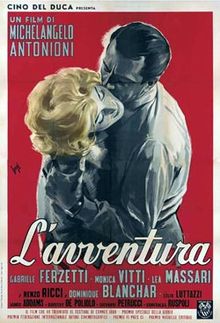
220px-L'avventuraSmall.jpgLooking at merely the first arc of the film—from the introduction of the characters, the wealthy upbringing, the passion shared by the characters, to the unexpected and mysterious loss of the seemingly primed major character Anna—it was beginning to look like any other film, since creating a conflict which would presumably be the center of the story. It is not the case in L’Avventura, however. The film is not about the search for a mysteriously missing woman. It is about the adventure.

The film does not follow the typical or the norm with a well-made and seamless flow of scenes in a plot. Somehow, I am also compelled to say that the film does not even feel like the normal films. Looking at how the Michaelangelo Antonioni picked the angles of the scenes and the noticeably zoomed-in frames, hearing the obvious candid sounds, realizing the obvious unsystematic plot, and noticing the blatant vibe that everything seems to be fake, the film was really less about the story, maybe a little bit about the character, but it is mostly about the experience of watching. Because only through experiencing the film on a deeper level would I be able to make sense of the characters and the unconventional plot.

I can vividly remember one of the first scenes where the camera was angled at the back of the car, as if I—the viewer, the spectator—was there along with them, on a journey. After the more than 2-hour ride of watching the film, I was drained and empty.

The experience allowed us to be in the awareness of the characters and their struggles, thus tiring. The dialogue and the different frames and actions in the film showcased how the characters seem to be problematic in a lot of different ways. They were not convincing in a sense that they could not embrace their full characters, showing hints of conflict brewing up internally.

Sandro, for example, faces the conflict of being Anna’s lover but he had troubles satisfying his sexual needs at the time when Anna was missing. His persona, being the missing woman’s lover, was challenged in the process. Eventually, somehow he has managed to lose the side of his character being Anna’s lover in a certain sense, confirming that his character shows no insistence or strength to fully embrace the character. In the case of Claudia, she faces an identity crisis throughout the film. From the beginning, she has always stayed by the side of Anna. And, this was somehow challenged when Anna was gone. There was struggle as to who she would be, and she manages to lose her own and mirror Anna instead. This is seen in numerous instances—the clothes and all. They were unconvincing, as if they themselves want to leave their own characters, which is a possibility given their backgrounds. This could explain how they sort of want an escape from a seemingly socio-political structure that they are boxed in.

Ultimately, L’Avventura shows manifestations of a truly innovative and visionary film. It was not like any film that I have seen. Sometimes though I feel as if there is a misalignment of what the intent of some scenes are to their overall effect. There was not a story being developed in the story, instead the film dug deeper into characters and into the setting through the unusual, blatant, somehow candid sounds and through the angles showcasing the landscapes and the zoomed-in faces of the characters.

L’Avventura is indeed tiring, probably to most or to a lot of spectators. It is exhausting for the mind, for the typical viewer who tries to think, who tries to connect the different scenes into one cohesive story arc that makes sense. But, it is not the intent of the film to narrate a typical storyboard that followed the normal paradigm. The film is designed to catch your attention, to capture your senses—your sight, your hearing, so that somehow you would feel and you would be part of, as the title of the film goes, the adventure. Though tiring and exhausting, it was indeed an adventure that was one of a kind.
L’Avventura: Emotions in an Existential World

Brooding and Self-pitying, Michaelangelo Antonioni’s 1960’s film, L’Avventura, showcases the uneasy reality of civilized love in an Existential world. At first, one might think that the film would revolve around Anna, Sandro’s suddenly-missing fiance, as she goes missing and the characters try their best to find her and, in doing that, unintentionally starts drama and have realizations about Anna’s true character and intentions – much like in Gone Girl and Pretty Little Liars. However, a dig deeper in the film, especially as it progresses, makes the audience realize that the film dedicates itself to revealing gender politics, especially in Italian 1960’s, and the inner loneliness and turmoil that the characters have as they find their places in discovering meaning from their empty lives. At first, it was confusing why, in some parts of the film, the characters would randomly do things that would get others’ attention. For instance, Anna makes up a story that a shark was swimming near them, consequently forcing everyone to panic and go back to their boat. However, when she was asked by Claudia why she did that, she merely shrugs and says, “Because.” There was also an instance when Sandro intentionally ruins an art piece by spilling ink all over it. This caused the young artist to get mad at him and tries to pick a fight with him, with Sandro nonchalantly saying, “Why would I do that?” In persepective, they may have done these “random,” mischievious actions, because, as stated before, in their dull, meaningless, and lonely lives, maybe they wanted some spice and excitement in their lonely, bleak lives.  

The film would also exhibit men in different life stages. There was the 17-year-old prince who paints nothing other than nude pictures of women, Sandro, a romantic marrying-age man, Giovanni, a married man who ignores his wife, Anna’s father, a retired diplomat, and unforgettably, the hordes of men that tend to flock over pretty women like Claudia and the woman who had a rip in the hem of her skirt. A common denominator on most of these men is their exhibition of lust and their desire to find the “ideal” partner. This is with the exeption on Anna’s retired father, who’s now sole focus is his daughter. However, again with the exception of Anna’s father, the depiction of these men with their active libido may have foreshadowed what Sandro did in the last part of the film. Furthermore, Sandro’s advances with Claudia was a red flag. For one, he is technically still engaged to Anna even though she is missing. Second, his advances show that he may have already forgotten about Anna, despite him telling Claudia that he did love Anna. This may indicate that Sandro may have not loved Anna anymore even when Anna was not yet missing — or he did not love her at all, especially when he begrudgingly told Anna that he was marrying her. Furthermore, his quick pace of moving on from Anna with Claudia, as well as his nonchalantness with the affair may indicate that he had already done it before, especially since he and Anna only saw each other every couple of months. This is why it was not surprising when he was revealed to have cheated on Claudia after the party — even though Claudia was surprised about it.

What frustrated me, however, was how the women in the film were controlled by their emotions. Although she initially tried to ignore it, Claudia eventually started a full-blown affair with Sandro. Furthermore, although at the start of the film, she was hell-bent on finding Anna, the latter part of the film portrayed how Claudia did not want Anna to be found anymore as she was scared that Sandro would leave her for his unofficial former lover. Moreover, when Claudia found out that Sandro cheated on her, she was distraught — one would even think she would end their relationship once Sandro caught up with her. However, when Claudia saw a weeping Sandro, she caressed his back as if saying that she forgives him. This can be seen as idealistic, as it usually happens in real life – people cheat, and their partners usually forgive them when they show emotions. This, however, portrays how Claudia can be swept by emotions, neglecting the reason regarding the events that had occurred. Giulia was also swept by her emotions. In her loneliness and frustration from being ignored by her husband, she slept with the 17-year-old prince.

Conclusively, L’Avventura is a lot of things, but overall, it is a film that depicts the loneliness and bleakness of the life of characters, however rich the characters may be, as they struggle to achieve the “ideal” life, mostly through romance. I would say that I liked the film, however, it morally disturbed me through its dramatics and its characters’ lack of values due to the shallowness of their lifestyles—which I think is what it is trying to achieve.

“How long will they last?”: L’Avventura (1960)

dir. Michaelangelo Antioni

“Who needs beautiful things now, Claudia? How long will they last?”

From the waves crashing violently against the rocks of a secluded island to the lavishly decorated halls of an Italian hotel, cinematographer Aldo Scavarda paints a picture of loneliness and ennui that reflects the inner turmoil of L’Avventura’s characters. Antioni has a great way of staging two of his characters in which one of them is far off and another one walks into the shot, creating a sense of depth that somehow makes it seem like these people are being swallowed by their surroundings. They’re visually beautiful and yet they still feel empty.

Entitled L’Avventura or The Adventure, I was fooled into thinking that this would be a Gone Girl-esque thriller in which the characters slowly uncover the truth behind Anna’s disappearance. From the very beginning, she is presented as an enigma. She’s indecisive, brash, and does everything out of whim. We focus on her when in reality, this story is about everyone else.

The adventure here isn’t about finding Anna, it’s about these characters looking for the next new thing that would pique their interest. None of them are fully satisfied. Their lives are empty and meaningless. Anna makes up a story about a shark that worries her companions. For what reason? She shrugs, “Because”. Sandro finds a stranger’s artwork and ruins it with ink. When duly accused of doing it deliberately, he’s nonchalant about it, “Why would I do that?”. In the span of 3 days after Anna’s disappearance, Sandro claims to be in love with her best friend as he slowly loses motivation to find her. Just like an ancient vase, possibly priceless, shattered with no care at all. It’s interesting until it’s gone, and they move on.

Interest is fleeting, just like everything else. All those empty buildings. That cemetery. Nothing is forever and these characters can only hope to find something that would give their lives a semblance of meaning, even just for a moment in time.

“I don’t feel you anymore.”

I really wish that I liked this movie more than I actually did. I love that it’s shot beautifully and I appreciate the story that it’s trying to convey. I think the mood that this movie has captured the feeling of ennui perfectly. However, I felt so detached to the plot and the characters that I had a hard time fully enjoying it as I was watching.

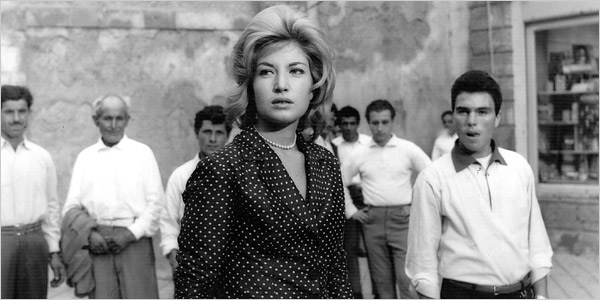
I was also very uncomfortable with the way this film treats its female characters, although that may be the point. They’re strong in their own right but it doesn’t seem to be enough as the men constantly belittle them. Giulia is often ridiculed by her husband which leads her to basking in the attention of a 17-year old boy. Anna’s worries are dismissed by her father and her fiancé, and altogether forgotten. This might just be an assumption but there’s a scene in this movie which I think inspired a scene from another Italian movie: Giuseppe Tornatore’s Malena (2000). Claudia waits for Sandro outside of a shop where he asks for information on Anna and immediately, a great deal of men unabashedly gawk at her, overwhelming her until she runs away. My best guess is that Antioni is trying to show these women as objects of interest as well, something that men get tired of and discard, judging by the scenes of the cheating chemist and his wife. Whatever it is, I feel like I’m missing something which I might get on a rewatch but for now, I don’t fully understand why this is necessary to the movie’s thesis.

This doesn’t mean that I’m giving up on Antioni’s films. Blow-Up (1966), which seems to be one of his most popular, has been in my watchlist for the longest time and I’m excited to see how his style translates to this murder mystery.


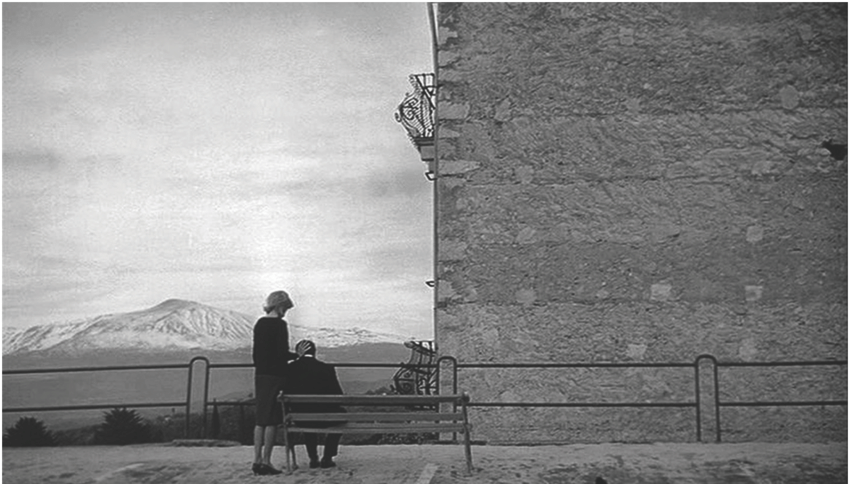
The ending is hauntingly beautiful. Sandro weeps on a bench as Claudia looks to the sea. They’re both tired. Gently, she reaches towards him and caresses his hair. As far as they’re concerned, nothing is alright but they seem to have made their peace with it.

“Everything is becoming hideously simple.”

Viva L’Avventura

L’Avventura (d. Michelangelo Antonioni, 1960)

Prior to watching the film, I remember being warned in class that L’Avventura was going to be one of the more so-called ‘pretentious’ European movies. And admittedly, when I first started the film, I was instantly intimidated by its lengthy runtime. However, two hours later, I was pretty much surprised that I had just sat through a nearly two and a half hour film without breaking a sweat and it felt like it just flew past by. This is because L’Avventura, more than anything, is almost like a dream watching it. It is black and white, yet the sceneries and environment feel distinctly colorful, there is a central mystery to the plot, and yet the film effortlessly focuses on things outside of the core mystery without the mystery ever feeling truly diminished.

While the plot initially seems to focus on the mysterious (and unexplained) disappearance of Anna, it soon transcends into being a plot about a couple that was unsatisfied with their relationship finding an out. Anna found her ‘out’ by disappearing, and Sandro found his ‘out’ through the form of Claudia, who he ‘falls in love’ with. The reason why ‘falls in love’ is written with a quotation is because the film actually is less of a love story and more of a showcase of dissatisfied people desperately clinging to things in an attempt to find satisfaction. Almost everyone in the film is rich but has nothing substantial to make themselves truly happy. And that is the silent tragedy of the film.

While Sandro may appear to be in love with Anna, the first chance he gets, he ends up going for her best friend Claudia. While Claudia may appear to be fully dedicated to finding Anna, the first chance she gets when she thinks Sandro has found her, she runs away in a panic, conflicted over her dedication to her best friend and her attraction to Sandro. When Sandro appears to want to marry Claudia, she refuses, but then accidentally rings a bell and has a grand time dancing, with Sandro amused at her and the two appearing to be in love. The Sandro-Claudia relationship seems to consist of nothing but mixed messages, and that really sums up the film – it is not only about a mystery unsolved, it is also about a love story that never truly was.

The perfect personification of this central theme of the film is actually its final scene. After everything they’ve been through, Claudia finally confronts her feelings by admitting that she’s afraid should Anna return because it would mean losing Sandro. But despite this supposed mutual attraction, Sandro still decides to check out other women and Claudia even catches him with Gloria Perkins. In shock and sadness, Claudia runs away to cry, and an equally tearful Sandro follows her. In this final scene, both of these characters are crying, both for what may be different reasons. Claudia is crying because she is hurt, and yet she may also be crying upon realizing that this relationship is something that is clearly unfeasible, something that is only useful for the moment and nothing long-term. Sandro is crying not only because he got caught, but because he may have finally realized that no matter what he does, he can never truly be committed to a proper relationship. The closing shot of the film is Anna placing her hand on top of Sandro’s head, both still in tears, as the sight of a beautiful mountain can be seen in the background. This, I believe, is what the movie is showing. There are beautiful sights, there are wonderful auditory noises throughout, but the central core of it, its heart, similar to its main characters, is empty. It is nothing. It never was about love and was always purely about what was convenient and enjoyable short-term.

All-in-all, L’Avventura is a wonderful film. While personally it’s not a film that I would be too keen on seeing again (mainly because of its heavy ending), as it stands it is a beautifully-shot and shockingly realistic view on relationships and the complications they bring.

gone but certainly not forgotten

Of the three films we’ve watched in class, L’Avventura has been my favorite so far. It was a movie that captured the beautiful Italy, with all it’s cobblestone roads, open balconies, and far away towns. The women in the cast looked stylish with their rich Italian dresses, matching perfectly with each character’s personality and background. Unlike Bergman’s Persona, L’Avventura was a film that I think was meant to be filmed in color, showing off the scenes attached with all its emotions. Other than its impressive aesthetics and cinematography, the plot kept me intrigued. When the film started off with the mysterious disappearance of a woman, I was hopeful that it would be as great as the renowned Gone Girl (2014) movie, with the audience trying to unravel the case of whether she had died or simply walked away. It was about halfway through the movie when I realized that it wasn’t about the search for Anna—not entirely. For the most part, L’Avventura was about the egocentric affair of two people and the lavish, yet seemingly predictable, lives of their friends.

After Anna had disappeared on the island, everyone spent all of 3 days searching for her. It wasn’t long until Sandro became enamored by Claudia and kissed her on the boat. But it wasn’t just these two who didn’t seem to care much for Anna’s whereabouts, but their entire group of friends. Each couple too preoccupied with their own problems to even mourn for Anna, instead moving on almost instantly with parties and sex. Claudia was the most concerned, but only until she decided to choose her affair with Sandro over Anna’s life. Halfway through the film, when Sandro and Claudia finally decide to be together, was the start of the decline of the memory of Anna. The film wasn’t about finding Anna anymore. Anna was forgotten. She started to fade into the background, but was still present enough to haunt the two lovers, especially Claudia.

Arguably, Claudia was a romantic at heart, she just wanted to fit in like all her friends, but she was still riddled with guilt. I think Claudia was even jealous of Anna, with the way she waited for Anna and Sandro after they had sex at the start of the movie and when she was trying on the brunette wig. When she finally had Sandro, we can tell how much had changed: “Only a few days ago, only at the thought that Anna might be dead, I felt that I could have died too. Now I won’t even cry. I am afraid she might be alive!” On the other hand, Sandro didn’t even seem to be really bothered by Anna’s disappearance, he was easily distracted and veered away from his mission to find Anna as soon as Claudia arrived. Their moral compasses were unsound, operating mostly on what they thought was love. It’s easy for me to say that both the characters were selfish. Despite this, it was also their characters that made me love the film. Frustration with them shows just how affected I was with the movie, how much I clung to its story, immersed in the experience.

While I’m a sucker for romantic movies where the girl and the guy fall in love with each other against all odds, I knew that this movie was not it. While Anna and Sandro didn’t have a great relationship, I can’t say that Claudia and Sandro did either. They could clearly only be together when they were alone in their bubble, a relationship hinged on physicality—joint together by sex. It was a desperate attempt to be in love and avoid loneliness. L’Avventura was barely a love story, but rather a story of two people too scared to be alone, too scared to face the reality of possibly having lost a friend, and instead they reach out to one another.

The Impact of Loneliness

Image taken from: https://www.researchgate.net/publication/326901082_Soundscape_and_Environmental_Design_Towards_Defining_a_Method/figures?lo=1

L’avventura was a film that I felt tried to paint a picture of the impact of loneliness and the tragedy that comes with it. Ever since the disappearance of Anna, the two lead characters that were mostly affected was her best friend Claudia and her lover Sandro, were placed in a vulnerable position that had no closure. After disappearing without a trace, both seemed to be confused, guilty, and lonely especially when here was no closure to Anna’s disappearance that was quite sudden. I believe that Anna saw no future with her lover, Sandro, so she decides to make an escape. 

Loneliness was key in the film’s storyline, especially when Sandro could not be at peace as he travels all around different cities and asking various people that can help him find Anna. However, it is in this process Sandro starts to fall for Anna’s best friend, Claudia. At first, she is reluctant to saying no but eventually admits she reciprocates Sandro’s feelings for her. I believe that Anna was also feeling this sense of loneliness and grievance towards losing her best friend, given that she really had no one else to run to. 

One of the things I noticed was the position loneliness puts the characters into. In the case of Claudia, she seemed to be very conflicted. It is also worth noting on how she suspected Sandro as one of the strongest factors for Anna to disappear. She cherished her best friend in Anna and grieves her loss. However now that she is gone, she gains a new lover but in the form of Sandro who is Anna’s former lover. When she finally gives in to Sandro, she still thinks about how Sandro still has feelings for Anna instead of loving her. In fact, she loses her bearings when she thought Sandro got back with Anna as she ran to the paint store. Furthermore at the near end of the movie, she actually becomes paranoid. She would want to see Anna again and reunite with her, but then again she would have to give up Sandro as he obviously still has unfinished business with her. On the other hand in the case of Sandro, he misses Anna but this feeling of loneliness actually leads him to have feelings for Claudia. I believe this was really just a matter of her being there as loneliness placed him in such a vulnerable position. This could be seen in how in the party, he was checking out other women as Claudia excused herself since she was already too sleepy. At the end of the movie, Claudia catches Sandro being intimate with Gloria Perkins, who was famous, as Sandro met her while pursuing the missing case of Anna. Claudia runs and Sandro follows her. The movie ends with Sandro crying and Claudia rubbing his head. This is a scene that shows how their actions were influenced by this loneliness and it resulted into nothing but regret and tragedy. Their relationship may have have provided comfort and safe haven from Anna’s disappearance but in the end it was not really the love that marriages were built upon. 

I believe the movie built the relationships sufficiently and it shows how Claudia and Sandro were left to cope with the loss of Anna, prompting them to be in a relationship together as they faced this loss without any form of closure. L’avventura showed how loneliness can disrupt peace and breed regret.