1961

“A Woman is a Woman” was the first French film I’ve ever watched. The style seemed very old, and was nice to observe dated design of this European movie. There were good aspects, as well as bad parts alike to anything in life. While I admittedly was confused while watching majority of this movie, I do have some commentary about my experience watching.

One prominent aspect of the film was that the music was abruptly starting and stopping. It didn’t aid the dialogue very much. It actually almost distracted me from the scenes, which didn’t have very smooth transitions. I’ve never really appreciated the significance of transitions between segments of a film until I watched Angela bicker with Emile and then kiss passionately in a choppy clip immediately after. Besides that, I found the long panning around the room to be uninteresting and dragging, still drawing my attention away from the point of the scene.

On a more positive note, I enjoyed the characters. I understood that Angela was beautiful, desired, and quite dramatic. She was very stubborn as observed in her endless efforts to conceive a baby with her lover, probably boyfriend, Emile. This could also be observed in how she forgave Emile over the phone but wouldn’t admit it. Their comments that were directed to the viewers gave a comedic tone to the film. It was nice that Angela was so lively and sassy, otherwise I might have dozed off during the film. Emile was as Angela described him, clever and handsome. Their silent treatment fight was ironically witty and could be offensive to some. They always seemed to make up, as seen in the awning signal Angela had for Alfred. Speaking of Alfred, I could only describe him as a sort of space cadet. Not very motivated or active minded, but incredibly passionate for Angela. Willing to run into the wall to prove his love for her, who was just stringing him along for her baby.

Putting aside the characters and technical parts of the film, it all did seem very french. The outfits of the civilians were stylish and layered according to weather. Many people had cigarettes, lighting the sticks of strangers, and even smoking indoors as well. In some corners couples would be holding one another in a passionate embrace. There were also many characters that were portrayed as strippers or prostitutes living very normal lives and having very normal relationships. I wonder if this is part of French or European culture. I always thought, not personally, that people with those jobs were looked down upon. I also have to question if it is still acceptable in the present day if it was so in the past. Angela seemed to be confident and actually quite happy. She even denied that job, I’m assuming that it was for her undying love for Emile.

Overall, it was a quite interesting movie to watch. But “A Woman is a Woman” was pretty difficult to watch, and it was easy to forget that it is a musical. I couldn’t tell if they were singing, or it the musical parts were the sound scores coming in and out of the scenes. I liked Angela, Emile, and Alfred. I even liked Angela’s prostitute neighbour that had many customers, she even had a phone. True to the dialogue, you won’t be able to tell if it is a comedy or a tragedy.
A Woman is a Woman Review

My initial reaction to old movies are that they’re conservative and hard to understand. I was also a bit scared to tackle on a European film because all my life I’ve only watched local and Hollywood films. However, after watching a woman is a woman, I would say that I actually enjoyed it more than I expected.

A Woman is a Woman by Godard showcases the power of a woman to get what she wants. Angela is beautiful and charming. She could get any man that she pleases but is dedicated to her partner Emil. Conflict arises when Angela soon realizes that she wants a baby. She tries to convince her partner to have a baby with her but the two quarrel like children over the matter. We can even see how Emil tries to avoid the topic completely while Angela tries to insert it in every conversation. Comedic aspects are used to lighten the mood of more serious issues when Emil rides around the house to avoid sitting down and talking about having a child. Another character worth noting is Alfred. He is head over heels for Angela and constantly begging her to notice him. Although Angela is with Emil, I feel like she always used Alfred as a back up plan. She didn’t have real feelings for him as seen in their conversation in the bar when Alfred says that he loves Angela while Angela says that the only important thing is that you love me (implying that it is one sided but that in this situation, she will never be the one getting hurt, only the one who gains). Angela uses Alfred to make Emil jealous, in the hopes of Emil finally agreeing to have a baby with her. I found it amusing how although Angela and Alfred were constantly bickering at each other in annoyance, they always found a way to go back to each other. In the scene by the stairs where Emil tries to leave the apartment to again avoid confrontation, Angela and Emil find each other back in each other’s arms before they start fighting again. Their relationship is really like a cat and dog fighting but at the same time, they can’t stay away from each other. Perhaps my favorite part in the movie is when Emil and Angela say that they don’t want to talk to each other and end up using books to communicate. Yet another proof that no matter what the situation is, they simply can’t avoid each other completely, their chemistry is too strong. In the end, Emil ends up sleeping with another woman because of his frustration with Angela and Angela ends up sleeping with another man because of her desire to get pregnant. As seen in the ending of the movie, this was a way for Angela to finally get Emil to agree to have a baby with her. She knew that challenging him that much would eventually lead him to agree to what she wants. I would say her methods were definitely deceitful yet it still showcased how she was capable of getting what she desired. A Woman is a Woman is the rightful title of this film because it truly is only a woman who can take matters to her own hands and insist on what she truly wants.

A woman is a woman

The movie “A Woman is a Woman” by Jean-Luc Godard focuses on the main character, Angela and her desire to have a baby. This desire leads to the conflict of the movie which involves her boyfriend Emil, and his best friend Alfred. Although the movie is a comedy, it takes on serious topics and stereotypes of each gender. It shows how society was back then, and the roles each gender played in it, albeit in a light tone.

When I first heard that the movie would be a romance comedy, I began to think about the stereotypical love stories that is shown in our movies today. However, the film goes beyond the conventional love stories that we see in Hollywood and makes fun of stereotypes that would be considered offensive in today’s standards. For starters, in terms of the background of the characters, Angela is quite different from most females we see in romance movies. Her job being a stripper makes her less desirable as compared to women who are portrayed to be princesses, heiresses of rich families, or being in positions which are desirable for men. In addition, Angela’s attitude seems so whimsical compared to most women in movies, she seems to have no driving force as to why she does what she does (in this case, wanting a baby), in fact when asked by her boyfriend as to why she wants a baby, she just responds “Because I want one”.  Another difference the film does compared to today is how Emil, as the boyfriend, reacts to Angela’s request of wanting a baby. In most movies, the guy would try to please the girl or if not, they would try soothe her to make her have a better understanding as to why he is not willing to comply with her request. Emil, however, seem to avoid the question as much as possible, or if not, try to aggravate Angela whenever given the opportunity. He even goes as far as taunting her to have a baby with his best friend or even with a complete stranger.

Although their arguments are portrayed in a comedic way, such as them arguing using books to show their displeasure with one another, they touch on stereotypes that we have created for each gender and show the social expectations that we had set for each gender back then.  For example, in one part of the movie Angela is singing that although she is crazy no man would leave her because she is beautiful, which play into the stereotypes that women only have value because of their face. Or in one part of the movie where Angela states that while women are allowed to avoid questions men are not. Although some of the these stereotypes or norms no longer exist as much today, there are still hints of them in our society. I found this part quite interesting since it shows how movements, such as feminism, have changed the set roles and our views of each gender in modern day society.  

Overall, the movie was quite enjoyable. Although it seems light and comedic for the most parts, it touches on topics which make you reflect on the dialogue. It makes you think about some of the scenes which just seem random and have no context, and makes you wonder if these scenes actually have a deeper meaning, or if is just there to confuse the viewers (similar to how the song of The Beatles “Yellow Submarine” has no meaning and is just to make fun of people thinking too hard on the lyrics of a song).  It is also quite a refreshing take on romance, which, however, left me wondering as to whether the movie truly was a comedy or a tragedy.

Girls Just Want to Have Fun: A Look Into ‘Une Femme Est Une Femme’

“Is this a tragedy or a comedy? Either way it’s a masterpiece,” says Émile Récamier. At first, Une Femme Est Une Femme presents itself to its viewers a seemingly simple and straightforward plot: the main character, Angela wants a baby. Yet, the film is far from uncomplicated because of the way Jean-Luc Godard wanted the narrative to play out. By having an ambiguous genre, unpredictable characters, and witty pokes on musicals, watching this leaves its audience dazed and thinking.

Boxing the movie into a certain stereotype is almost impossible, because it breaks many of our preconceived notions of what a romantic comedy or a musical—let alone film—should be. Angela, with her do-it-herself attitude explains quite explicitly early on while singing and dancing, “I’d like to be in a musical…with Cyd Charisse…and Gene Kelly…Choreography…by Bob Fosse!”. Scenes like this, together with the abrupt music cuts, allow us to realize that this is not your typical movie. For one, the characters seem to break the fourth wall many times and obviously at that. Another notable scene is when the main characters Angela and Émile are arguing with each other, then it cuts straight to them kissing afterwards. It makes viewers feel as though they are being reminded that we are not just watching these people’s lives, but that everything is one big, entertaining spectacle.   

Even though we are constantly being reminded that this is a work of fiction, one can’t help but notice Godard’s play on realism. The outward façade of the film and its supposedly simple plot actually unfolds not long after to show us the real situation of Angela. Viewers begin to understand more what is going on inside the quirky exotic dancer, as we follow her throughout the day, and even fight with her lover, Émile. Love and relationships are not uncommon topics in art, after all. At one point, she says, “It’s not fair. It’s always when you’re with someone that you’re not with them. And vice versa.” This scene is particularly striking because we get to see things in her point of view, literally. Clips of strangers walking past and staring into the camera makes audiences realize this is what she goes through on a daily basis.

While the overall theme might seem heavy, the movie mixes in just the right amount of comedy and satire to keep us from thinking that this is solely a drama. Some of the comedy was physical, like Angela trying to slam the door but failing thrice, or the couple arguing by taking turns holding the lamp and looking for books with insults in the title. Other times it was through clever dialogue, such as when Alfred outsmarted the bartender with the question, “Answer yes, and I owe you 100 francs. Answer no, and you owe me 100, okay? Can you loan me 100 francs?”

But what some of us miss is that the film is not about whether or not the couple gets back together and lives happily ever after. It is a narrative that talks about womanhood and freedom through its main star of the film, Angela. The number of times she changes her alone gives us an indication of what kind of woman she is—unpredictable. In one of the scenes, she asks Émile if he would rather have fish or meat for dinner. Even though he would always choose the exact opposite of what she actually made, she still managed to present her well-done roast beef to him. Taking it into a larger scale, even though Émile was against having a baby with her at first, in the end Angela got what she wanted. The film ends with him telling her, “Angela, you are horrid,” and her reply being, “No, I am a woman,” together with a playful wink.

But although she is very unique and has her own quirks, this film talks about women in a general sense as well. A lot of the time, their dialogue gives us a peek into what actually goes on in women’s minds. Sometimes it is playfully, like when she tells Alfred to stop avoiding the question, but when he states he is just following her example, she remarks, “Women are allowed to avoid the question.” Other times it is in a somber mood, like when she is crying in the kitchen and says that we should boycott women who don’t cry. All of these are realities that we are all too familiar with, such as that sometimes women don’t say what they mean, but other times they do as they are complicated. But one thing is for certain—women always get what they want in the end.

Girls will be girls

As a simple film viewer (uncultured swine — just kidding), I typically shy away from films that are personally difficult to understand, i.e. films that are not in the realm of mainstream American and Philippine cinema. European Film, as an elective, kind of made me nervous because I consider it to be uncharted territory. The anxiety heightened when we watched the first European film for class — A Woman Is a Woman. As I was watching the film, I had no idea what was going on. There was always a frozen couple by the stairs of the main character’s apartment, Emile was always biking around inside their home for no reason whatsoever, and so on. What made me all the more confused was that it was introduced to the class as a musical. It was not the usual musical I was expecting; it was no High School Musical. I started to wonder if my idea of what a musical is was wrong all along, or if Europeans are just crazy. A part of me thinks it’s the latter.

Admittedly, I really had a difficult time grasping the film in itself. Amazingly enough, there was a silver lining — something I perfectly understood. I’m aware that it might not even be an angle the filmmakers wanted their audiences to focus on, but I wanted to shed a light on it despite the weird music and the unusual dialogue. Angela and Emile’s relationship was — as the typical millennial would describe it — toxic. Whenever I watch films with any type of romance, I always find myself pointing out whether a relationship is healthy or not, and in this film’s case, it is obviously unhealthy. The main conflict on the film centered around Angela’s desire for a baby and Emile’s hesitance towards what she wanted. Instead of being like mature adults by finding a way to compromise, Angela tries to get Emile jealous just to get him to agree with her, and Emile challenges her to do it throughout the entirety of the film. Compromise and communication are key ingredients to a healthy relationship, which Angela and Emile apparently did not understand fully. It was always about what the individual personally wanted, no matter what the other party said. If it were a reality, they would never resolve the issue, even though they seemed to have made up in the end. Since Angela really wanted it, she would probably push for it again in a day or two. Maybe.

With the toxicity of their relationship in mind, a question that bothered me while I was watching the film was this: is the movie sexist towards women? I mean, the title is “A Woman Is a Woman”, and the woman in the film is a crazy, self-obsessed girlfriend who is focused on getting what she wants even though she is told no. Did the title itself imply a “girls will be girls” notion where women are always spoiled and selfish? Or am I reading into it too much?

Perhaps the film’s narrative voice is actually a positive message, but personally, my interpretation was the total opposite. I guess that is the beauty of art — it is always open to interpretation.

Eccentric Rom-com

Eccentric. That is the first word that comes to mind after watching the first few minutes of A Woman is a Woman by Jean-Luc Godard. It is an entirely new ballgame for those who are used to seeing Hollywood movies. I myself was always on my toes, waiting for something to happen but to no avail. I expected the scenes to change or at least increasingly turn into something more exciting but they remain flat. The cameras stay inside the apartment as they mainly follow and focus on Angela, the protagonist. It creates an uncanny yet intimate feeling to the viewers, making it seem like we are stuck inside the all-white walls of her apartment to witness different events unfold. Some of the scenes wold start slow until they eventually turn into a roller coaster of emotions that is quite fast to follow. They leave the viewers grasping to comprehend how events turn out. The musical score even amplifies the atmosphere of certain scenes but the way the music abruptly stops and turns everything into a deafening silence (aside from the dialogue of the characters) leave the audience hanging. Everything else were entirely strange.

To be honest, I find it really unusual but I never lost interest in watching it. One would never expect what exactly would happen in the scenes that would follow given the arbitrariness of the entire film. It brings the viewers’ attention to all sorts of elements that are being introduced without straying too far from the situation of the characters. One would be the eye-catching colors and details of most scenes inside the apartment. Another would be the choreography that goes smoothly with the characters and the vibe that the film is trying to give. Interludes or events that are quite absurd, such as Emile riding a bicycle inside the apartment, would just pop out. It really felt like watching art.

Despite the theatricality, one could also easily immerse into the lives of the characters. The intimacy offered by the film to its viewers allow us to understand the emotions of Angela, Emile, and Alfred regardless of the irrationality of most of their issues and reasoning. That may be added to the comedic factor that bizarrely complements the drama. The constant switch between the two emotions provided a playful personality to the film.

The entire film might be something really unique but I cannot say that I did not enjoy it. It offers a completely new experience from the types of films that I am used to and it only brings excitement to someone who is yet to experience films of this caliber. It challenges the viewer to actually notice the other elements in a film. For me, A Woman is a Woman gracefully broke the barriers of a “normal” film.


“There she goes”: A Woman is a Woman (1961)

dir. Jean-Luc Godard

“Is this a comedy or a tragedy? Either way it’s a masterpiece.”

It’s a simple story. A woman wants a child but her lover says no. His best friend, however, is willing and apparently in love with her. Thus begins a whimsical love triangle — an exploration of gender roles and the dynamics within a relationship.

The tragedy lies within the clashing of a couple, evidently very much in love but still unable to reach any compromise. It’s a premise we’ve seen before but Jean-Luc Godard puts his own comedic twist to it.

This is a film wherein Godard’s passion for the art form truly shines. Just as Angela manipulates Emile into cooperating with her desire to have a child, Godard is as playful with how he manipulates his film. He creates a world in which there are very little boundaries. Continuity is often broken and so is the fourth wall. He inserts a random montage of strangers looking into the camera right in the middle of a conversation. Godard even gives a little wink to the audience with a reference to his most notable film, “Breathless”.

There are small details peppered throughout the film that make it seem just a little bit more magical. My personal favorite is a couple that stands outside of Angela’s apartment, unmoving and unbothered by their surroundings as they continue to kiss throughout multiple scenes. The apartment itself feels like a stage, with long panning shots that switch to a different character once it is their time to speak. Emile rides a bicycle into a shot seemingly out of nowhere and the audience laughs at how absurd it looks. Several times, both characters refuse to speak, choosing to walk around holding a lampshade and communicating through book titles. But maybe that’s not weird. Maybe that’s just how french people are.

“I want to be in a musical”, says Angela, and that’s exactly what this film is, but it’s just not what we’re used to. This is a musical that plays with sound mixing and audience expectations. About five minutes into the film and the sounds cuts abruptly, making the class wonder if there might be something wrong with this copy of the film. Apparently not; Godard is just having fun.

This was released in 1961, almost 60 years ago, and yet in 2019, this still feels absolutely fresh and unique. Anna Karina gives a charming, captivating performance as Angela and you can clearly see the chemistry she has with Jean-Claude Brialy who plays her stubborn lover, Emile. These two, along with Godard’s direction, elevate a simple story into an innovative piece of art.

My favorite moment happens somewhere in the beginning of the film. Angela walks away from the shot and right before Godard cuts, Lubitsch (Jean-Paul Belmondo) turns to the camera and says, “There she goes.”


A Woman is A Woman: A Film on Female Empowerment

Comedy meets drama as Jean-Luc Godard brings life to a cinematic artwork and masterpiece in his film A Woman is a Woman. The feature delves into the recurring conundrum of Angela as she attempts to persuade her unwilling boyfriend, Émile, to have a child with her. Godard constructed an unconventional comedy on a whole new different level through the use of theatrical and playful elements woven into each and every scene. The various concoctions of conflict, drama, romance and comedy evident in the film create a harmonious balance of happiness and sadness highlighting Godard’s scintillating talent in the making of it. 

As a mere comedic element to add to the film, Godard plays on the use of print and text as a method to elucidate more vividly the narrative or storyline of the film. This includes the use of text as a way of narrating the events of the film and the continuous imparting of dialogue through book titles which was evident at the very start of the film. This was seen during the scene where Angela was inside a bookstore looking for a magazine to buy. As she was looking at the magazine rack, the camera focuses on a pregnancy magazine that Angela was eyeing on. Godard has already given us a peek behind the curtains of the dilemma or conflict that our actors will be encountering in the film. 

Another take on Godard’s film is his tremendous scoring that added depth and zest to the film. Not only did Michael Legrand did a great job in properly inserting the score to the most appropriate scenes in the film, he also was able to convey the feelings and mood of certain characters. When Alfred and Angela were on the phone, the scoring would be cut into several pieces as scenarios would switch from Angela’s to Alfred’s. Angela, at the time, who was feeling distraught and disappointed, was given a dull and almost empty scoring, while Alfred who was gladly talking to Angela on the phone was given a lively scoring with a mix of background noise. Other than the perfectly woven scoring of the film fit into several scenes contributed to the theatrical element that was evident, making it look like the characters were almost always about to burst in a song, ready to sing a musical piece. 

A Woman is a Woman celebrates female empowerment and sexual-liberalist themes laced into its storyline that revolves around the incessant dilemmas a woman experiences in the midst of contradictions and oppositions against her needs and desires. In the film, Angela is portrayed as a classic archetypal woman who continues to experience the existing disruptive masculine behavior among the men she is surrounded with who impede her from having a child. Phrases such as “Women are the cause of suffering!” or “women always play the victim”, were used and uttered by Émile to Angela. Which is why, gender plays a pivotal role in Godard’s film as he chooses to empower women through Angela with her independent and liberated character that has eventually given her what she wanted at the start of film. 

The title “A Woman is a Woman” was uttered at the end of the film after Angela finally got what she wants. This highlights the character of Angela as she achieved success in the end, for a woman is a woman and it doesn’t get any better than that. 

A Woman is a Woman: An indifferent feeling

Being a graduating Economics Major at the University, I had never taken a film class in all my years of schooling. Having cousins who are local film directors, triggered my curiosity in the beauty of the entertainment industry that we all seem to love so much. Despite my lack of knowledge in the subject, I opted to enroll in a class that I believed would further give me the capacity to truly understand the value of entertainment.

Godard’s A Woman is a Woman was relatively an interesting choice to begin the semester. It tells the story of Angela and her partner, Emile. The conflict of the characters begins when Angela decides that she wants to have a child, while Emile does not want to be a father yet. From this point forward, never-ending love quarrels would erupt as the two main characters were very firm on the choices they’ve made regarding the topic. As desperate as she was, Angela would even begin to have an odd relationship with Alfred, Emile’s best friend. Despite the gravity of the issue in their loving relationship, the two seemed to have remained in love with one another as they continued to live together.

Although the issues seemed to be quite sensitive, Godard was able to present it in an unusual, yet funny way. As the film, A Woman is a Woman was released in the 1960s, the type of comedy presented appeared to be quite different. I’m honestly not sure if that had something to do with the age of the film or the foreign cultural background that I have not been accustomed to yet. The silliness of the characters was quite entertaining. The way the two would argue in their flat, about having a baby was very immature in a sense. Instead of sitting down and a having a mature conversation, Emile would often hop on his bike in their dining room to avoid the topic. Angela, on the other hand, would continuously beg Emile to help her make a baby. In a very silly way, Emile would even go around his block looking for someone else to father Angela’s baby. This sense of comedy was quite enjoyable to the audience as it was not boring and dull.

The film felt like it was quite raw but also creative. The playfulness of the audio and visuals for a movie that was produced in the 1960s was sometimes confusing but still quite enjoyable and fun. The way the directors paused the music at the beginning of the film while Angela would sing the lyrics, rattled much of us, who were watching. For a moment, I was not sure if it had something to do with the lack of technology during the production. As the movie went on, it seemed like it was also just a means for the Godard to continue to be playful in the production of the film. I also found it quite interesting that the characters would speak to the camera as if they were addressing and creating a bond between the audience and themselves.

Towards the end of the film, A Woman is a Woman tried to make the audience depict whether it was actually a comedy or a tragedy. The movie proved to be very light and different in a sense when I found myself not really getting affected when Angela had sexual relations with Alfred. As someone who enjoys watching romantic flicks, it was quite interesting that I felt very indifferent about the situation, where I would normally be frustrated at certain characters. Although I was very indifferent about the situation, I still felt like I could somehow relate to the characters. Despite their odd relationship, the two seemed to understand that they would always end up with one another. This version of love seems to be quite evident in the youth today.

As I don’t usually watch European films, A Woman is a Woman seems to have been a very interesting choice to start of the semester as it invokes unique and different emotions to its viewers than what I was used to when watching other movies. Godard’s confidence in taking risks seems to have paid off as the movie seemed to be quite a success. I am looking forward to watching other European films and seeing if they too can present something that is new to me.

The Charms of a Woman: A Discussion on A Woman is a Woman

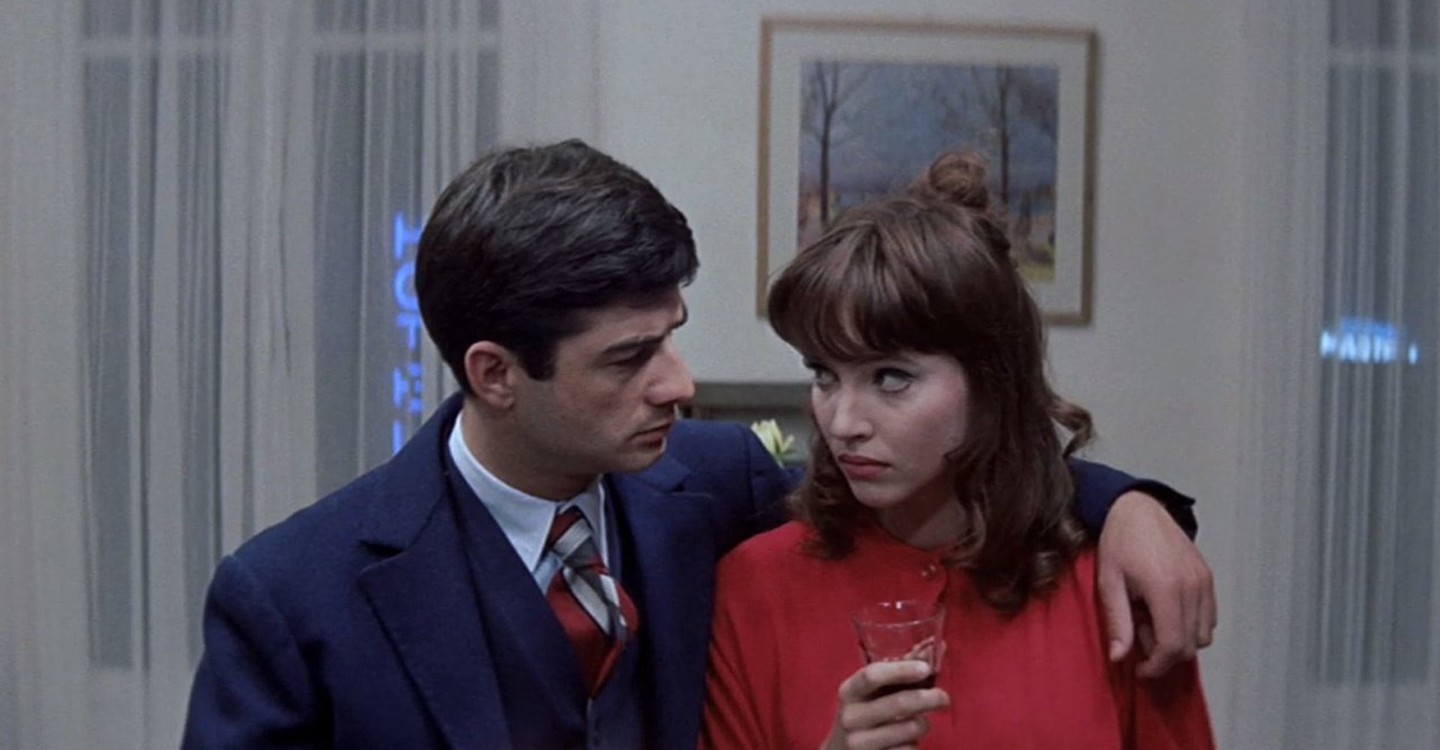
Anna Karina and Jean-Claude Brialy in A Woman is a Woman, directed by Jean-Luc Godard

Jean-Luc Godard’s A Woman is a Woman is a playful film illustrating the complexities of a relationship between a stripper and her lover. Angela had doubts on her love for Emile and believed that having his baby will give her an answer. Emile refused to give her what she wants, and so began their tragic love affair. Right off the bat, the storyline captures my attention because here, we have a woman who actually wants a baby at a time when having a baby and putting the needs of their husband first is imposed on women. As the film progresses, the vibrant colors, unique editing, and catchy score lures us even more. However, this is not to say the film was not difficult to understand.

Most of the time, events just happen. There are intermittent flashes that makes the audience wonder whether the scenes are connected to the storyline. A seemingly straightforward plot becomes more confusing, and you may find yourself confused with the film. We are quite unsure what will happen next, which I believe made the film even more thrilling to watch. There is no clear structure as compared to Hollywood films, and yet we remain glued to the screen because we are encouraged to uncover the mysteries. The use of a musical style heightens our experience by challenging us to find meaning or satisfaction amidst the chaos, but we find none because Godard creates displeasure instead. He irritates the audience by withholding information and refusing to provide clarity. Unlike Hollywood films that focus on narrating a stories that can entertain, A Woman is a Woman invites us to focus on the creativity of the visuals and how it complements the theme.

Considering the period when the film was released, I was surprised how Angela got what she wanted in the end. Perhaps, A Woman is a Woman is hinting that the changing role of women in society is gradually starting. It seems like Godard is exploring the topic of women’s sexuality, which was evident through Angela’s job as a stripper. Her dances were more of an expression of herself, rather than an avenue for the satisfaction of men. Contrary to our perception of strippers, Angela seems much more confident and able to show her femininity because of her job. She was not afraid to be creative and to defend herself, which can be seen when the couple were conversing through book titles. She argued that emotions are not a woman’s weakness when she said, “There’s nothing more beautiful that a woman in tears.” By touching on social issues such as women’s independence, A Woman is a Woman rejects Hollywood films that choose to focus on showing the good parts of life for entertainment. However, the Godard does not tell us what we should think or how we should feel about these issues; rather, he simply desires to shed light on them whilst creating an artistic film. Ultimately, Godard succeeds in breaking barriers in European Cinema not just through his unconventional filmmaking techniques, but also by discussing issues that society hides from.