A Review of Godard’s Une Femme est Une Femme

femme-est-une-femme-blu-ray-movie-title

In the minds of the contemporary movie-goer, the word ‘musical’ would easily bring forth memories of movies such as La La Land, Les Miserables, or Mamma Mia. Common among all these three are the extensive use of song numbers across the different scenes throughout the movie. Sometimes aided with dance numbers, musicals have gained a reputation for themselves of being able to masterfully relay a story with the use of songs combined with an excellent soundtrack.

However, it was to my surprise that the word ‘musical’ could potentially have had a different connotation back in 1961. This was the immediate thought that came to my mind as the first few minutes of Jean-Luc Godard’s A Woman is a Woman was being shown. At the mere mention that A Woman is a Woman was going to be a musical, I began to anticipate and imagine the kind of song and dance numbers they had during the 60s. Yet, several minutes into the movie, there was an undeniable lack of song and dance numbers. What I noticed instead was how the soundtrack was being erratically changed from one scene to another. It was only after 10 minutes that I came to realize that perhaps A Woman is a Woman’s classification as a musical referred to the manner in which the music and the soundtrack were utilized in the movie.

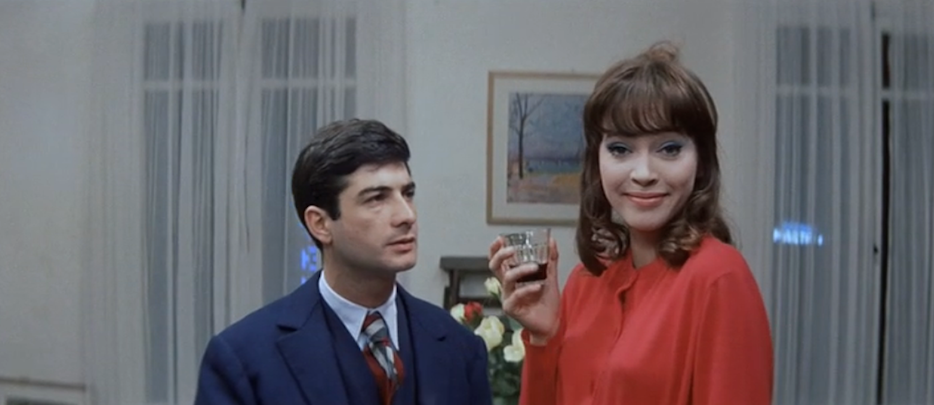
Despite the surprise, A Woman is a Woman still proved to be an interesting watch. What struck me at the onset was the abrupt and seemingly unexplained silences that occurred early in the film. Frankly, I thought that the DVD copy that we had could have been damaged but it was at its second occurrence that I realized that these mute scenes were done intentionally. These silences were used in the scene where Angela (Anna Karina), the lead star of the movie, was strolling through the city and was headed towards her workplace, the cabaret. The shift of camera angles, from up close shots of Angela to an overview of her walking in the city, is where these abrupt silences were placed in between the music. What got me thinking was that these silences appeared to be placed randomly. Unlike the masterful use of silence in Anna’s performance at the cabaret, the silences in these scenes seemed unwarranted. The shot was a simple as it is—it showcased a woman walking through what most normal cities look like. It remains a point of interest to me for the scene held no particular importance for it to be given the distinction of silence.

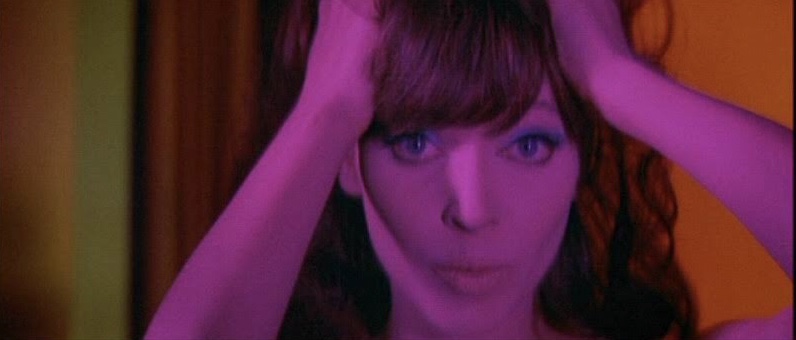
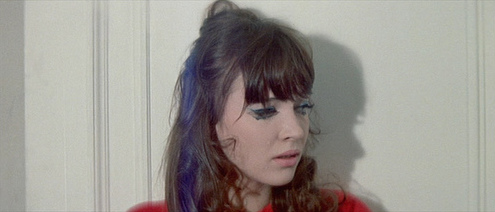
Fortunately, Godard compensates with other aspects of the movie from this small, albeit conspicuous, oddity. The use of color and what can be presumed to be its calculated use throughout the film is laudable. Interlaced from scene to scene, the colors red, blue, green and its plethora of blends are used against a plain background. Angela’s performance at the cabaret is a testament to this. The rotation of colors simply pops out of the screen and distinguishes Angela’s character amongst everyone else.

Overall, A Woman is a Woman can be said to be a movie one can enjoy given its easily digestible plot and interesting use of techniques.

2/7/19 Bautista

A Suspicious Identical Twist

Persona was a movie that seemed to revolve around two different characters with identical and parallel experiences. I believe these two people resonate with one another, which is why Alma developed an attachment towards Elizabeth. On the other hand, Elizabeth would claim to “enjoy” studying her. Some of the scenes that show their similarities is through their history. Alma was in love with a man named Karl-Henrik, however despite this, she still joined the sexual activity by her friend Katarina with two other men. In effect to this, Alma became pregnant and decided to abort the baby. This was somehow parallel to the experience of Elizabeth. The latter was an actress who became unintentionally pregnant. In order to continue acting, she decided to abort the baby. However, she was unsuccessful as she shows hatred for her son. This could be seen how she saw a picture of a boy and tore it apart. This was all exposed when Alma confronted Elizabeth, which was a scene that repeated twice. I thought this was a way to place emphasis on this dramatic scene. 

Another way their lives were similar was in relation to the sexual experience. In a particular scene, a man appears out of nowhere and it seemed to be the husband of Elizabeth. However in a surprising way, which caught me off-guard, the husband addresses Alma as Elizabeth. Afterwards, they started to make out and even decide to make love to each other. The unusual part in this scene is the reaction of Elizabeth. She doesn’t seem to do anything rash about it and just acts as a spectator in this scene. 

It also caught my attention on how there are various scenes where Elizabeth and Alma would usually be together in mirrors, as if they are a part of one another. In fact, Elizabeth caresses the hair of Alma and in the concluding scene, Alma stares in the mirror without Elizabeth but caresses her hair in the same manner. I really think that both characters seem to have a lot of regrets, and can’t seem to forgive their past. Because of this, they can’t seem to move forward and face life with loneliness and anger. This could be seen on how Alma easily confesses to Elizabeth her personal stories, which I believe was ironic. Alma was playing the role of the nurse and yet, it became Elizabeth who served as the one comforting her troubled past.  On the other hand, Elizabeth can’t seem to move herself forward. At the start of the movie, she didn’t even move and chose to not speak in almost the entirety of the movie. In fact, in order to cure her, she was forced to live near the ocean with Alma watching over her as the nurse. It was like she did not even want to exert any more effort, a manifestation of this is how she never responds to Alma’s anger with exception to the part she almost throws a pot of boiling water at the actress. When Elizabeth was confronted with a picture of a boy, she expressed a great amount of rage. Both characters are greatly identical but I believe it’s anger, one-sided love, and troubled past that sets the tension between their relationship. 

The Inner Workings of Silence

Persona (d. Ingmar Bergman, 1966)

Persona by Ingmar Bergman is certainly a movie to say the least. Watching it, I felt multiple emotions (mainly disturbed), but considering how the film is classified on the internet as a “psychological drama”, I feel like that was precisely the point. Persona has a horrifying opening scene that has bizarre elements such as internal organs, an old film projector cracking, a cartoonish vampire, and even an erect penis, followed by a bizarre sequence of a child awakening from sleep and reaching out to an enormous screen showing the two protagonists of the film. This opening scene is only amplified in its unnerving and terrifying nature by a film score that seems to exist to do just that.

In fact, the score is precisely what makes Persona a disturbing experience. The film plays with sound to amplify the conflicts of its plot and the style of its directing to make a weird and unnerving experience. Even the smallest thing such as the central two characters being comforting towards each other are treated in an unnatural way and even flashed back to at the end of the film with the help of the ominous score.

The score existing to be as unnerving as it is is precisely what makes the film even more nerve-wracking – the story is about a woman named Elisabet who randomly took a vow of silence and her nurse named Alma who accompanies her to a cottage to help her recuperate. It is a simple premise, and yet the score compliments the element of insanity that one might naturally encounter when having nothing but another human being with you that refuses to talk and only you and your thoughts to accompany you for hours on end.

When the film was introduced to us in class, the main thing told to us was that the film “is about two women talking to each other”. And honestly, while that does sum up the film’s basic premise, it seems to gradually devolve from two women talking to each other to another slowly losing her mind as she appears to become the other. This is very clear near the end of the film, where Elisabet’s husband arrives and sees Alma as his wife, seemingly oblivious to Alma claiming otherwise. At the same time, Alma herself also seems to accept slowly becoming Elisabet, as she even sleeps with her husband.

It is actually at the exact ending sequence of the film where Alma fully realizing she has become Elisabet is shown. After a lengthy monologue shown from Elisabet’s perspective where Alma deduces Elisabet’s life that led to her forced vow of silence, the film repeats it again, this time from Alma’s perspective. Immediately after, Alma wounds herself, has Elisabet drink her blood, reaffirms her identity as herself before forcing Elisabet to say the word ‘nothing’ and running away from the cottage she spent her last few days in, followed by a film crew. In this scene, I think it really showed that while Alma may believe that she has not turned into Elisabet, the mere fact that she attempts to hide Elisabet and run away with a camera crew capturing her shows otherwise. She may try to escape it all she wants, but she has effectively turned herself into Elisabet. And that, I think, is the terrifying impact of the film – how ‘nothing’ (Elisabet and her vow of silence) can eventually result into ‘something’ (Alma turning into Elisabet), despite ‘something’ being unwilling to do so.

Ultimately, Persona is a weird, disturbing, and unnerving film, and yet it is memorable enough to serve as a unique look into one’s psyche.

Godard: Amateur or Incendiary?

Une femme est une femme (A Woman is a Woman) is a 1961 film directed by Jean-Luc Godard about a woman who blackmails her partner into having a baby together by threatening to sleep with other men. Putting the narrative into words seems a great departure from the film that I experienced. It was my introductory Godard film, and it really set the tone for what’s to come in the class. I have heard of Godard and his films before, but I never got around to watching any of them. Having viewed one of them for myself, I understand now where the frustration of Godard’s viewers come from. I believe it comes from an inability to comprehend what was just seen—as if the work and the artist didn’t want to be understood.

As a consumer of Hollywood cinema, I initially approached the film as I would a mainstream one. I paid close attention to the nuances in the scenes, contemplated on the conversations shared by the characters, rationalized the peculiarities of the film like the random sound cuts and the occasional breaking of the fourth wall. I even attempted taking down notes which, by the end of the movie, was filled with question marks mostly due to confusion. Because the film was putting me in some sort of a block, I referred to Steiner’s essay to identify the nature of my difficulties.

Although the movie is from an entirely different generation, I encountered just a few contingent difficulties—e.g., who Cyd Charisse, Gene Kelly, and Bob Fosse were. The film did pose, however, multiple modal, tactical, and ontological difficulties. These came from unfamiliar, sometimes jarring elements of counter-cinema outlined by Peter Wollen in “Godard and Counter Cinema: Vent d’Est” that I observed in the film.

The segments of the plot shown in the film barely made sense, and only a few parts appeared coherent. Some scenes seemed irrelevant and out of context given the simple premise of the movie. The characters’ actions and motives had me scratching my head throughout the 84 minutes running time. For instance, we have no idea why Angela, the female lead, wants a child in the first place. Her relationship with the Emile, her boyfriend, is also very peculiar. The scenes depicting them collecting books from the shelves and using their titles to communicate with each other is one of many Angela-Emile scenes that contributed to my confusion. I also recall a part where they were acting as if they were rehearsing the scene that was actually being filmed and the audience was then witnessing. These “shortcomings” seemed like mistakes an amateur would make.

All these quirks of the film came to me as a strangeness I couldn’t shake off. The techniques Godard employed were foreign to me, and I wouldn’t know what to make of them since I’m not equipped with the proper faculties to do so. As for the entirety of the film, I didn’t understand what it was trying to tell me, and it seemed reluctant to reveal itself. It has an undercurrent of feminism and women empowerment which is very progressive at the time, but I don’t want to attribute just that to the film. The emplotment of the narrative is certainly unique, and I want to know the reasoning behind it.

Given the difficulties I encountered with the film, it initially wasn’t a very enjoyable viewing experience, and I honestly felt frustrated immediately after. We never enjoy what we don’t understand, anyway. However, having gained some knowledge on the nature of counter-cinema (of which Godard was a pioneer), I am now beginning to understand what the film is trying to say. What I realize is that Godard and his contemporaries sought to depart from the glamour, artificiality, and uniformity of Hollywood cinema, and create something that mirrored reality a little better: messy, complex, unpredictable. It also brings to fore the artistry of the film’s creators instead of simply immersing the audience in its fabricated world. Godard has created something that totally deviates from our expectations of what a film should be, and his work invites us to reject the standard mass-produced cinema has created in assessing films. Art need not be pleasurable all the time. Sometimes, art is made to challenge, to provoke, to destroy. And boy does Godard challenge.

Godard’s Playfulness and Fervor in A Woman is a Woman

Jean-Claude Brialy and Anna Karina

Spunky, playful, and silly. I thoroughly enjoyed everything about A Woman is a Woman. Prior to watching the movie one of the people I trust the most when it comes to taste in movies, already speak highly of Jean-Luc Godard. My friend absolutely adores his 1969 film, Pierrot Le Fou, and I have to say that Godard did not disappoint when I watched A Woman is a Woman. The movie was a treat from start to finish, with so many things to discuss about it. There’s the spirited plot, perky characters, and it’s complete deconstruction of the cinematic form of a conventional Hollywood musical. But perhaps simple pleasure of being a film that enjoys itself without restrictions and any imposed boundaries what is to be loved most about the film.

I wholly believe that before being concerned about anything else, the movie wants to have fun and represent what cinema could be if it’s stripped of all it’s rules. The whole fight between Emile and Angela complete with a humorous rolling of their R’s, a whole fuss about cooking, random biking inside a house, fighting over a lamp, and making comments using books, They were tongue-in-cheek humor that I repeatedly watch scenes several times again after I saw the movie. Yet even though Emile and Angela are obviously to be rooted for, there are also times you enjoy with Alfred and his character’s charm and his relentless pursuit of Angela.

Godard’s love of the craft of film transcends this masterpiece more than anything else. It feels as if we are being taken into his own colorful mind where characters dance around and babble nonsense and music suddenly plays out of nowhere. The plot didn’t have much depth to it, we were dawdling, bantering, and flirting with the characters to care too much about it. The story was merely a canvas for Godard to paint upon bright colors that beam back and forth as his camera drifts to subjects carrying on with their superfluous conversations as scenes are cut in-and-out without warning.

Despite not having seen Breathless, being an avid cinephile means being aware of Godard’s fame and how he redefined traditional cinema by blatantly using sudden, unorthodox cuts. I didn’t understand at first the depth of storytelling those cuts could actually carry, but after seeing A Woman is a Woman, I can’t help but think there’s more to it than Godard making a statement about filmmaking that’s free of restrictions. In fact, I think it’s his way of separating us from the characters, suddenly cutting us off, and telling us not to be to engrossed by the story and the movie’s troubles. He constantly reminds us, that hey, this is a viewing experience. It’s just a film. Enjoy it. I think this is also why his characters suddenly breaks the fifth wall every now and then to acknowledge the audience our bow to them.

Especially in A Woman is a Woman, Jean-Luc Godard is challenging viewers to forget about inhibitions, forget everything you know about cinema, sit back and relish in music and vibrant frames. His fervor in this nonconformist piece is truly a delight and I honestly believe there’s no one else in the world who could’ve made a film like this.

Une Femme Moderne

“No, I am a woman.” This revolutionary line, as I could imagine, sparked the interest of thousands of French and non-French people all around the globe. It showed the clash between man and woman through a series of conversations and arguments by the Angela and Emile. It showed how a woman can have power through her actions and words and how easy it is for women to get their way. I also liked the way the director, Jean-Luc Godard, used Anna Karina’s innocence and playfulness to highlight the general populace of women. He used her personality to feature how women can be. Silly as we may be, we always get our way. 

According to our professor, this film was supposed to be a musical and it was, for a short while, which was kind of confusing. Aside from the scenes that Angela had in the exotic club where she worked at and the part where she sang about Gene Kelly (link – 1:08-1:22). Which was quite interesting because apart from those two scenes there was no hint that it was a musical. Which is why despite it being called a “musical”, I personally didn’t think it was one, not a mainstream one at least. It showed Godard’s way of breaking the rules, creating a so-called “musical” without it being an actual musical.

The story-telling’s flow was pretty simple and was easy to follow. It was a good mix of quirky and funny to make sure that the audience was kept on the hook. It was a classic French New Wave film, similar to Godard’s other films. When asked about this particular film, he said, “I thought of the subject [of Une femme est une femme] while thinking about a musical neo-realism. It is an absolute contradiction, but it is precisely that which interests me in the film.”

I could compare the main character (Angela) to a modern woman, which is why my title is “une femme moderne” which is French for a modern woman. The film was made in 1961, which is where many if not most of the roles of women have progressed in France. The film vividly manifested Godard’s idea of a woman, which like most his films were way advanced from his time.

I wasn’t surprised when I watched the film and it’s outrageous plot. It was different, a breath of fresh air if you will. It showcased Godard’s personality and his ideals as a director. It was interesting how he used music and different sort of shots in order to exhibit each character’s personality and individuality. I loved how the director, used lights in order to focus the attention on what Angela wanted to portray.

I would consider Une Femme est Une Femme to be an art film, which is why when I read the supplementary reading Film Form and Narrative by Suzanne Speidel. I understood that heroes and heroines weren’t meant to relatable and likeable. They were meant to be unconventional and different to make audiences think. Both characters showed their own personal flaws and audiences found it weird and distasteful. Let us start with Angela’s occupation and Emile’s complete lack of concern towards Angela. 

Ultimately, I loved the film. I wouldn’t say it was Godard’s best one but I definitely enjoyed it. Although, I personally didn’t understand some parts it was interesting and watching this film. I realized that one does not need to understand every single concept that a director exhibits because some ideas were meant for us to find our own interpretation of them.

A WOMAN IS A WOMAN: TOO UNCANNY OR STRANGELY BRILLIANT?

A Woman is a Woman, Jean-Luc Godard’s creation, has a simple yet unconventional type of plot in France during the 1960’s. A beautiful lady named Angela who worked at a strip club had been longing to have a baby with her boyfriend, Emile. However, this idea was not something Emile agreed on and thus led to Angela showing a child-like attitude with her playful type of teasing to try and convince Emile of her plea.

Honestly, I have no idea of the type of movies even how European movies are different from the normal “Hollywood Film” that I am more accustomed to watching. The start of the film was a little bizarre for me since there were scenes wherein the music would suddenly stop and then come right back on. There were also scenes wherein random people on the street would look straight to the camera and do nothing. It is in these certain parts of the film that shows how distinctively different European Films are to the typical commercial cinema that I am more exposed to. Even with this twisted and peculiar cinematography, the film was still something I would want to watch again because of how different it is. It was not an easy film to watch at first because of the manner of how the movie presented its characters but what captured me the most was how realistic to life the scenes were. The short glimpse of France and the people walking on the streets made me feel like the movie was something that happened in real life, which really does.

At a certain age, women have certain desires that men would not always understand. Having a baby is one of those desires that may be difficult for other men but that motherly-instinct just sometimes appears and at times can not be controlled. At the end of the film, Emile then realises that losing Angela because of not wanting a baby would be far more painful. Because of this, I think that the movie can either be interpreted as women being manipulative and controlling due to the things they do in order to get what they want or the movie can also be interpreted as how intelligent and powerful women truly are which I think makes the movie brilliant.

Comedy Against Tragedy: A Commentary on Godard’s A Woman is a Woman

Anna Karina in A Woman is a Woman

Common western films today are, what I would describe, very mainstream. A lot of the films I have seen often have common story arcs and themes. We’re exposed to romance, comedy, horror, action, and the like which are reflective of daily life or show a break from it. These films are what we would usually classify as normal; we’re used to them and it takes a really good film to surprise us. However, in this elective we will be exposed to films that disconnects itself from the norm. Such films are meant to be different and unusual to the point that it may be discomforting at times.

A Woman Is a Woman by Jean-Luc Godard is a French film that causes such feeling. Released during the French New Wave, it is a salute to American musical comedy which rejects traditional film mediums. And because it is so different from traditional film, it may be considered to be too odd, especially for people like me who is only immersed in mainstream film.

The film begins with a beautiful woman named Angéla. She is captivating like most stereotypical women in film. Her happy-go-lucky attitude fits perfectly with the music that comes along with every scene she’s in. However, at odd moments the music stops; almost as if someone purposely muted the film randomly. It made me so uncomfortable at times that I began thinking if it was really part of the film or was the film broken given that it is old. As the movie progressed, I realized that at the moments when the music played, a comedic scene is shown.

One scene in particular where Angéla and her lover Émile began arguing about having a child, best exemplified this tug-of-war between the comforting sound of a perfectly fitting musical score and the silence which accompanied scenes that were very serious in tone. It was as if the film and all the elements in it were fighting about whether it will be a comedy or a tragedy, as said by Angéla who has dreamed of being in a comedy herself. The comedy comes when the music is cued and the characters begin acting childishly, like when Émile rode his bicycle around their apartment and when the two lovers made up. The conversations of the characters were also odd at times, first sounding childish and playful which was accompanied by music, then becomes very serious in silence as characters are pulled away from the fantasy of the comedy.

I realized that throughout this movie, the seriousness that came about the silence of the music seemed to be showing Angéla’s true emotions. The beginning of the film shows you a stereotypical woman in film but surprises you with the fact that Angéla was in fact an exotic dancer. She seems very liberated at first but through the montage of her in the bar, I saw and felt that maybe she was trapped in some way. When the silence of the music comes, you notice Angéla’s vulnerability. This for me was best shown when she performs in the bar. The song she chose talks about her being cruel, yet she is a beautiful woman. The creative use of color, music, and lines made me feel captivated, yet sorry for her. It was for me, both entertaining and somber. Although this may be foreshadowing her choosing to cheat on her lover when he refuses to have a child with her, I kind of saw that she was trapped in the limited time she has to bear a child. This being her ultimate goal, motivates her to act on her own as a woman with no limitations. In the end, her story towards this goal best exemplifies a story that is both comedic and subtly tragic.

1961

“A Woman is a Woman” was the first French film I’ve ever watched. The style seemed very old, and was nice to observe dated design of this European movie. There were good aspects, as well as bad parts alike to anything in life. While I admittedly was confused while watching majority of this movie, I do have some commentary about my experience watching.

One prominent aspect of the film was that the music was abruptly starting and stopping. It didn’t aid the dialogue very much. It actually almost distracted me from the scenes, which didn’t have very smooth transitions. I’ve never really appreciated the significance of transitions between segments of a film until I watched Angela bicker with Emile and then kiss passionately in a choppy clip immediately after. Besides that, I found the long panning around the room to be uninteresting and dragging, still drawing my attention away from the point of the scene.

On a more positive note, I enjoyed the characters. I understood that Angela was beautiful, desired, and quite dramatic. She was very stubborn as observed in her endless efforts to conceive a baby with her lover, probably boyfriend, Emile. This could also be observed in how she forgave Emile over the phone but wouldn’t admit it. Their comments that were directed to the viewers gave a comedic tone to the film. It was nice that Angela was so lively and sassy, otherwise I might have dozed off during the film. Emile was as Angela described him, clever and handsome. Their silent treatment fight was ironically witty and could be offensive to some. They always seemed to make up, as seen in the awning signal Angela had for Alfred. Speaking of Alfred, I could only describe him as a sort of space cadet. Not very motivated or active minded, but incredibly passionate for Angela. Willing to run into the wall to prove his love for her, who was just stringing him along for her baby.

Putting aside the characters and technical parts of the film, it all did seem very french. The outfits of the civilians were stylish and layered according to weather. Many people had cigarettes, lighting the sticks of strangers, and even smoking indoors as well. In some corners couples would be holding one another in a passionate embrace. There were also many characters that were portrayed as strippers or prostitutes living very normal lives and having very normal relationships. I wonder if this is part of French or European culture. I always thought, not personally, that people with those jobs were looked down upon. I also have to question if it is still acceptable in the present day if it was so in the past. Angela seemed to be confident and actually quite happy. She even denied that job, I’m assuming that it was for her undying love for Emile.

Overall, it was a quite interesting movie to watch. But “A Woman is a Woman” was pretty difficult to watch, and it was easy to forget that it is a musical. I couldn’t tell if they were singing, or it the musical parts were the sound scores coming in and out of the scenes. I liked Angela, Emile, and Alfred. I even liked Angela’s prostitute neighbour that had many customers, she even had a phone. True to the dialogue, you won’t be able to tell if it is a comedy or a tragedy.

A Woman is a Woman Review

My initial reaction to old movies are that they’re conservative and hard to understand. I was also a bit scared to tackle on a European film because all my life I’ve only watched local and Hollywood films. However, after watching a woman is a woman, I would say that I actually enjoyed it more than I expected.

A Woman is a Woman by Godard showcases the power of a woman to get what she wants. Angela is beautiful and charming. She could get any man that she pleases but is dedicated to her partner Emil. Conflict arises when Angela soon realizes that she wants a baby. She tries to convince her partner to have a baby with her but the two quarrel like children over the matter. We can even see how Emil tries to avoid the topic completely while Angela tries to insert it in every conversation. Comedic aspects are used to lighten the mood of more serious issues when Emil rides around the house to avoid sitting down and talking about having a child. Another character worth noting is Alfred. He is head over heels for Angela and constantly begging her to notice him. Although Angela is with Emil, I feel like she always used Alfred as a back up plan. She didn’t have real feelings for him as seen in their conversation in the bar when Alfred says that he loves Angela while Angela says that the only important thing is that you love me (implying that it is one sided but that in this situation, she will never be the one getting hurt, only the one who gains). Angela uses Alfred to make Emil jealous, in the hopes of Emil finally agreeing to have a baby with her. I found it amusing how although Angela and Alfred were constantly bickering at each other in annoyance, they always found a way to go back to each other. In the scene by the stairs where Emil tries to leave the apartment to again avoid confrontation, Angela and Emil find each other back in each other’s arms before they start fighting again. Their relationship is really like a cat and dog fighting but at the same time, they can’t stay away from each other. Perhaps my favorite part in the movie is when Emil and Angela say that they don’t want to talk to each other and end up using books to communicate. Yet another proof that no matter what the situation is, they simply can’t avoid each other completely, their chemistry is too strong. In the end, Emil ends up sleeping with another woman because of his frustration with Angela and Angela ends up sleeping with another man because of her desire to get pregnant. As seen in the ending of the movie, this was a way for Angela to finally get Emil to agree to have a baby with her. She knew that challenging him that much would eventually lead him to agree to what she wants. I would say her methods were definitely deceitful yet it still showcased how she was capable of getting what she desired. A Woman is a Woman is the rightful title of this film because it truly is only a woman who can take matters to her own hands and insist on what she truly wants.