Love in full color

Jean-Luc Godard’s avant-garde masterpiece, A Woman is a Woman, revolves around Angela, a strip tease dancer, and her desire to conceive a baby with her boyfriend, Emile. However, Emile is not exactly pleased with her idea, which only leads them to go on and on with Angela convincing him throughout the film with teasing, sneering and playful scenes that make it a film so full of life and high-spirited. 
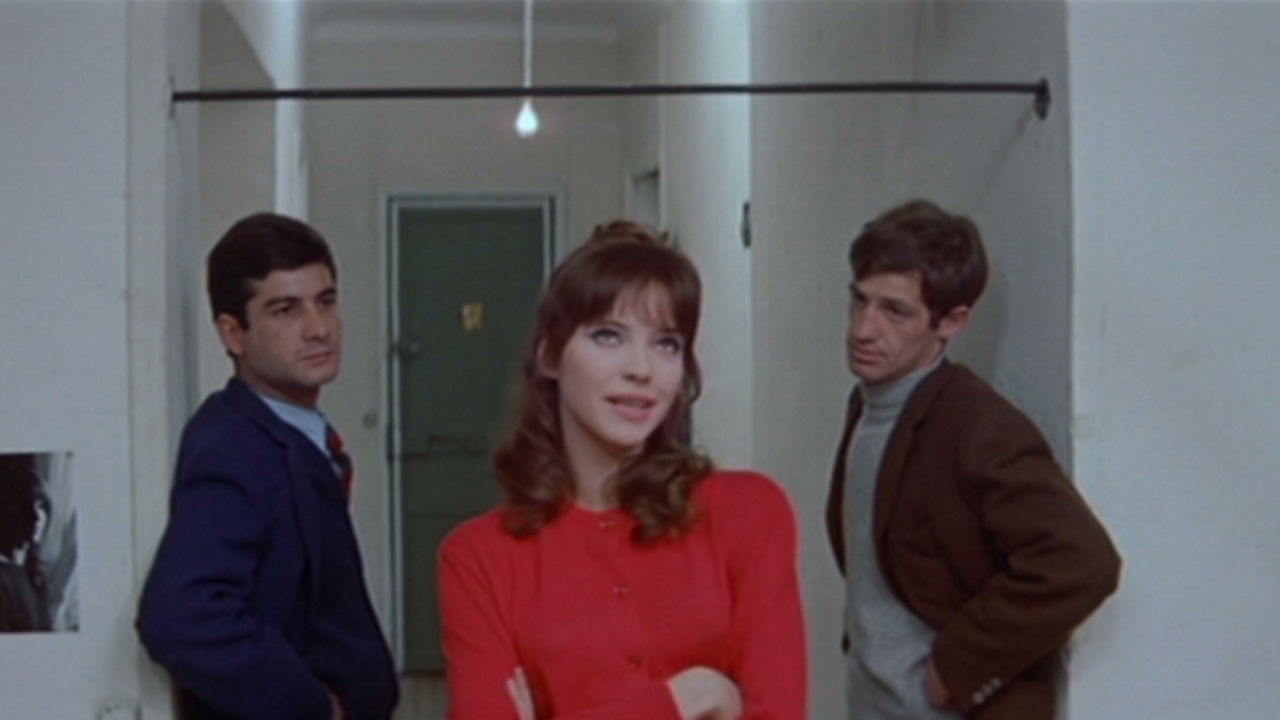
The mis-en-scene of the film depicted a play with vibrant colors and quite fashionable statements from that era as scene in Angela’s clothing choices and make up, which were strongly expressed throughout the film. I believe these were big factors as to why Angela was such a captivating character. I really liked the definition of the cinematography, with the jolly and lighthearted music in the background, at the same time putting a halt to this at certain parts of the film.

The strip club she works in is quite the concept. It’s quite different from the strip clubs one would envision, she walks in fully clothed, slowly undressing herself under a mood light. The spectators sitting quietly in a line of round tables surrounding the supposed “dance floor” with their drinks at hand. Angela gracefully dancing for a few minutes, she ends her “show” and departs the club, living a normal life on the streets. But the questions is, why was Emile completely fine and unbothered by the fact that his girlfriend is a striptease artist? Or was this just not an issue at all? Even when Angela was planning to sleep with Alfred in order to conceive a baby, he seemed to be strangely okay with it. 

In addition, there is a sense of ridicule in its plot, which was expressed when she was cooking an egg, tossed it and dashed towards the telephone to answer the call, runs back a few moments later to catch the egg she tossed. There were also some parts of the film where there were a few questions unanswered. I wish they gave us a background on Angela and Emile’s relationship as well as Emile’s relationship with his best friend, Alfred.
It is definitely not your average romantic film, it was quite odd. There were moments throughout the movie that confused me, when the music would stop abruptly, what they were doing exactly in the scene before bed, where they were grabbing books. It took me quite some time to realize they were quarreling through the titles of the books since they did not want to speak to one another. In comparison to the films shown at present day, the central love story remains— the predicament a man and a woman would face in the relationship and how they would overcome this in the end. Love is complex, the movie was able to exhibit this in full color literally and figuratively; however, unlike most romantic films nowadays that leaves you bawling your eyes out frame by frame with cheesy pick up lines here and there, A Woman is a Woman had a different take on it with humor, mockery and a visual portrayal of jealousy. Maybe these inputs are what made this film so great.

a woman is a woman

To be honest, I’m not very knowledgeable about films in general. I enjoy watching movies, but only the typical American Hollywood type of films that people love to talk about. When I’m asked about a certain movie that I watched, I usually just say “I cried”, or “I fell asleep”, or “The soundtrack was amazing”, or “I’m crushing on that character.” Never have I actually attempted to understand the movie beyond its plot nor its cast selection. So when our professor said we would be watching non-conventional European films, I got quite worried and nervous. It didn’t help that the first movie we would be watching in class was a 1961 film by a director I have never heard of nor actors I have never seen on screen. So to be completely frank, watching this old French film with an odd take on a romantic comedy musical (honestly, how was that a musical?) for the first time was a whole new experience for me that I’m not sure I quite liked.

A Woman is a Woman by Jean-Luc Godard revolves around an unconventional love story involving a stripper named Angela, her partner Emile, and their friend Alfred. The film tells a story about how Angela wanted to have a baby while Emile didn’t, resulting to endless fights and arguments, and eventually leading Angela to sleep with Alfred who has long been in love with her. The film follows a very different non-mainstream flow that makes it unique which I believe invites its audience to keep their eyes on the screen. Personally, however, I found its unusual interludes and sporadic use of music awkward and quite confusing. I found myself trying to figure out why Godard chose to abruptly cut off a song, or suddenly change the shot or frame, or randomly mute the characters, but I couldn’t understand why. There were also specific scenes I found really weird like that scene where Angela and Emile were fighting and agreed not to talk so instead they would pick up the lampshade to get books from the shelf in the dark and use the books to continue arguing in silence, and that random couple in front of their apartment who kept making out in the same spot on different days. I guess I’ll need a little more guidance to be able to grasp and appreciate Godard’s style. I also didn’t feel connected with the characters in a way that would’ve made me empathize with them. Plot-wise, I think their kind of love story is also very odd because I don’t think I’ve ever come across a love story of a fictional couple where the boyfriend would go around randomly asking strangers if they could impregnate his girlfriend who wanted a baby so badly, threaten his girlfriend that he would leave if she wouldn’t stop asking for a baby, be “okay” with the fact that she actually slept with someone else since he wouldn’t, then out of nowhere decides to have sex with her right after so that there would be a chance that the baby would be his. Weird. Really different. But I guess I could say I kind of liked that about the movie. Despite how uncomfortable I felt throughout, I still picked up something that I appreciated – its portrayal of love and its imperfections, and sometimes, its foolishness.

Overall, I don’t have a strong convincing argument as to why I didn’t find the movie as enjoyable as much as it was expected. I think it’s honestly just the fact that I’m not used to films like this one. But nonetheless, I’m pretty excited for the rest of the movies we’ll be watching and discussing in class because I’m genuinely looking forward to finding and developing an appreciation for movies outside my comfort zone, which is actually the reason why I joined this film class.

A Woman Is a Woman: A Different Kind of Comedy

In Godard’s A woman Is a Woman, I was really enchanted by the visual flare that the film showcased. It just shows how much a rule breaker Godard is because he really produced images that is not normally seen in mainstream films, especially the ones made in Hollywood. This film became a refreshing experience to see such a different film in a visual context. One of the parts of the film that struck me the most is when the scenes become freeze frames to highlight their stance. This scene came out of nowhere and it was an interesting way to depict these kinds of actions from the characters. I also was struck by the panorama tracking shot, that contained narration and text. This was a playful way for Godard to show us the general mood in the setting and what was happening that was not being said by the characters. Overall the visual aspect of the story was one of the main reasons that it was easy for someone, who has never watched a Godard movie, to be easily allured by it.   

The film has a weird flow that is not normal in mainstream films, But, even though it was very different from what regular audiences normally watch, the comedy in the film was universal. The film made me laugh so much and capitalized on a screwball type of comedy that is not very common nowadays. It was very refreshing to see this kind of comedy that didn’t rely on being crude and rude. It even made it more fun to watch how the hilarious antics of the characters were done in the way of classic comedy films, but with the french style of Godard. The film, although the style was confusing was really put together and made entertaining to any viewer because of the comedy that was produced in the movie. Even though there were some parts of the film that confused me,  the comedic elements did not put me out of the film and really showed that the film was entertaining.

Another aspect that I really found was an aspect that made the movie great was the actors and their characterization, particularly Anna Karina as Angela. Angela was oozing with charisma throughout the film and made her so interesting and resulted to the audience being really engaged with her. She also had perfect comedic timing and was one of the main resources of all the comedy from the film. One scene, where she asks Emile what he wants for dinner, was one of the comedic highlights that showed how Anna Karina has spot on comedic timing, with the help of Godard’s direction. Emile was also entertaining like Angela, but he really only worked when he was in the same scenes with Anna Karina.  

The only thing that made me question about the film was Godard’s description of the movie. When Godard said that he considers this movie a neo-realist musical, I was expecting a different kind of film. I saw the musical aspect immediately and that the film had clever use of music. But, the neo-realist description was odd because compared to the Italians, who did it more naturalistic, the film was really stylized and rehearsed. But, overall the film was still an enjoyable movie to watch that shows that there are other ways to be entertaining that is outside the standard of mainstream Hollywood movies.

Enrico R. Barruela COM 115.5 A

godard: awed or odd?

Jean-Luc Godard’s A Woman is a Woman revolves around the intertwined relationship of a stripper named Angela, her boyfriend Emile, and his best friend Alfred. Angela, desperate for a baby, seems to be willing to pull out all the stops in order to be able to conceive, even giving Emile, who is repulsed by the idea of having a child, an ultimatum and actually cheating on him with Alfred. The French film follows Angela’s constant back and forth between the two men coupled with odd interludes of silent scenes and musical scores. For a film that was meant to be a musical, I couldn’t help but get the feel of a silent comedy. By comparison, it wasn’t quite the type of musical I had ever watched, no characters randomly breaking out into song and dance numbers, aside from Angela’s amateurish performance at the sleazy bar.

It was undoubtedly one of the weirdest foreign-made films I have come to watch, unlike the spread of British films I was accustomed to, but with a storyline that was not particularly ground breaking nor impactful for a European Film class. Admittedly, I had been a little judgmental throughout watching the film, I was so used to big-budgeted blockbuster movies with their all-star cast and incredulous special effects, basically what Speidel refers to as Hollywood and mainstream narratives. Old films and foreign cinema were things I tend to veer away from, so the 1961 French film was definitely something new. Despite this, it was refreshing to see how cinema was like in its early stages—before its evolution into the oversaturated movies we see today. Also, an exposure to films created in a culture completely different from mine or what I was used to was something I took into account when I was enlisting in this European Film class.

A Woman is a Woman is a seemingly light film that plays its part as a romance movie yet, it still manages to pay close attention to the details. This, I think, is what makes the film a great one, maybe even a classic to some. From the very beginning, the audience is greeted by French words and names in a large, retro Hollywood font. Some musical choices were fitting to the scene, but others weren’t, almost as if to intentionally make the feel of the movie awkward. And then there were more visual details, the couple making out in the same spot over several days was a weird addition, but the scenes with book titles were incredibly smart and well-played. The aesthetic of Angela and Emile’s apartment, with its multiple balconies, random bicycle, hanging clothes dryer, and neon bathroom lights was odd but fitting enough for the odd film. The scene wherein Angela looks at the photo of Emile and another girl, with the back and forth shots of Angela, the photo, and Alfred, partnered with the emotional song from the jukebox forced the audience to be confronted by what Angela was feeling in that moment.

Looking past these details, I still couldn’t help but feel detached from the characters. The audience doesn’t really fall in love with any of their stark personalities other than Anna Karina’s beautiful looks. There isn’t an understanding about where all these things are coming from—why did Angela randomly and instantaneously yearn to be a mother? Just because it was in her horoscope? Why was Emile so flagrantly irate at Angela? Overall, the movie had a few loose strings and random details (or maybe I’m just not as informed and understanding quite yet!), but it was a good, light start to a class on European Film.


tragic, comic love affair

A Woman is a Woman, created by Jean-Luc Godard, is a free-spirited work of art, shattering the norms of a stereotypical American Hollywood musical. The film tells a story about an unconventional love triangle consisting of a stripper who wants to have a baby (Angela), her sophisticated boyfriend (Émile) who does not want to be part of the plan, and their common friend (Alfred) who is in love with Angela and is willing to do the work for her. Lots of interesting elements are brought out onto the film that somehow proves the undeniable wit of the director and his mastery of filmmaking by not following the rules but by breaking it.

One great characteristic of A Woman is a Woman is how it showcases a luscious piano score that is segmented into various scenes. The music randomly interchanges with the characters’ dialogue, making it seem like the actors are somewhat singing along with the music. This film is unconventionally theatrical given that there is a huge play on bright colored lights, entertaining choreography but no real dancing and random, quirky camera movements all throughout.

There is a sense of rawness to the film as most of the dialogue in this film is improvised, giving the actors the freedom to show who their characters are.  Other significant features include the actors addressing the camera directly showing much more vivid emotions, film captions that explicate the characters’ situations, sudden camera freezes and jumps, and wide panning that capture the entire room setting with all the extra details even before the main characters convey the storyline.

These different elements make some scenes very distinct and seem strangely realistic. An example of this is the random interplay of background music and traffic noise while Angela was strolling along the Paris streets encapsulating how it is like to be in the Paris scene back in the 1960’s. Other scenes displayed true-to-life relational dialectics between couples as Émile and Angela argued about their future, their possible marriage and the pregnancy that Angela is yearning for. Even though their arguments seem pragmatic for a couple who live together, it was creatively exhibited in the movie as they switched turns in conveying their thoughts through titles on book jackets, as they argued passionately while Émile was running around in circles on a bicycle, and as they had amusing phone calls where they hide their feelings of love through sarcasm and fake anger.

When it comes to the ludicrous yet amusing storyline, the main character delivers everything gracefully with her sweet and goofy aura. From making duck poses, to singing acapella, to overcooking dinner and to hammering the broken shower, Angela encapsulates how unvarnished and faulty a woman can be, but can still possess that dazzling beauty as she walks along the streets with her head held high. Moreover, the male leads mesh well together with Angela’s playful “I-can-get-everything-I-want” attitude, as one completely defies her overindulgence and the other, gaily chases her around. These two extremes establish the solid foundation of who Angela [as a woman] really is.  Frisky and vibrant, the movie knows too well that the audience may be confused whether the woman getting her way is a comedy or a tragedy. But as said in the movie, no matter how bizarre this experimental film might turn out to be, it truly is a masterpiece.


A Love Story is a Love Story

A Woman is a Woman (1961, Jean-Luc Godard)

A Woman is a Woman is a simple movie with a certainly unique execution. The plot mainly concerns an exotic dancer named Angela and her relationship with her boyfriend Emile, which becomes rocky when Angela decides she wants to have a child.

The way the movie is presented is unique in that it is almost like a musical or a stage play. There is perky music in the background, the way the characters move are almost animated and non-realistic, and there are even numbers where the characters sing or dance. And yet something that the movie chooses to do during these scenes is that it randomly shuts off the music at certain parts of the film. I found it a bit weird to say the least, but I believe it may have been part of the movie’s underlying execution – despite all the singing, dancing, and music, it is not a musical, it is about this couple struggling through something in their relationship and the silence means reality.

In connection to this, I think one thing about the movie that I noticed as well was that the ridiculousness of several of the antics in the film work to emphasize the plight of the main characters instead of existing merely for the sake of absurdity. Cases of this type of absurdities in the film include Emile randomly riding his bicycle around their apartment, an egg that Angela flips into the air staying there until she returns from the telephone, and an argument between the couple that culminates in both of them picking up the entire lampshade, going to the bookshelf in their apartment, and then showing specific parts of book titles to represent how the other feels about the other in the heat of the moment. 

Furthermore, the ridiculousness of these scenes also seem to amplify the central conflict – Angela wants to have a baby so bad that she actually considers the option to get pregnant by someone who is not her romantic partner and even does it near the end of the film. Emile as well is shown to not be fully uninterested, as he is shown going as far as to ask random strangers on the street if they would be willing to give Angela the baby she desires.

Through these scenes, it really goes to show how despite the ridiculousness of the relationship and the ridiculousness of the film’s events, the central love story is unbothered. Though they may argue and they may act as if they hate each other, they never really leave and they never really lose the love they have for each other (as even by the end of the film, Emile finally gives in just so there is a chance that the baby is his). And that, ultimately, is likely the central core and heart of the film. Yes the film is over the top, yes it is too theatrical, yes it is too ridiculous of a premise to accept in reality. But stripped down to its core, it is a story about love and the various absurdities that come with it.

First

A Woman is a Woman by Jean-Luc Godard

                When our professor explained that this would be the first movie that we would watch, talking about how the plot was on a woman (a prostitute nonetheless) who wanted to get pregnant, yet her husband did not want a child (so she slept with someone else) was kind of easy to understand. A “neorealism musical” was a heavy term to swallow right off the bat. The musical part I got but neorealism? A modified form of reality? I have never watched a movie that would present itself as ‘neorealist’ At first thought, okay? so what? What would be so special about this movie that it would make it the very first movie we would watch on a class on European Films? The plot was not anything about Europe as a culture or something that was specific to just the continent. It was a story I could see anywhere else, why would we have to watch this one specifically? But then the first few minutes started, and I realized I had no idea what I was talking about at all.

                The beginning was loud. Big fonts that took up the entire screen with bright colours, presenting the actors, the director, producers, and the like. It was all very theatrical. And upon us meeting the protagonist, Angela, she herself was wearing white, seemingly standing out against the other people around her. As the film progressed I realized how different and divergent it was from the usual films that I have watched in the past. Full of random fourth wall breaking, cuts in the musical score when Angela would be talking on the phone with her husband, Emile, to a magical door that when walking through it would mean an automatic change of clothes. The movie turns into more than just a string of scenes telling a story, but it becomes a piece of moving art. Not to say that most movies are not art itself but there was a way in which the movie created the scenes, the score, the dialogue (or even the lack here of), the colours used, everything was important to make the story a visual spectacle for the viewer.

                What made me love the movie in the end were the last few scenes. After realizing that Angela has slept with someone else, Emile (with Angela’s help) decide to have sex as to perhaps cancel out the fact that she may be having someone else’s baby. They realized how great of a plan this is until after Emile finally realizes that Angela tricked him into finally having a baby. “Damn you, woman,” Emile says. “Not damn me, but dame me,” Angela replies and faces to the audience to wink at the camera. That last scene for me helped wrap up the entire movie and helped encompass the title of the movie, A woman is a woman. A woman who knows what she wants in life and how to get it no matter what the cost. A woman is a woman. What else can she be?

Not Your Typical Love Story

The film, A Woman is a woman, was not the typical love story of a movie for me. It was centered around Angela, who worked as a dancer and performer in a bar. I believe she was quite determined to get a baby. It first started when she read in her horoscope from a newspaper with her friend that something romantic will happen to her in the near future. This then led her to have two admirers which were Emile and Alfred. She would choose Emile and live with him despite the persistence of Alfred. Later on, she would desire for a baby. One of the ways she showed this was when she placed a pillow inside her clothes to see how she would look if she was pregnant. What caught my attention was how committed her partner, Emile, was to not have a child with her. A manifestation of this was how he invited Alfred, who was his best friend and admirer of Angela, to his house and even allowed him to spend time with Angela in the bathroom to have a baby however the deed did not push through. In fact, he even explicitly told Alfred to impregnate her. The second manifestation was ridiculous for me, as Emile literally asked random strangers in the sidewalk if any of them wanted to impregnate a woman, which was Angela. Later on, Angela would eventually give in to Alfred. Alfred was pursuing Angela right from the beginning of the film and he would readily agree to impregnate her. In fact, he even tried to persuade Angela to choose him instead, as they were talking in a restaurant. Because of this, Angela would sleep with Alfred. It puzzled me when Emile found out about it, as he wasn’t furious about it. At first, he showed signs of disappointment but if your partner sleeps with someone else, you would expect a more aggressive reaction. However, this wasn’t the case. In fact, it would then become one of the factors that would encourage Emile to give in to the wishes of Angela. Emile had a change of heart and decided that he wanted to be the father of Angela’s baby. At the end of the movie, he did the deed with her. 

I would say that this is not a typical love story because couples usually say and do things that are sweet to one another or abide by each other’s wishes at least. However in this movie, Angela and Emile are constantly arguing with one another and calling each other insulting names. In fact at night, they would end the night by telling each other how they don’t want to speak to one another. Then, they would wake up and gather books, as the title of these books frame the message that Emile or Angela want to convey to one another, in order to continue their argument. I am quite surprised that they even wanted to stay together. Overall, it was a movie that had humor that revolves around Angela’s desire for a baby.