Persona (1966)

Long after viewing Ingmar Bergman’s Persona (1966), I still do not feel as though I have completely processed the events in the film, nor do I feel like a complete understanding of it is possible. Bergman offers a unique experience with the film, one that I felt was a rather headfirst introduction into European cinema.

Persona sees decorated stage actress Elisabeth Vogler settling into life as a recluse after she suddenly stops speaking. Her only company is her nurse, Alma, with whom she forms a different kind of bond.

A number of Peter Wollen’s noted features of counter-cinema are made glaringly obvious in Persona from the get-go, particularly those of estrangement and un-pleasure. In the first ten minutes alone, I was overcome by a deeply palpable sense of dread despite not fully comprehending just what I was watching. While this dread is something of a staple in the psychological horror genre, the film, whose genre is already hard to pinpoint as it is, the execution completely dismantles any expectations a viewer might have of the film.

Estrangement, on the other hand, comes in that the viewer knows practically nothing about Elisabeth for most of her screen time save for her background as an actress and a few bits about her family despite her being somewhat a protagonist. It is clear from this that Liv Ullmann puts on a fantastic performance as Elisabeth, given that she was limited solely to facial expressions for the most part.

I felt that the movie was a very sensory experience in most parts: I felt as though my senses were disturbed by the strange sounds and images I was faced with. I get the sense that the introductory scenes were placed there solely for the visual effect, and not necessarily to contribute to the film’s plot directly. In this portion of the film, viewers are left confused as to what is happening. Yet, despite the lack of clarity and explanation, the film is still completely engaging, as these scenes manage to capture the audience’s attention in a nearly trance-like manner.

Thematically, the film tackled a number of topics; the sincerity of interpersonal relationships, the fragility of the human psyche, insanity, gender, lesbianism, infidelity, among other things. Content-wise, this rather unusual subject matter alone already signifies a departure from what I have grown accustomed to in mainstream cinema.

Personally, I felt a deep sense of catharsis after witnessing Alma’s impassioned and seemingly unsound ramblings. Her circumstances aside, I feel like she touched on a few very relatable themes: for instance, the inherent existential insecurity and fundamental loneliness that comes with being human.

By the film’s end, viewers still do not quite understand exactly what caused Elisabet to enter her catatonic state, or what will become of her and Alma. But that is far from the point. As the film’s plot sets in, the initial disturbance felt is only heightened by this point, and this is a feeling that will stick with audiences for many days to come.

A Witty Documentary: The Five Obstructions

            The film, The Five Obstructions is a very interesting, witty, and playful documentary of Lars von Trier. The work was probably the easiest film that von Trier’s had to create as it seems as if most of the work, that he’s had to do in particular, was done before the whole documentary was filmed. Perhaps, this is the most fun and least amount of work a director has had to do in terms of directing a film. Despite the lack of work the von Trier’s had to do to make the film, it is this very concept that makes the film quite entertaining to its audience. This is what makes The Five Obstructions my favorite film amongst the films that have been shown in. class.

            Lars von Trier posed a challenge to another filmmaker and friend, Jorgen Leth. Leth’s twelve-minute film, The Perfect Human was actually von Trier’s favorite film. The challenge of von Trier to his old friend was to remake the movie in through five different obstructions(obstacles), each in the manner as instructed by the former, hence the title of the film. At the beginning of the film, it was easy to feel bad for the middle-aged filmmaker, Jorgen Leth, as he appeared to continually be bullied by von Trier, as he needs to comply and achieve the certain obstacles, he’s handed to him. Leth even calls von Trier “insane” at some point, regarding his demands. I sympathized for Leth as he was trying to accomplish the first three obstructions. He appeared to be punished at certain points of the film when remakes were not done to von Trier’s liking. Despite the high demands of von Trier, it showed that he was a filmmaker that most colleagues would look up to, with the way Leth complied with the tasks that he was handed.

            The 4th obstruction or challenge that was presented to Jorgen Leth by Lar von Trier was the cartoon. This is what appeared to be the most challenging for both filmmakers as they repeatedly said in the film that they both hated that type of genre. Leth had to find a way to be able to remake it in such a way that he would also enjoy, which seemed to be a tall task. As the remake was shown to both filmmakers and the audience, everyone displayed and expressed their awe in the manner that Leth was able to achieve this.

Despite the manner of which von Trier displays himself, as shown in his experimental film which he simply directs from a distance as he lies on his couch, you can see his grit and determination in terms of being able to push fellow colleagues that he also looked up to even better their work. You can see his love for the industry as he encourages other filmmakers, and the viewers to learn how to continue to have a sense of hunger and wonder in being able to achieve and do more. As we will be able to accomplish so many things in our lives, he teaches us to never be contented and try to create an even better version of ourselves.

            With the amount of wit that von Trier possesses, I look forward to watching much more films of the cocky director as the playfulness and cleverness of the ideas as displayed in The Five Obstructions is one that I will continue to admire and appreciate.

The Five Obstructions: a cinematic face-off

Portraying itself as a documentary, “the five obstructions” directed by Lars Von Trier is a highly inventive and visionary film composed of a series of films and behind the scenes shots, all coming together to construct the masterpiece that is “the five obstructions”. The short film, “the  perfect human” directed by Jorgen Leth presents ordinary, day-to-day tasks done by a man and a woman separately. With the hopes of recreating Danish filmmaker, Jorgen Leth’s masterpiece, he was put to the test by another renowned filmmaker, Lars Von Trier to recreate the film under his rules— five times in five different ways and places. 

Leth and Von Trier went head-to-head throughout the film as Leth followed Lars Von Tier’s monstrous and far-fetched requests and challenges. Without a doubt, It was not a smooth ride. It is definitely not easy to re-create a film, most especially if this film was shot in the 60’s, even more when you, as the director, will be starring in this remake in different locations. Commendable and insurmountable are understatements as to how Leth was able to excellently execute Von Trier’s commands. This whole idea of reinvention has brought him to the worst/most miserable place on earth, asking him to create an animation in which he expressed his dismay for, but did it anyway, and excellently, at that. Von Trier was actually dissatisfied with what they shot in Mumbai and gave Leth two options— either to fly all the way to India and do it all over again or create a freestyle film. Despite this, Leth continued on. 

In the five obstructions, we are able to perceive the film from the creator’s perspective. It gives you a bird’s eye view on why these filmmakers work the way they do, the creative process that takes place and how everything comes together by listening to their discussions and exchange of views. We see the film unfold beautifully before us, I think that is what sets this film apart. 

Although Leth may have had a hard time with Von Trier’s challenges, the whole point of Von Trier’s ridiculous commands only led Leth to eventually step out of his comfort zone, which brought colour and vibrance to his previous masterpiece, “the perfect human“. Lars Von trier’s ridiculous requests/proposals only led Leth to create and produce another masterpiece, potentially as big or even bigger than his much acclaimed short film, “the perfect human”. More than anything, it was a work of art. The visual style of the sequences and shots were magnificent, leaving you mesmerised while watching. Leth’s style of film making was definitely put to the test in the process but in the end, he was victorious in putting the film together, successfully stepping out of his comfort zone. We see how Leth cherished and believed in control and stability, and putting him together with Von Trier’s twisted ideas defying what he valued, only resulted in a ravishing work of art. It has driven Jorgen Leth’s much esteemed spot in the film world to even greater heights with this remake. 

162622

“This is how the perfect human falls”: The Five Obstructions (2003)

dir. Lars von Trier

Lars von Trier is a sadist, this much I know. He’s notorious in the film community as someone who loves misery and ugliness, and this documentary serves as further proof. Where others would worship their idols, he sets out to challenge (and sometimes even punish) his. He wants to see them go through hell just for the sake of showing his idol’s humanity. He scares me and I love him for it.

“A good perversion to cultivate” (Leth)

From what I’ve gathered, Jørgen Leth’s ‘The Perfect Human’ claims that the perfect human sees or experiences no limitations. This serves as a paradox to what von Trier is trying to achieve with his documentary. He asks Leth to recreate his own film but with several obstructions — limitations. So if the original film serves as the perfect version of all the subsequent films, the question then becomes: Can the remake of a perfect film still be considered perfect even if it is not true to its essence?

“It’s totally destructive. He’s ruining it from the start.” (Leth)

Lars von Trier fails and he falls hard. He gives torturous filmmaking rules for the first obstruction, notable editing-wise, where he restricts Leth from having any single edit that lasts longer than 12 frames. One would think that this would completely ruin the end product. The resulting film, however, is a breath of fresh air. It’s an editing nightmare full of life. The film itself is frenetic and vibrant, and the obstruction which was supposed to hinder acts as an advantage. What once was seemingly a detached piece of art feels much more human now that it’s attached to a location (Cuba). For this film, Leth has gained the upperhand.

“I want to banalize you… We may be able to do so by finding things that hurt.” (von Trier)

For the second short film, von Trier seemingly wants to humanize Leth. Based on ‘The Perfect Human’ and on the other things that Leth has said (ex. “I isolate places and things that I want to examine precisely”), there is a certain detachment to Leth’s filmmaking. Lars von Trier wants Leth to film a movie in the most miserable place on earth but to not show any of it on camera. From what I think, I believe that von Trier is trying to get some of that misery to affect Leth and is hoping that it bleeds into the movie through innovative nuances. Leth, however, remains unaffected.

There’s a small interaction in this movie which made me laugh the first time that I saw it and I can’t stop thinking about it whenever I’m reminded of this movie:

Leth: [talking about the 4th film] I am very pleased with it. [von Trier’s face falls]

“Lars von Trier has this romantic notion that I’ll be so affected by being placed in a situation where a social drama is going on beside you. He wants to quantify how much it rubs off, how much it affects me. Will it be visible? Will it be quantifiable? But I think it’s pure romanticism.” (Leth)

Being directors, both of these men seem hyper aware of the camera. They may be in front of it for the most part of the documentary, but in some ways they are still directing how the film turns out. Both of them are incredibly dramatic with their words, which is why I’ve decided to collect a lot of their quotes and include them here. They want to be in control of the situation because that’s what they’re used to. They want to be in charge of how they are perceived through the lends because this is what they know the audience sees. Their job is to frame reality and as a result, they too become characters in their own documentary.

“He serves hard and we return hard as nails. That’s the way it is.” (Leth)

It’s clear that von Trier holds Leth to high standards. What differentiates him from other ordinary fans though is that he too is an accomplished filmmaker. He plays the same game as Leth. Throughout this entire project, it is von Trier who dictates what to do and Leth must follow. It’s an interesting role reversal and it produces a great collaboration between the two.

“Here there are no limits. Here there is nothing.”

Leth overcomes the next two films and produces stunning outputs. Even his hatred for animation couldn’t falter the creativity of the fourth film. Each of his new films remain truthful to their thesis and yet all of them feel new and reinvigorated. Leth is clearly a master at work and at times it feels like von Trier is experiencing more obstructions than he is, which is why I understand von Trier’s choice for the last film.

von Trier has complete control over the final film and knowing Leth, this isn’t an easy decision. This is the man who refused complete artistic freedom over his own film saying, “I’d rather have something to hang onto”. By having his name attached to a film he has no say in, that just might be one of the biggest subtle obstructions in filmmaking there is.

“You wanted to make me human but that’s what I am!”

Nevertheless, he pushes through. And by doing so, he winds the game against von Trier. Going by Leth’s film, the perfect human is someone who has no limitations. Bringing this further, we can say that the perfect human has no limitations because of his ability to overcome them. Throughout this process, he is perfect because he does this while staying true to his version of humanity. von Trier knows this which is why he ends the movie accepting his defeat. He repeats a clip of Leth falling to the ground,

“This is how the perfect human falls.”


The Five Obstructions

In Lars von Trier’s The Five Obstructions, he creates a documentary about the creation of art, specifically in the medium of film. My instant reaction to this film was that it was unlike the documentaries that I have watched before. This film continues the continuous theme in the films that I have watched in COM 115.5, wherein the European directors really digress from the standards that Hollywood in general has put in movies. The main difference that I noticed in this film, in contrast to more accustomed documentaries, is that it does not tackle a big social issue. The movie itself feels very small and contained to the goals that von Trier wanted to get out of Jorgen, the director of the original film he wants to be remade. My initial reaction was that the film felt minuscule because I was accustomed to documentary films having something to say in a social context. This film felt like a film fan, von Trier, being able to interact in the real world with his film idol, Jorgen.

It was interesting to see the different interpretations of Jorgen’s original film that von Trier gets out of Jorgen. It showcases different perspectives of how the film could have been made, under the stipulations von Trier made. This was a highlight for me because it showcases the quality of art that does not limit it to a particular style. It makes you appreciate the art mor and in this case, the original film because the different variations changed it but still had the essence of what Jorgen made.

I did feel that the film was quite dragging because I am not well aware of Jorgen’s original film so remaking it in different styles did not really encourage me to enjoy the movie. One factor is that it had a lot of conversations between Lars and Jorgen and then it goes to the finished product. I would have been more interested in Jorgen’s new process in remaking his film in the different styles. Although the film showed a few glimpses of behind the scenes filmmaking that Jorgen did, it was more focused on the dialogue between LArs and Jorgen and the finished film.

I also felt that the films that they were producing was to avant garde for me that I end up not getting what the point of the “The Perfect Human” is and it detaches me from the film. It also didn’t help that they were easily bouncing off to a new obstruction so I don’t have enough time to process the previous variations of the film. Although they were beautiful to look at I was not able to connect with the end goal of Lars and Jorgen.

I did like the back and forth between Lars and Jorgen because  it was the comic relief in the film that was full of artistic pretentious acts. I wished that the film either focused more on the relationship of student and teacher, between the two filmmakers, or the filmmaking process of the remake. This would have kept me engaged in the film, but the the film that I saw was interesting but just really hard to connect with.

Enrico R. Barruela COM 115.5

The Five Derivatives

The Five Obstructions (d. Lars Von Trier, Jorgen Leith; 2003)

In all honesty, the film The Five Obstructions was probably the only movie so far that I’ve seen in this class that I did not enjoy. Part of this was because I felt the film was too redundant, and another was because I felt the film was too self-indulgent for its own good.

Maybe another is that I am not a fan of Director Lars von Trier. The films of Von Trier that I have seen feel like it’s too much pandering for art for the sake of art or for something to force a message. Von Trier’s style is really just not for me, and while this specific film does not have any graphic violence or dark themes, rather it is a more straightforward look into what makes a film, I found it to be just too slow and uninteresting.

The film’s basic plotline is Von Trier challenging fellow director Jorgen Leth to remake his short film entitled The Perfect Human. The titular ‘five obstructions’ come in the form of challenges Von Trier imposes on Leth. These include remaking the film in Cuba with a forced frame limit for each cut, remaking the film in “the most lonely place in the world”, and animating the film. Leth takes on each challenge in a unique way – he films in Cuba and makes the framerate challenge work by taking on hyperspeed editing, he films in India by having a near-transparent screen, and he finds an animator to help bring his vision to life.

In my opinion, while the first version of the film was very interesting (and honestly really well-made – despite the messy and frantic editing the basic gist of the short film was still faithfully translated), the rest of the film just does not live up, despite the clear quality of the craft on display.

I think the main scene that I also have a hard time with the film is when Von Trier and Leith talk about animation in a negative way and deride it. I really just found this entire conversation pretentious and condescending, especially since they were so dead set on knowing that as long as its animated “its going to be crap”. Considering the value animation has (it is a medium where the impossible is possible, it is a world where non-realism can prevail) to cinema as a whole, I found both Von Trier and Leith’s comments very disrespectful and close-minded as directors.

Furthermore, the movie seems to be aimless. While the central conceit is interesting in seeing five different versions of a short film, what the structure of the film means is that by seeing five different versions, even though they are different aesthetically, the inner message is still the same, which leads to very very monotonous viewing. I felt that while the movie-making parts of each obstruction had their own merits, the actual showing of the obstructions felt very very slow. This is why despite the movie not even being 100 minutes long, it feels like it went on for even longer than that.

Overall, there is no denying that there is a lot of talent and craft that went into the film from both Von Trier and Leth’s perspectives. Von Trier for attempting to make something new out of a documentary framework and Leth for showing the different facets of filmmaking, particularly how a story can be told in multiple ways. However, it is really just not for me.

Let the Games Begin

The Five Obstructions is somewhat a documentary film about two directors Lars von Trier and Jørgen Leth, where Leth has to create five obstructions to von Trier’s “favorite” film. Von Trier orders around Leth to do five obstructions of the film “The Perfect Human” which was directed by him as well. The Perfect Human was a 13 minute film that showed what a “perfect human being” was, where they moved in a boundless, abyss-like room. 

The first obstruction was to recreate the film in Cuba, with no less than twelve frames. He hired two actors to play the scenes and thus it was created. This one, he completes with no problem. It was a good few shots and the von Trier was no short of pleased with the film that was created. 

The second obstruction was to recreate the film in the “worst place in the world” with Leth playing the man in the film. He recreates this in the streets of Mumbai with a white screen behind him he was ready to go. Although, von Trier was not pleased with this film. He saw that Leth didn’t follow his exact specifications thus making this a failure. During this time (the showing of the film), the audience can see how displeased von Trier was with the creation. He somehow scolded Leth with his creation. I found this eerie as Leth was so much older than von Trier. He was a senior by nature. It was weird how someone younger was reprimanding Leth. 

Since von Trier was disappointed with the second obstruction, he gave Leth the choice to pick tthe third obstruction. Either to go back to India and do it again, or make a free-style film with his own style and no direction at all. Leth chooses the later and shoots in Brussels. Von Trier was once again pleased with the film and moves on to the next obstruction. 

The fourth obstruction, my personal favorite, was to remake the film into a cartoon. It was interesing at is was beautiful. The digital art work reminded me of “Archie’s Final Project”. They felt so the same, not in terms of story-line but in the was the graphics were maintained. He does so with the help of Bob Sabiston. It came out to be an animated film but nonetheless was still beautifully crafted.  

Lastly, the fifth obstruction was von Trier’s own version of “The Perfect Human”. This was to be credited and voiced by Leth, but was manufactured and written by von Trier. This was to encapsulate the entire project.

I felt as though the film was outrageous. It was a series of experimental short films put into one film. It was great but at the same time confusing. Like I said in the earlier paragraph, von Trier was obviously so much younger than Leth which played a big role in my being confused. If he was the senior why was he being ordered around like a little child and why did he allow himself to be ordered around so? I felt like throughout the film von Trier was making fun or was playing around with Leth. Which is why, I picked the title “Let the Games Begin” because I felt like the entire film was a game, playing with Leth’s head and skills. 

L’avventura Movie Review

What kept going inside my head while I was watching the movie was “She’s just not that into you”. The way Anna acted around her fiancé made me question if she was as invested in their relationship as he was. I think that the time they spent apart made her realize that she was capable of being and living without him. Sure she misses him from time to time but she also constantly wanted the space. In a way, I felt that she was trying to find a way to leave him without really leaving him. In the boating trip, I could see resentment in her eyes even if she would kiss Sandro almost like she felt trapped in the relationship. Of course I really couldn’t tell what she was thinking but based on the body language, it’s what I assumed. When she jumped into the water and faked the shark in the water, it made me wonder again if she really wanted to disappear. So when Anna really disappeared, I wasn’t entirely shocked. The movie never lets you know what really happened to Anna. If she committed suicide, if she escaped to somewhere else without letting anyone know or if she got into an accident and died or if she was injured. It just lets you wonder on your own. One of the things that struck me was that they ruled out suicide just because they saw a bible in Anna’s things. As if having a bible meant that she would never attempt harm on herself, an absolute false basis.

The story line that was focused on Anna in the beginning, quickly begins to focus on her best friend, Claudia. Which is a big shift because in the start she seemed as if she were just a third wheel that didn’t have much depth. Although, we suddenly see a different side of Claudia after Anna’s disappearance. She is anxious and deeply worried of what really happened to her best friend. I think even if she doesn’t say anything, she leaned towards Anna running away rather than getting into an accident. She blamed Anna’s fiancé for her disappearance but as the day progressed, the two found themselves getting closer to each other. I believe the loss of a person they both thought to be closest to them is what brought Sandro and Anna together. This closeness soon develops into a strong attraction that Anna tries so hard to control. She controls it not because she doesn’t have feelings for him but because she feels it is too soon. She’s ashamed of herself because she knows Sandro is really Anna’s and not hers for the taking. But just as she tries to fight it, the more she is drawn and the further she is drawn to Sandro, the more the two forget about Anna. You could see in the movie, how quickly the two move on from Anna, barely even mentioning her. But at the same time, I think this might have been a coping mechanism for the two which would explain why they also seeked comfort from each other. Because of how quickly things were moving between the two, I wasn’t really sure if what they had was love. I knew they were attracted to each other but I was unsure of the motives and sincerity of this love. In the end when Claudia was getting hysterical thinking that Anna had come back and that Sandro would leave her, it made me think that maybe they were both just trying to push the idea of Anna further back as a way not to bear the pain but that it was always just floating at the back of their heads. I did feel that both characters did not show enough sadness in their mourning but then again maybe this was their idea of coping with loss. Another thing that I thought was that maybe they knew Anna was alive, that she just needed time apart, thinking that one way or another she would eventually come back. In the very ending of the movie, I finally see Sandro cry which is something he had not done when he initially found out about Anna’s disappearance. I think that in that moment, it sunk into him that maybe she was truly gone. The movie title is translated as Adventure. I think that this was truly an adventure for the characters. They moved around in trying to find Anna and in the process also tried to find and understand themselves.

Creative Derivations of the Perfect

The movie, The Five Obstructions, was a great comedic movie that showed a competitive challenge offered by Lars von Trier and taken by Jorgen. Here, there were lots of instances of creative shots, where it allows the audience to appreciate forms of art and beauty. When it showed the original version of The Perfect Human, it was evident that the focus is meant to be placed on various human body parts such as eyes, lips, face, legs, and many more for both male and female. This was the case when the characters in the film are eating, shaving, smoking, or even as simple as lying down. It was simply a movie of the ideal person in different cultures and contexts, while maintaining the message of what it means to be ideal. 

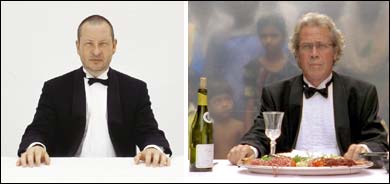
In other cases, when Jorgen was doing the variations, there were different backgrounds for each The Perfect Human version. It included Brussels, Bombay, Cuba, Denmark, and even a cartoon version. The notable one for me was the one in Bombay, where he chose to shave and to eat with a real background of kids and residents there watching him film the specific scene. For me at first, I thought it was out of place and inappropriate. It seemed like it was in a public market and he starts to jump as the public looks on. Afterwards, he shaves and then later on start to eat a fine dining. The dining scene struck me the most because it shows how much the people wanted to be in his position, having an abundance of delicious food while living a comfortable life. For them, it was the ideal life which shows how for the people of Bombay, it is the perfect human. On the other hand, in the cartoon version, I really appreciated the animated form of the characters. I thought the drawings were really excellent as the facial expressions truly captured the scenes. Furthermore, I noticed the nudity was more explicit as compared to the one with real characters. It was bold in terms of showing the private parts of both male and female. The bodies were really well-crafted, as there were details such as the defined abs, attractive breasts, and other beautiful body parts. It was certainly an animated version of manifesting on what a perfect human is like. In the Cuba version, the dancing was compromised to be more in-line with its culture. Another act that they changed for the culture was the smoking scene and how the Cuban actor plays around with the cigarette. I believe this was a way of conveying a perfect man in the eyes of Cuba. 

When deriving the original version of The Perfect Human, Jorgen took into consideration the context, challenge of Lars, and culture of his audience while maintaining its message. I believe this was very creative and credit to Jorgen for being well-versed with different cultures and knowing what kind of person is ideal in their perspective in the form of lifestyle, clothing, food, and etc. 

ReplyForward

The adventure of L’Avventura

Coming into this elective and having watched two amazing films so far, my expectations for L’Avventura by Michelangelo Antonioni was set high. I was expecting something thrilling; something that is beyond my expectations of cinema. Indeed, my knowledge of 60s European films were limited to the oddness, yet captivating screenplay of A Woman is a Woman by Jean-Luc Godard and the eerie themes of Persona by Ingmar Bergman. Yet, despite my high expectations of being surprised with another kind of film, L’Avventura seems to both fail and exceed such expectations.

Honestly speaking, L’Avventura is the most confusing film I have ever experienced. Not only did it confuse me with its extraneous plot points, it also made me feel generally confused about my feelings towards the film and the activity of being made to watch the film for class. What was I supposed to feel about a movie that I have a hard time understanding to begin with? It may sound harsh, but such feelings led me to believe that this movie is testing me in some way. However, one thing I learned in this class is that one’s personal expectations never seem to meet what the films we’re shown present to us. There is always something surprising, or at least something worth being at awe at.

L’Avventura fulfills such expectation in a way one would not expect it to. When we think of something that surprises us, we think of extravagant things; things that deviate from what is normal, where such deviation creates an exciting feeling for the weird and the unknown. However, L’Avventura is neither extravagant nor exciting. A lot of scenes were prolonged stills of the characters expressing their emotions. In fact, the progression of the film is so slow that when you set the film at twice its regular speed, it would still look like a normally shot film. (This is proven by the fact that my friends and I tried this while watching the film, and to our amusement, the film was still comprehensible despite its unusual speed).

The film then is made surprising by its unusual way of storytelling. It may not have been as exciting as the other films we have watched so far, but it still exceeded my expectation regarding European cinema in the 60s. What makes it great for me is its ability to evoke strong emotions to its audience. It’s almost as if the mournful emotions the characters portray permeate through the screen towards its audience. We mourn for the characters’ inability to communicate their intentions just as the characters mourn for their state, made problematic by their choices. The frustration is strong for both me and the characters as they struggle to solve the real dilemma.

Despite L’Avventura’s inability to bring excitement to its audience, I believe it did bring something significant to us. It surprised us in a way that no known and popular films would. The emphasis on the slow progression allowed us to immerse ourselves with the emotions portrayed by the characters, especially in the slowest moments of the film. This, I believe is what made L’Avventura the most surprising film I have watched for this class so far. It brought me something boring, yet different and meaningful than what was initially expected. Maybe the title itself shows us that there’s an adventure one can seek when watching L’Avventura––and that is seeing its beauty amidst our preconceived expectations.