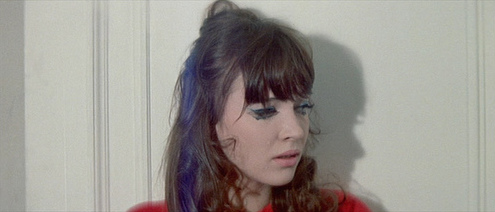
A Woman Is A Woman

A Woman is a Woman is a 1961 french musical film by Jean-Luc Godard. The film revolves around Angela and Emile, a couple living together, and their struggle to find common ground after Angela voices out her yearning to have a child.

The story of this film seems very simple, but how the plot plays out gets pretty wack. The prime example of this was Angela resorting to sleeping with Alfred, Emile’s best friend, just to have a child, with Emile just consenting to it. Another example of this is how they argue in bed. In the middle of the night, they will decide not to talk to each other, opting to use books as a medium to talk. They hurl insults and apologies to each other using titles of books, which I did not understand because I do not know how to read french.

This film makes me think that all French people do in the 60s was smoke. The characters in the film smoke literally all the time. They smoke before showering. They smoke during dinner. They smoke in bed before sleeping. They smoke while talking. This gives me the impression that smoking is a big part of French culture back then, as smoking was very present in Godard’s other film, Masculin Feminin.

The actors’ performances were very mannered, as they acted very theatrical. They also had odd scenes where they posed standstill as if they were acting something out.

Overall, this film was enjoyable even for me, who doesn’t regularly enjoy period films.

Godard: Amateur or Incendiary?

Une femme est une femme (A Woman is a Woman) is a 1961 film directed by Jean-Luc Godard about a woman who blackmails her partner into having a baby together by threatening to sleep with other men. Putting the narrative into words seems a great departure from the film that I experienced. It was my introductory Godard film, and it really set the tone for what’s to come in the class. I have heard of Godard and his films before, but I never got around to watching any of them. Having viewed one of them for myself, I understand now where the frustration of Godard’s viewers come from. I believe it comes from an inability to comprehend what was just seen—as if the work and the artist didn’t want to be understood.

As a consumer of Hollywood cinema, I initially approached the film as I would a mainstream one. I paid close attention to the nuances in the scenes, contemplated on the conversations shared by the characters, rationalized the peculiarities of the film like the random sound cuts and the occasional breaking of the fourth wall. I even attempted taking down notes which, by the end of the movie, was filled with question marks mostly due to confusion. Because the film was putting me in some sort of a block, I referred to Steiner’s essay to identify the nature of my difficulties.

Although the movie is from an entirely different generation, I encountered just a few contingent difficulties—e.g., who Cyd Charisse, Gene Kelly, and Bob Fosse were. The film did pose, however, multiple modal, tactical, and ontological difficulties. These came from unfamiliar, sometimes jarring elements of counter-cinema outlined by Peter Wollen in “Godard and Counter Cinema: Vent d’Est” that I observed in the film.

The segments of the plot shown in the film barely made sense, and only a few parts appeared coherent. Some scenes seemed irrelevant and out of context given the simple premise of the movie. The characters’ actions and motives had me scratching my head throughout the 84 minutes running time. For instance, we have no idea why Angela, the female lead, wants a child in the first place. Her relationship with the Emile, her boyfriend, is also very peculiar. The scenes depicting them collecting books from the shelves and using their titles to communicate with each other is one of many Angela-Emile scenes that contributed to my confusion. I also recall a part where they were acting as if they were rehearsing the scene that was actually being filmed and the audience was then witnessing. These “shortcomings” seemed like mistakes an amateur would make.

All these quirks of the film came to me as a strangeness I couldn’t shake off. The techniques Godard employed were foreign to me, and I wouldn’t know what to make of them since I’m not equipped with the proper faculties to do so. As for the entirety of the film, I didn’t understand what it was trying to tell me, and it seemed reluctant to reveal itself. It has an undercurrent of feminism and women empowerment which is very progressive at the time, but I don’t want to attribute just that to the film. The emplotment of the narrative is certainly unique, and I want to know the reasoning behind it.

Given the difficulties I encountered with the film, it initially wasn’t a very enjoyable viewing experience, and I honestly felt frustrated immediately after. We never enjoy what we don’t understand, anyway. However, having gained some knowledge on the nature of counter-cinema (of which Godard was a pioneer), I am now beginning to understand what the film is trying to say. What I realize is that Godard and his contemporaries sought to depart from the glamour, artificiality, and uniformity of Hollywood cinema, and create something that mirrored reality a little better: messy, complex, unpredictable. It also brings to fore the artistry of the film’s creators instead of simply immersing the audience in its fabricated world. Godard has created something that totally deviates from our expectations of what a film should be, and his work invites us to reject the standard mass-produced cinema has created in assessing films. Art need not be pleasurable all the time. Sometimes, art is made to challenge, to provoke, to destroy. And boy does Godard challenge.

Godard’s Playfulness and Fervor in A Woman is a Woman

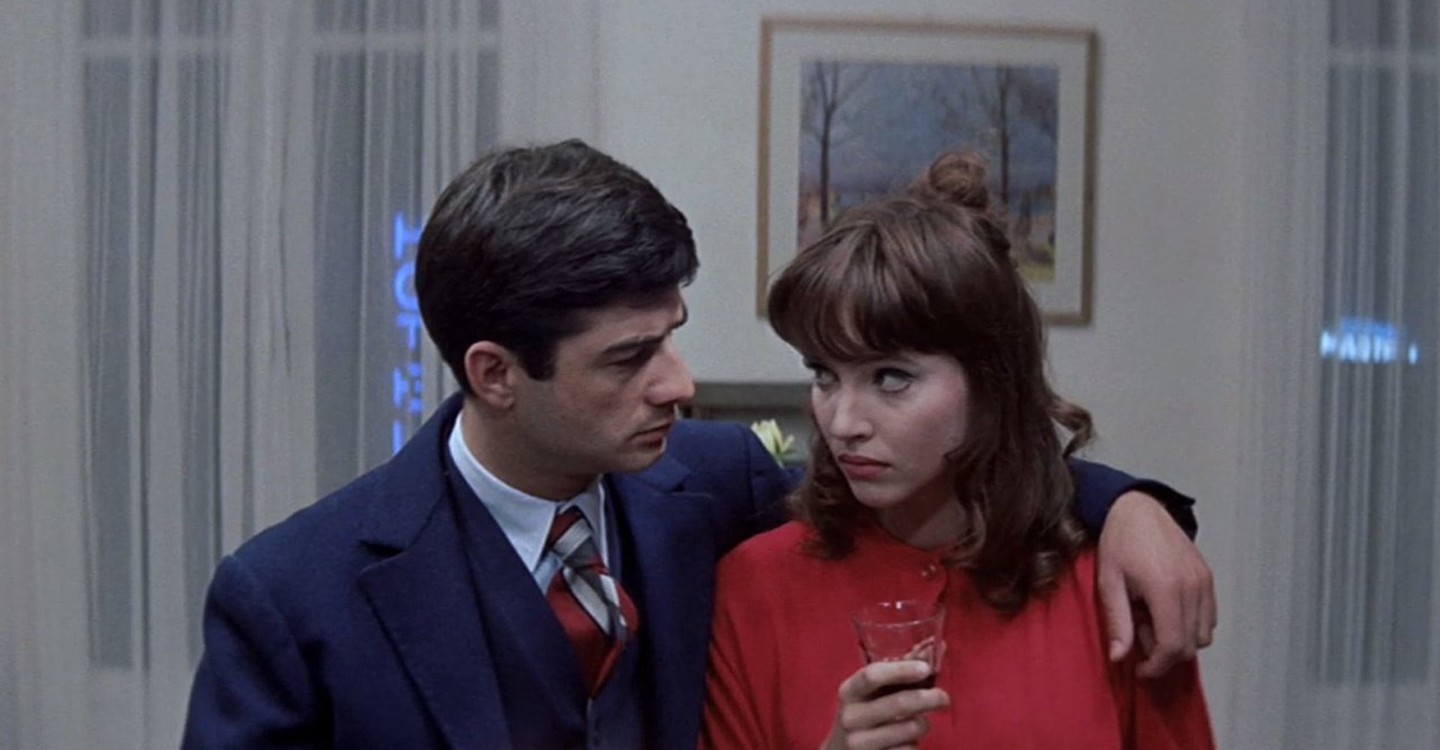
Jean-Claude Brialy and Anna Karina

Spunky, playful, and silly. I thoroughly enjoyed everything about A Woman is a Woman. Prior to watching the movie one of the people I trust the most when it comes to taste in movies, already speak highly of Jean-Luc Godard. My friend absolutely adores his 1969 film, Pierrot Le Fou, and I have to say that Godard did not disappoint when I watched A Woman is a Woman. The movie was a treat from start to finish, with so many things to discuss about it. There’s the spirited plot, perky characters, and it’s complete deconstruction of the cinematic form of a conventional Hollywood musical. But perhaps simple pleasure of being a film that enjoys itself without restrictions and any imposed boundaries what is to be loved most about the film.

I wholly believe that before being concerned about anything else, the movie wants to have fun and represent what cinema could be if it’s stripped of all it’s rules. The whole fight between Emile and Angela complete with a humorous rolling of their R’s, a whole fuss about cooking, random biking inside a house, fighting over a lamp, and making comments using books, They were tongue-in-cheek humor that I repeatedly watch scenes several times again after I saw the movie. Yet even though Emile and Angela are obviously to be rooted for, there are also times you enjoy with Alfred and his character’s charm and his relentless pursuit of Angela.

Godard’s love of the craft of film transcends this masterpiece more than anything else. It feels as if we are being taken into his own colorful mind where characters dance around and babble nonsense and music suddenly plays out of nowhere. The plot didn’t have much depth to it, we were dawdling, bantering, and flirting with the characters to care too much about it. The story was merely a canvas for Godard to paint upon bright colors that beam back and forth as his camera drifts to subjects carrying on with their superfluous conversations as scenes are cut in-and-out without warning.

Despite not having seen Breathless, being an avid cinephile means being aware of Godard’s fame and how he redefined traditional cinema by blatantly using sudden, unorthodox cuts. I didn’t understand at first the depth of storytelling those cuts could actually carry, but after seeing A Woman is a Woman, I can’t help but think there’s more to it than Godard making a statement about filmmaking that’s free of restrictions. In fact, I think it’s his way of separating us from the characters, suddenly cutting us off, and telling us not to be to engrossed by the story and the movie’s troubles. He constantly reminds us, that hey, this is a viewing experience. It’s just a film. Enjoy it. I think this is also why his characters suddenly breaks the fifth wall every now and then to acknowledge the audience our bow to them.

Especially in A Woman is a Woman, Jean-Luc Godard is challenging viewers to forget about inhibitions, forget everything you know about cinema, sit back and relish in music and vibrant frames. His fervor in this nonconformist piece is truly a delight and I honestly believe there’s no one else in the world who could’ve made a film like this.

Comedy Against Tragedy: A Commentary on Godard’s A Woman is a Woman

Anna Karina in A Woman is a Woman

Common western films today are, what I would describe, very mainstream. A lot of the films I have seen often have common story arcs and themes. We’re exposed to romance, comedy, horror, action, and the like which are reflective of daily life or show a break from it. These films are what we would usually classify as normal; we’re used to them and it takes a really good film to surprise us. However, in this elective we will be exposed to films that disconnects itself from the norm. Such films are meant to be different and unusual to the point that it may be discomforting at times.

A Woman Is a Woman by Jean-Luc Godard is a French film that causes such feeling. Released during the French New Wave, it is a salute to American musical comedy which rejects traditional film mediums. And because it is so different from traditional film, it may be considered to be too odd, especially for people like me who is only immersed in mainstream film.

The film begins with a beautiful woman named Angéla. She is captivating like most stereotypical women in film. Her happy-go-lucky attitude fits perfectly with the music that comes along with every scene she’s in. However, at odd moments the music stops; almost as if someone purposely muted the film randomly. It made me so uncomfortable at times that I began thinking if it was really part of the film or was the film broken given that it is old. As the movie progressed, I realized that at the moments when the music played, a comedic scene is shown.

One scene in particular where Angéla and her lover Émile began arguing about having a child, best exemplified this tug-of-war between the comforting sound of a perfectly fitting musical score and the silence which accompanied scenes that were very serious in tone. It was as if the film and all the elements in it were fighting about whether it will be a comedy or a tragedy, as said by Angéla who has dreamed of being in a comedy herself. The comedy comes when the music is cued and the characters begin acting childishly, like when Émile rode his bicycle around their apartment and when the two lovers made up. The conversations of the characters were also odd at times, first sounding childish and playful which was accompanied by music, then becomes very serious in silence as characters are pulled away from the fantasy of the comedy.

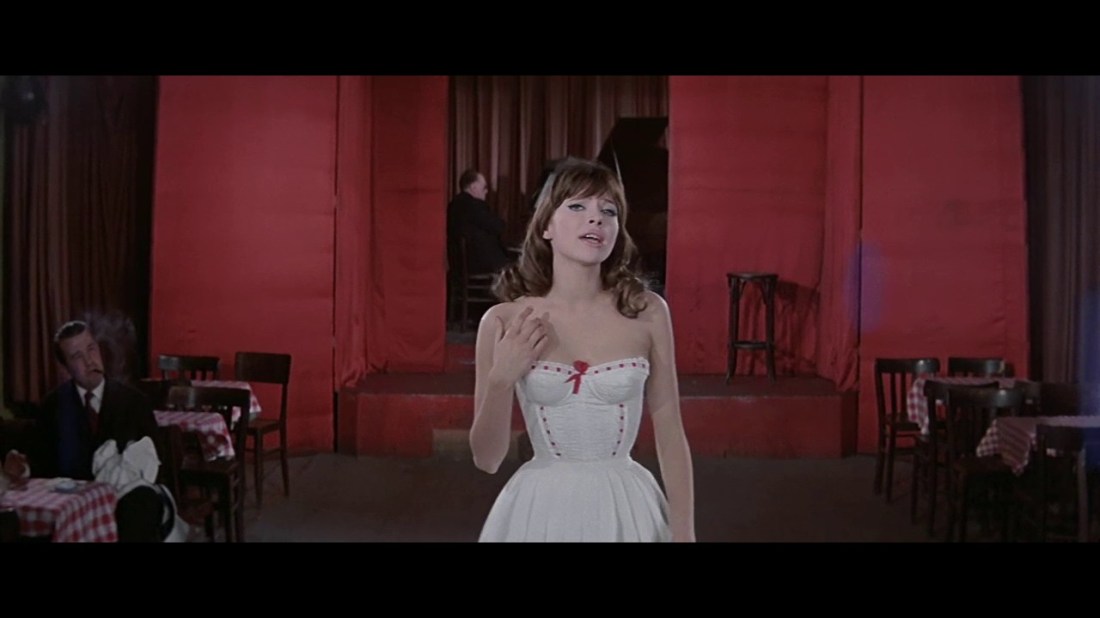
I realized that throughout this movie, the seriousness that came about the silence of the music seemed to be showing Angéla’s true emotions. The beginning of the film shows you a stereotypical woman in film but surprises you with the fact that Angéla was in fact an exotic dancer. She seems very liberated at first but through the montage of her in the bar, I saw and felt that maybe she was trapped in some way. When the silence of the music comes, you notice Angéla’s vulnerability. This for me was best shown when she performs in the bar. The song she chose talks about her being cruel, yet she is a beautiful woman. The creative use of color, music, and lines made me feel captivated, yet sorry for her. It was for me, both entertaining and somber. Although this may be foreshadowing her choosing to cheat on her lover when he refuses to have a child with her, I kind of saw that she was trapped in the limited time she has to bear a child. This being her ultimate goal, motivates her to act on her own as a woman with no limitations. In the end, her story towards this goal best exemplifies a story that is both comedic and subtly tragic.

Girls will be girls

As a simple film viewer (uncultured swine — just kidding), I typically shy away from films that are personally difficult to understand, i.e. films that are not in the realm of mainstream American and Philippine cinema. European Film, as an elective, kind of made me nervous because I consider it to be uncharted territory. The anxiety heightened when we watched the first European film for class — A Woman Is a Woman. As I was watching the film, I had no idea what was going on. There was always a frozen couple by the stairs of the main character’s apartment, Emile was always biking around inside their home for no reason whatsoever, and so on. What made me all the more confused was that it was introduced to the class as a musical. It was not the usual musical I was expecting; it was no High School Musical. I started to wonder if my idea of what a musical is was wrong all along, or if Europeans are just crazy. A part of me thinks it’s the latter.

Admittedly, I really had a difficult time grasping the film in itself. Amazingly enough, there was a silver lining — something I perfectly understood. I’m aware that it might not even be an angle the filmmakers wanted their audiences to focus on, but I wanted to shed a light on it despite the weird music and the unusual dialogue. Angela and Emile’s relationship was — as the typical millennial would describe it — toxic. Whenever I watch films with any type of romance, I always find myself pointing out whether a relationship is healthy or not, and in this film’s case, it is obviously unhealthy. The main conflict on the film centered around Angela’s desire for a baby and Emile’s hesitance towards what she wanted. Instead of being like mature adults by finding a way to compromise, Angela tries to get Emile jealous just to get him to agree with her, and Emile challenges her to do it throughout the entirety of the film. Compromise and communication are key ingredients to a healthy relationship, which Angela and Emile apparently did not understand fully. It was always about what the individual personally wanted, no matter what the other party said. If it were a reality, they would never resolve the issue, even though they seemed to have made up in the end. Since Angela really wanted it, she would probably push for it again in a day or two. Maybe.

With the toxicity of their relationship in mind, a question that bothered me while I was watching the film was this: is the movie sexist towards women? I mean, the title is “A Woman Is a Woman”, and the woman in the film is a crazy, self-obsessed girlfriend who is focused on getting what she wants even though she is told no. Did the title itself imply a “girls will be girls” notion where women are always spoiled and selfish? Or am I reading into it too much?

Perhaps the film’s narrative voice is actually a positive message, but personally, my interpretation was the total opposite. I guess that is the beauty of art — it is always open to interpretation.

Eccentric Rom-com

Eccentric. That is the first word that comes to mind after watching the first few minutes of A Woman is a Woman by Jean-Luc Godard. It is an entirely new ballgame for those who are used to seeing Hollywood movies. I myself was always on my toes, waiting for something to happen but to no avail. I expected the scenes to change or at least increasingly turn into something more exciting but they remain flat. The cameras stay inside the apartment as they mainly follow and focus on Angela, the protagonist. It creates an uncanny yet intimate feeling to the viewers, making it seem like we are stuck inside the all-white walls of her apartment to witness different events unfold. Some of the scenes wold start slow until they eventually turn into a roller coaster of emotions that is quite fast to follow. They leave the viewers grasping to comprehend how events turn out. The musical score even amplifies the atmosphere of certain scenes but the way the music abruptly stops and turns everything into a deafening silence (aside from the dialogue of the characters) leave the audience hanging. Everything else were entirely strange.

To be honest, I find it really unusual but I never lost interest in watching it. One would never expect what exactly would happen in the scenes that would follow given the arbitrariness of the entire film. It brings the viewers’ attention to all sorts of elements that are being introduced without straying too far from the situation of the characters. One would be the eye-catching colors and details of most scenes inside the apartment. Another would be the choreography that goes smoothly with the characters and the vibe that the film is trying to give. Interludes or events that are quite absurd, such as Emile riding a bicycle inside the apartment, would just pop out. It really felt like watching art.

Despite the theatricality, one could also easily immerse into the lives of the characters. The intimacy offered by the film to its viewers allow us to understand the emotions of Angela, Emile, and Alfred regardless of the irrationality of most of their issues and reasoning. That may be added to the comedic factor that bizarrely complements the drama. The constant switch between the two emotions provided a playful personality to the film.

The entire film might be something really unique but I cannot say that I did not enjoy it. It offers a completely new experience from the types of films that I am used to and it only brings excitement to someone who is yet to experience films of this caliber. It challenges the viewer to actually notice the other elements in a film. For me, A Woman is a Woman gracefully broke the barriers of a “normal” film.


“There she goes”: A Woman is a Woman (1961)

dir. Jean-Luc Godard

“Is this a comedy or a tragedy? Either way it’s a masterpiece.”

It’s a simple story. A woman wants a child but her lover says no. His best friend, however, is willing and apparently in love with her. Thus begins a whimsical love triangle — an exploration of gender roles and the dynamics within a relationship.

The tragedy lies within the clashing of a couple, evidently very much in love but still unable to reach any compromise. It’s a premise we’ve seen before but Jean-Luc Godard puts his own comedic twist to it.

This is a film wherein Godard’s passion for the art form truly shines. Just as Angela manipulates Emile into cooperating with her desire to have a child, Godard is as playful with how he manipulates his film. He creates a world in which there are very little boundaries. Continuity is often broken and so is the fourth wall. He inserts a random montage of strangers looking into the camera right in the middle of a conversation. Godard even gives a little wink to the audience with a reference to his most notable film, “Breathless”.

There are small details peppered throughout the film that make it seem just a little bit more magical. My personal favorite is a couple that stands outside of Angela’s apartment, unmoving and unbothered by their surroundings as they continue to kiss throughout multiple scenes. The apartment itself feels like a stage, with long panning shots that switch to a different character once it is their time to speak. Emile rides a bicycle into a shot seemingly out of nowhere and the audience laughs at how absurd it looks. Several times, both characters refuse to speak, choosing to walk around holding a lampshade and communicating through book titles. But maybe that’s not weird. Maybe that’s just how french people are.

“I want to be in a musical”, says Angela, and that’s exactly what this film is, but it’s just not what we’re used to. This is a musical that plays with sound mixing and audience expectations. About five minutes into the film and the sounds cuts abruptly, making the class wonder if there might be something wrong with this copy of the film. Apparently not; Godard is just having fun.

This was released in 1961, almost 60 years ago, and yet in 2019, this still feels absolutely fresh and unique. Anna Karina gives a charming, captivating performance as Angela and you can clearly see the chemistry she has with Jean-Claude Brialy who plays her stubborn lover, Emile. These two, along with Godard’s direction, elevate a simple story into an innovative piece of art.

My favorite moment happens somewhere in the beginning of the film. Angela walks away from the shot and right before Godard cuts, Lubitsch (Jean-Paul Belmondo) turns to the camera and says, “There she goes.”


The Charms of a Woman: A Discussion on A Woman is a Woman

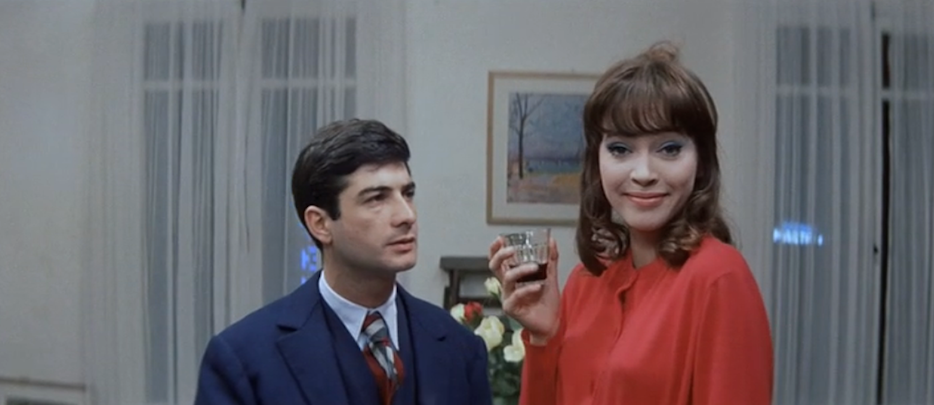
Anna Karina and Jean-Claude Brialy in A Woman is a Woman, directed by Jean-Luc Godard

Jean-Luc Godard’s A Woman is a Woman is a playful film illustrating the complexities of a relationship between a stripper and her lover. Angela had doubts on her love for Emile and believed that having his baby will give her an answer. Emile refused to give her what she wants, and so began their tragic love affair. Right off the bat, the storyline captures my attention because here, we have a woman who actually wants a baby at a time when having a baby and putting the needs of their husband first is imposed on women. As the film progresses, the vibrant colors, unique editing, and catchy score lures us even more. However, this is not to say the film was not difficult to understand.

Most of the time, events just happen. There are intermittent flashes that makes the audience wonder whether the scenes are connected to the storyline. A seemingly straightforward plot becomes more confusing, and you may find yourself confused with the film. We are quite unsure what will happen next, which I believe made the film even more thrilling to watch. There is no clear structure as compared to Hollywood films, and yet we remain glued to the screen because we are encouraged to uncover the mysteries. The use of a musical style heightens our experience by challenging us to find meaning or satisfaction amidst the chaos, but we find none because Godard creates displeasure instead. He irritates the audience by withholding information and refusing to provide clarity. Unlike Hollywood films that focus on narrating a stories that can entertain, A Woman is a Woman invites us to focus on the creativity of the visuals and how it complements the theme.

Considering the period when the film was released, I was surprised how Angela got what she wanted in the end. Perhaps, A Woman is a Woman is hinting that the changing role of women in society is gradually starting. It seems like Godard is exploring the topic of women’s sexuality, which was evident through Angela’s job as a stripper. Her dances were more of an expression of herself, rather than an avenue for the satisfaction of men. Contrary to our perception of strippers, Angela seems much more confident and able to show her femininity because of her job. She was not afraid to be creative and to defend herself, which can be seen when the couple were conversing through book titles. She argued that emotions are not a woman’s weakness when she said, “There’s nothing more beautiful that a woman in tears.” By touching on social issues such as women’s independence, A Woman is a Woman rejects Hollywood films that choose to focus on showing the good parts of life for entertainment. However, the Godard does not tell us what we should think or how we should feel about these issues; rather, he simply desires to shed light on them whilst creating an artistic film. Ultimately, Godard succeeds in breaking barriers in European Cinema not just through his unconventional filmmaking techniques, but also by discussing issues that society hides from.

A Woman is a Woman: A Portrayal of Adolescent Relationships

I have never been to a film class before, and although I have only watched a few European films, Jean-Luc Godard’s 1961 avant-garde masterpiece, Une Femme est Une Femme, portrayed the most playful acting from all the French films I have watched. It is important to consider, though, that I am not completely knowledgeable of the culture in 1960’s France (when the film was produced). Thus, some of the factors that I may point out may be wrong.

Revolving around a stripper named Angela, her boyfriend, Emile, and their friend, Alfred, A Woman is a Woman conspicuously showcases a whimsical rendition of how men and women are stereotyped when it comes to relationships. However, deeply embedded into the film, and is what we will be focusing on, is a portrayal of a not-yet-matured relationship of two individuals who do not yet know the repercussions of their actions as well as what they really want.

From the title of the film itself, “A Woman is a Woman” suggests the stereotypical notion that women’s wants are absolute. That is, as portrayed in the film, women want babies, and when women want something, they would do anything to get it — no matter how they would get it. It also portrays women as emotionally-driven, dramatic, always pouting, and pabebe. This was showcased throughout the film, when Angela kept pouting in front of Emile when he keeps rejecting her request for a baby. Her being emotionally-driven is also conveyed in a scene where the camera focuses on her while tears were rolling down her cheeks. Furthermore, Angela’s non-admittance of missing Emile when they were talking on the phone and, then, covering the phone and wistfully admitting to herself that she does miss him showcases the childishness of individuals like her during the early stages of a relationship.

The same can be said for Emile. The film portrays him as a guy who is not yet ready to marry nor have a child. Although this may not pose a problem in his character, there are scenes where, while arguing with Angela regarding her request, Emile can be seen riding his bicycle in circles inside their apartment. This may either suggest his thought that the two of them are merely going in circles, his lack of maturity, or both. Furthermore, his inability (or, maybe, unwillingness) to admit his jealousy towards Alfred and, contradictingly, further irritating (rather intentionally) Angela may seem a bit immature in their relationship.

There are also scenes that, although amusing, showcase the adolescence of their relationship. In the scene where the two did not want to talk to each other, they kept going to bookshelves and pulling out books in their attempts to concoct words and literally arguing without talking to each other. This can also be seen when the two of them keep trying to sass each other and, humorously, settling the argument with a demonstration of the proper technique of pronouncing “r.” More importantly, the adolescence in their relationship was conspicuosly showcased with a text telling the audience that Angela and Emile are so deeply inlove with each other that would go far beyond what they can go through, which would lead to reprecussions — that is, Emile’s “approval” that Angela can have Alfred’s child and Angela’s “compliance” just to spite Emile.

The film also portrays other factors in the film, such as when Angela was shown a picture of Emile with another woman — suggesting that Emile cheated on her. The scene kept going back and forth to the picture and to a close up from Angela’s somber face. For this, it seems to portray how Angela may be obsessing (and maybe overthinking) about Emile and the woman he is with in the picture, which is usually a typical reaction in inidividuals in seemingly committed relationship.

Conclusively, Une Femme est Une Femme sets a mostly-realistic portrayal of adolescent relationships, showcasing flaws that two imperfect individuals may have even though they truly are in love with one another and exhibiting it through colorful and entertainment dramatics.

A Woman is A Woman: A Lover’s Quarrel

Francis Gavin S. Musngi

A Woman is a Woman tells a story of a conflict between the sexes male and female. Angela planned to have a child with her boyfriend Emile, but Emile says otherwise, and provides him alternatives to her conundrum. Godard, the director of this film, tells this tale by creatively using out-of-this-world cinematography and acting choices to display this spectacle of when a woman doesn’t get what she wants. And when a woman really wants something, sometimes she needs to maneuver around her own problems. The film shows how much Angela and Emile stood their ground in the idea of birthing a child, and eventually found a resolution to their predicament – while showcasing interesting direction provided by Godard’s vision.

The tensions between the two, Emile and Angela, create a feeling of playfulness or light-heartedness as they tackle the idea of childbirth in their own ways. Emile tries to openly reject Angela’s advances – even suggesting one of his friends sire their child. While on the later scenes, Emile circles around in his bicycle and talks with Angela despite saying “no talking” in bed. This goes to show that even though he may be stern on his response, he feels a softness for his girl Angela – that even with differences between the couple, they still find time to love one another. Angela, on the other hand, tries to push her agenda forward with Emile, adamant with getting a baby from his lover. She tries things available to him, even “sleeping” with Emile’s close friend, just to get Emile to get her pregnant. All of which is shown in a dramatic and funny way – with friendly banter sprinkled throughout the film.

The film goes to show that indeed, “A woman is a woman,” in the way that they would be fixated to something they really want. The film goes to show the cleverness of the “woman” in a society that is depicted dominated by the opposite gender. Men tending the stores, bars, and other business, while women in the movies are depicted as the temptresses and mistresses shown in the strip club. It’s interesting to see that despite the gender divisions shown, the woman can wrap a man around her finger through her sharp wit and charm, depicting the battle between the sexes that resonated with that generation of people then. It’s an attempt to change the viewers perspective of women – to show that women are more than what they seem, and they are persons who go after what they want, no less than any other person.

What I enjoyed out of this film is the interactions between Angela and Emile, especially during the times when they share opposite reservations about the childbirth. The conversations regarding the pregnancy is what I would call, “cute,” as the playful cinematography alleviates the tense topic of one reject her lover’s will for bearing a child. Angela and Emile love each other, without a doubt, and this shown on how they interact and exchange words with one another. The conflict, despite it being very dramatic and something tense, becomes a play on who gets their way, and what it will take to get that.