The Troll Toll

Trollhunter (2010, André Øvredal)

When I first found out that we were going to watch Trollhunter, I was pretty surprised. This is because I actually have had the pleasure of watching this movie before when it came out at the height of the fount footage movie boom. After Paranormal Activity’s breakout and success in 2007, found footage horror movies became the in and new industry trend, and while plenty of these movies were terrible, some used the found footage conceit to create something distinctly unique and wonderful – and it just so happens that one of those movies that I have seen is Trollhunter.

Trollhunter’s main plot concerns itself with a group of students investigating the death of a bear that was illegally poached. What begins as an ordinary investigation suddenly turns into something much more supernatural as the students find out that the hunter of the bear is actually a Trollhunter – mandated in secret by the government. With the titular trollhunter wanting to quit his dangerous and underpaid job, the students join him as he hunts trolls and risk their lives along the way. 

In essense, Trollhunter’s plot is actually almost like the found footage movie that started it all – The Blair Witch Project. It is like Blair Witch in the sense that the film is about students recording something mysterious that is happening, and yet at the same time one can also see how this blind devotion to recording takes a toll on the characters. They get scared, they get injured, they risk their lives several times, and yet the camera keeps rolling as their determination sticks. What the film has differently over Blair Witch, however, is that while the scared students panic and run over each other, the film’s titular character is nonchalant and indifferent towards his work. To him, this is just something normal, and it is this neutrality that makes every troll encounter in the film equal parts thrilling and almost-comical.

Furthermore, something that really surprised me about the movie is that while the found footage style of filmmaking allows this movie’s visual effects to have more wiggle room with regards to how good it looks, the movie does not take this road and instead utilizes this style of filmmaking to amplify the scale and fearful wonder that the movie brings. When the eponymous trolls are on screen, the loud sound design and nervous camerawork keeps the film’s pace at a high rate.

Additionally, despite the film not being bound by normal means of cinematography, the film manages to capture beautiful views of the Norwegian landscape. From bright green forests to desolate and cold fjords, the film moves with its setting as much as its characters move the cameras, and this was very memorable and noticeable.

The movie, however, like most films in the genre, suffers from issues. One is that I felt that the characters were rather flat allthroughout. There was really no distinct character that stood out, and that made it very hard to empathize with any of them. Secondly, for some reason, the film felt too long near the second act. While the movie is a very easy and breezy 104 minutes, the midportion of the stretch suffers from some pacing issues that were very noticeable and contradictory to a majority of the movie. And the last issue of the film is that its ending manages to both be vague and confusing – maybe part of it is that I do not understand the social or political satire that the film attempts at times with the presence of the government agents but it just did not feel like an appropriate ending

Still, despite these problems, as a whole, Trollhunter was still an exhilarating and thrilling 104 minutes and is one of the best examples of this type of film.
Holy Motors

Holy Motors

                  The first scene already gave an eerie vibe. It gave me this idea that this movie was going to be hard to understand. I think that throughout the film, it gives the impression that it isn’t meant to be understand. In the first scene, the man unlocks a secret door which opens up to an audience that appears to be watching. I think this sets the intro to how each scene to follow is meant to target an audience. It really is meant to be an art form and show. The next scene appears to be a wealthy businessman who walks out of his mansion and enters a limo. At this point I think ok I guess it revolves around this businessman. Only to find out that his first appointment isn’t actually a meeting but him playing a role. He starts dressing up as an old beggar and executes it so perfectly. But nothing really happens here except for him doing the part. So by this time, I’m really so confused and I prepare myself for the movie to actually keep getting weirder. I found the next appointment really interesting because it seemed very futuristic like how they make animated movies. I was again impressed because his stunts were done so well and he really is so versatile. I think the scene with the woman was meant not to be humanistic, it seemed like they were filming something that was supposed to mimic animals or aliens. The next appointment was the one I was most impressed with. He did it so professionally. Like he even ate a full meal to prepare for his next role. This beastly role was done so well, he was freaky and bizarre in a really good way. When he bit the assistant’s fingers, I was shocked and left hanging because I don’t really know what happened to the girl afterwards. The contrast between the model and the “beast” appears as a modern beauty and the beast. The next scene of the actor and the daughter made me confused as to whether this was his real character only to realize that it was still just another appointment. In the scene where he kill his doppleganger, only to be “killed” as well. At this point I think, how can he survive, this is probably the end of the movie. But I think at this point it shows that death it something that’s so easily reversible in the film, death doesn’t actually mean death in the act. The next scene where he acts as a dying father, was the first time I saw another actress acknowledge that they were acting. The daughter tells her real name and introduces herself once the scene was finished which shows how everyone in the scenes are all part of the act. The next scene where he met up with his former lover was probably the realest part of the film. It was realy because he didn’t set up an appointment with her, it was sort of by chance that they saw each other there. They also seemed like they haven’t seen each other in so long are have both been so submerged in their different characters for so long that they barely recognized each other. They used the spare 20 mins that they had to catch up. It was extremely romantic and intimate even as the song expressed what they truly felt with each other. At one point I even felt like they were unsure if everything they’ve been doing has been worth it. But even if they had true feelings for each other, they were still stuck in this bubble of acting a part. They can’t actually be together because that’s not where their story leads them to be.
She has a fiancé/boyfriend (probably also just part of an act or part of her character). That’s why this time is so precious because it’s the only time they show a glimpse of who they really are apart from their roles. When the woman committed suicide, I was so unsure as to whether it was real or was this just another way of them creating death and bringing her back to a different character. Although I had a feeling that this was somehow real because the way Oscar reacted was different as how he used to. Normally, once he enters the limo, he switches his emotions/character right away. That’s sort of his neutral state but when he saw the woman fall, he was not able to handle it. He screamed and drank as if he was depressed. (maybe it was the tipping point) I somehow felt that through out this movie, the man was just so trapped. He had no chance to be himself, no chance to make his own decisions because someone was always watching him. I think to a certain extent, it was really beautiful how he was able to channel himself into all those characters. It was entertaining as one of the people in the audience. But it also begs the question as to if he was happy, maybe he’s been inside this acting job for too long. He seemed overworked, lacking inspiration and desperate for something more than this life he had. This goes to show how a performance is really just a facade, it’s beautiful in the outside but these individuals have a whole lot more going on inside of them.

Holy Moly Motors

This film was an extreme roller coaster ride of intense abstract scenes. The film sheds light to the importance of role-playing in one’s life. This helps people really find themselves and who they are. How we as humans would present ourselves in different moments in our lives. An interesting factor of the film is that Denis Lavant is so masterful in his appointments that take him in different disguises and personas that are completely different have no link whatsoever. A puzzle for me was trying to piece them together and make sense of each persona’s link to the other but it was a futile effort.

I had two scenes in the movie that I really found interesting and admired. One was the motion capture suit scene where an abstract dance was done. This scene although abstract and made no conventional sense, had purpose. It portrayed the wild and happy expressions of youth. Then the scene I was most fond of in the film was the accordion playing scene. This was a nice change of pace as it acted as the intermission for the film’s unending abstract storylines. Even though a break was in order as said, it wasn’t going to be a conventional break and this scene really impressed me.

Sixth

Holy Motors by Leos Carax

If people would ask me what would be the weirdest/strangest movie I could recommend to them, this would be it. I feel that this movie really challenged me in a sense that to try to understand it is to not even try at all.

Holy Motors by Leos Carax focuses on a man named Mr. Oscar who goes around France portraying different and quite unique characters in front of crowds without them noticing it is a part of an act. The movie calls these jobs of Mr. Oscar as ‘appointments’ while he goes around in a limo driven by the only other main character in the movie, Celine, that is used to transport him to different places around France. Each ‘appointment’ that Mr. Oscar goes to escalated from quite normal for the movie to down right strange. This also goes for the movie that became increasingly weird yet engaged me enough to want to know what he would do next.

The way the movie introduced its premise was quite slow, we first meet the protagonist leaving his home and immediately is told about his first appointment and he starts putting on make up and a costume. It is never immediately explained on how the main premise of this being a sort of ‘show’ until a man is in Mr. Oscar’s limo. They talk about the ‘business’ and how it is now changing. Mr. Oscar talks about how he “misses seeing the cameras” and how he is doing this for the “beauty of the act” as well which may come to the conclusion that this may have been filmed more obviously back then and was seen by a bigger audience and was quite popular back then. From simply becoming a beggar on the streets of Paris, to murdering a banker, and to finally coming home to a family of chimpanzees as his last appointment the movie is nothing short of bizarre and unique.

To understand this movie, I believe is to try and understand the weird and uncomfortable. To create beautiful acts or scenes is to embrace the oddity of what it all means. To create something beautiful through weird and complicated means may sometimes become too fantasized by those who want to try and be different and want to seem more inclusive of other kinds of art. Just as Mr. Oscar was portraying Mr. Merde, the photographer simply started taking pictures of him against a backdrop of wanting to portray the ‘weird’. It seemed as if he was forcefully trying to connect both the normal and unique odd-ball types of art forms. From this, a question that came on to me was “To what extent would people go to create beautiful art and what does it mean for art to be beautiful?”

The world continues to change together with its cultures and how people react to art. Society back then used to love the acts that Mr. Oscar portrayed through his appointments. From intimate scenes between father and daughter and another one of his appointments where he talks about life as an old dying man, which shows raw and true vulnerability in film to the outright bizarre craziness of biting off people’s fingers and murder action. But now, we have somehow embraced a different kind of art, one that is all about who and the amount of profit that can be garnered from it.

HOLY COW

HOLY COW.. is what was continuously being said in my head throughout each scene of this movie. In most movies, the longer you watch the film the more you get to understand everything, but this is definitely not the case for this film. It seemed that whenever I added another scene to the big picture, the more did it unhinge me. I was just getting more puzzled as I watched the film. Even until the very end, when you would expect to have everything finally piece together, things were just made even more confusing.

The movie started with Monsieur Oscar in what I think is his actual form? At the time he just seemed to be an ordinary wealthy businessman who lived in a great house, and owns a limo, but his day to day assignments proved otherwise. M. Oscar had 8 assignments for the day and through his assignments he was able to showcase to me the abnormalities and the randomness of life. Through his different roles/personas, I sort of tried to make sense out of everything by proving to myself the significance of what he’s doing. I just feel that, although some assignments he did were weird and seemed to have no positive effect on anybody, there are actual people in our world who act similarly and they are sort of important in maintaining the balance of the world, I guess?

Just when things got really weird after the finger-biting homeless, and old beggar woman role M. Oscar surpasses death? Or so I think he does? He gets stabbed in the neck and you’d expect him to die by then, but he turns out fine and goes on towards his next assignment. Later on in the movie, it is revealed that other people involved in M. Oscar’s assignments, are also playing a role or doing an assignment as well. This just made things even more confusing, and I really couldn’t tell between reality within the film, and acts vis-a-vis.

As he continued to succeed in completing his assignments, I started to doubt his humaneness due to how much talent he had. It didn’t seem possible to be that talented to be able to perform all these personas. Without consulting external analysis, I came to the conclusion that M. Oscar is a robot, or isn’t human at least? This probably isn’t the case, but to me it explained a lot of blurry parts in the movie. How he was able to escape death, how he was able to have so much unique talents and skills, and how an agency with so much parallelisms between employees are just some of the parts explained by my theory. Even the title could seem to hint to something of the likes.

HOLY MOTORS: What was The Point?

Leos Carax’s Holy Motors (2012) has outranked all of the movies we’ve seen in class with regard to being the weirdest. The main character of the film, Oscar has assignments with a driver of his limousine, Celine. Without direction or any given context as to why it was happening, he goes around the city to play different roles. In contrast to Trier and Leth’s The Five Obstructions (2003), each of the tasks given to the main character were definitely not related to one another and even seemed to serve no purpose at certain times.

            After a very confusing beginning scene of the film, I was finally ready to begin to comprehend the rest of the movies. Oscar, the main character, appeared to be a businessman that had many appointments to accomplish. The film begins to become confusing in scenes, such as when he had to dress up as an actual old female beggar, and the time when he appeared to be a naked freak to the unbothered character of Eva Mendes. These definitely confused me when it came to searching for the film’s essence and direction. After a while, you begin to realize that Oscar was actually an actor and the scene of him appearing to be a businessman was just as fake as all those other roles that he’s played. Work doesn’t seem to end for Oscar, as he continues to play a certain role until the following day.

            I felt that the movie was actually teasing the audience that were in search for the “true Oscar” and who he really was. In between appointments, we can try to read his actions, but you’ll definitely not fully understand, who he is throughout the entirety of the film. You couldn’t really tell which parts of the film outside the limousine showed the actual side of Oscar. Some roles tend to fool you into thinking that it was his actual life, such as when he was with a little girl that appeared to be his daughter, or when he met with an old friend at the rooftop of a building.

            The movie seemed like its purpose was to truly confuse and disturb its audience. Creating an illusion of a lack of purpose in the film. As a member of the audience, you look for the film’s purpose and search to answer the question as to why the character was doing what he was doing. I was awaiting the end of the film, hoping that it would finally reveal the reasons behind all of these. The movie ends with talking limos of the other actors in the city. This annoyed me even more as I had to think of reasons with regard to that scene too.

           A week after watching the film, I begin to wonder if the purposelessness of certain scenes could be related to our own lives. Sometimes we act like robots, doing what we do for something we feel serves no purpose at all. Oscar is confronted by his superior asking him why he continued to do what he was doing. Oscar expresses that he continues to do what he does because he remembers why he started. If there’s any lesson that I personally learned in the movie it would be to remember that regardless if you feel like what you’re doing serves no purpose, recall why you were driven to do it in the first place.

           Despite the confusion and headaches the film offered, the film viewing experience was actually still quite enjoyable, I continue to look forward to the rest of the films that the course has in store for us.

Holy Motors – Review

The movie had my attention from the very first moment when the man asleep in bed wakes up to approach a wall or the room that resembles a forest. He seemed to have played the “Find Waldo” version of opening the door often, as he knew just where to look to unlock the door using a key growing from his finger. This is when I knew that I was in for a ride.

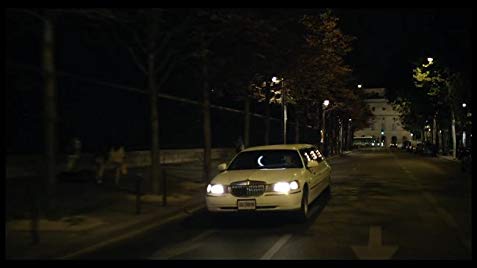
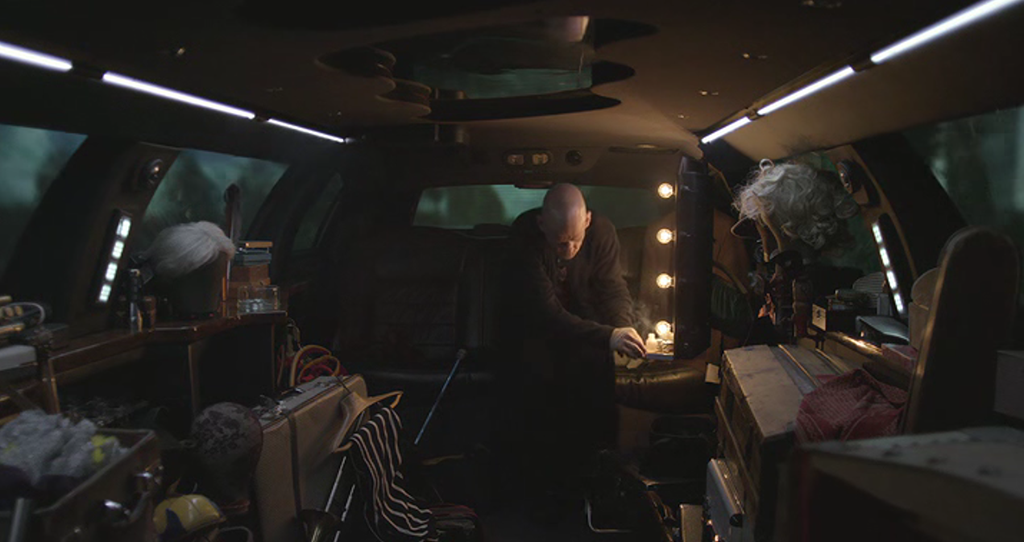
He gets into the waiting limo, driven by a taciturn woman, and we see that the back of the limousine is significantly larger than it seems on the outside, similarly resembling the tents in Harry Potter. The back of the limousine is filled with costumes and props with even a dressing mirror installed. The first transformation, the first of many to come in the day, takes place as he dresses up as an old lady begging for money in the streets. When he gets out the first time, he has transformed himself into a wretched beggar woman. His performance was nothing short of superb, fooling everyone that walks past him in the street, or perhaps it was because no one ever really cares for the poor. His succeeding performances or embodiment get even more bizarre, with him embodying the spirit of his characters as if it were himself. His “appointments” take him into personas so diverse, it would be futile to try to link them, or find a thread of narrative or symbolism. If there is a message here, Walt Whitman once put it into words: “I am large. I contain multitudes.”

One of the more memorable moments in the film was shortly after when Oscar bit the finger off of the famous fashion designer and kidnapped the model to an underground tunnel. It was there that Oscar ripped her clothes to change her to look like a Muslim woman. The model doesn’t flinch much in the process, as she stays in character of her job as a model – staying posed and not reflecting any emotions. Her job as a model preceded her emotions as a person, a statement that this movie seem to make of how our society has forced us to embrace our jobs as a large part of our self identity. Sometimes it constitutes our entire self.

Holy Motors: A surrealistic take on film making

Splashing around in a pool of wit, theatrical splendour and unbounded imagination, Holy Motors is a true original, serving as an avenue for us to open our minds towards what could be. There is something so thrilling about its lawlessness leaving the audience more engrossed, wondering “what’s gonna happen next?”

The spontaneous turn of events kind of remind us that there is so much more to discover, so much more to see. It reminds me of simulation games where you could choose a character you’d want to play with a number of lives, the possibilities are endless. 

There is something so enigmatic about the way Denis Lavant’s character, Monsieur Oscar moves, how he takes on new roles or embodiments and portrays them quite perfectly, it is almost believable. His embodiments were so intriguing it gets you thinking, is this a mere simulation? Could there be a schizophrenic phenomena? Denis Lavant probably took on one of the most strenuous and demanding roles of all time, having to portray ten different personas. 

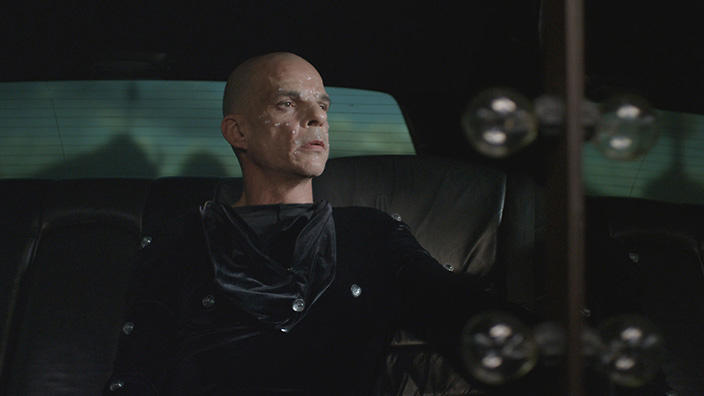
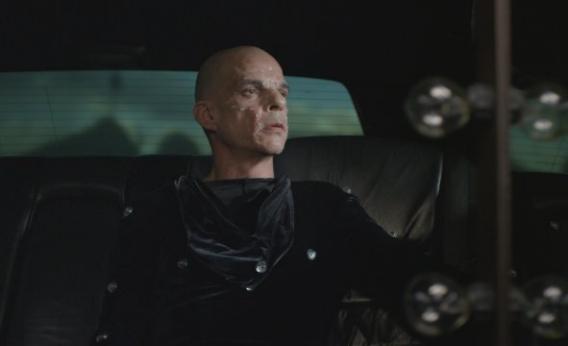
We learn to appreciate the physical tremor actors may go through as they portray their own roles with great skill and talent stretching themselves out just for the love of the craft. This is exemplified when a mysterious man with a red mark on his face asks Monsieur Oscar if he was getting tired in his job. 

As part of the audience, you learn how to choose not to make sense of it anymore and just simply enjoy watching the events that unfold. The filmmaker gives you the power to define it and give your own interpretations. It could bring in a new kind of cinema, one that is more explorative of the plot, stepping out of the cinematic conventions, letting go of its habitual and ritualistic ways. 

I think the filmmaker was exceptionally visionary and valiant. The entire movie felt like a fantasy dream, that could take you to places and allow you take on whatever role you would want. Despite the unconventional plot, it was still an oddly spellbinding film that open-minded individuals would love indefinitely. Its plot is unparalleled, without a doubt. Its peculiarity made the film an avant-garde masterpiece. 

Holy Motors

Holy Motors is a film, to put it simply, not easily digestible.

However it can be once you see it as it is – as if from a child’s perspective seeing it for the first time. The film if taken in in with our scrutinization over every singular aspect renders it almost utterly incomprehensible. However, it is also in this taking apart that we finally realise what the film is about – not a mere bundle of random clips of ostentatious scenarios put together, but a film about performance, acting, and cinema itself.

Towards the end of the film, we see the main character, Oscar, speaking to his presumed boss (“What keeps you going?” “The beauty of the act”.) One of the things that make a film a film, and that which drives the plot forward, are the characters who bring the story to life and are essentially the moving force behind the continued progression of the plot. In Holy Motors, we see a multiplicity of fragmented plots and the film’s clever transitions between them, as well as its integration of multiple genres and types of movies – drama, a musical, a CGI-edited film.While all of the plots seem to have rather mainstream narratives – even the scene with Eva Mendes, which may be said to be indicative (if we look closely) of a more explicit rendering of the otherwise not uncommon Beauty and the Beast movie theme. Performance is an extremely rich area of cinematic expression (Spiedel, 2016). More often than not, actors portray their character intentions on screen actors’ through carious aspects and mannerism they intergrate within their performances. According to Speidel, performances and our decoding of them are shaped by our everyday shared understanding of human body language, which alerts us to the possibility that (ex.) the act of chewing a lip, for example, may signify anxiety.The main actor Denis Lavant may then be said to have succeeded immensely in his portrayal not just of one, but nine drastically different roles, some of which are not even human. The entire film was animated by acting – both of the entire cast and Lavant. The only thread of continuity was the Holy Motor – otherwise, the film is a fragmented set of various scenes, ranging from the normal (the father-daughter conversation, the bedside table scene)  to the obscure (the CGI simulated sex scene) and the absurd (Chimpanzee scene). The entire film, in that sense and from the perspective of the viewer, may simply be said to be a testament to the actor’s versatility and raw talent.

However, despite this, without a consistent narrative, a setting/situation to hold onto, without actions having consequences, how do we arrive at the character’s purpose? We know he’s an actor, and we come to expect these performances, and yet the expectation of seeing the “real life” underneath is sometimes teased but never really met. Hence we proceeded to an analysis of his performance itself, without still knowing the meaning of the film nor the intent behind these performances. In the realisation of the reality that there are an infinity of different interpretations of the film. And since it’s quite impossible to come to one, we realise:


The main question Leo Carax’s film begs its viewers, more important than what it means, or even more important than how we comprehend it, Is it possible to enjoy a film that lacks such a crucial filmic element – narrativity? Is it possible to enjoy a film that doesn’t allow you to orient yourself in it?is is it possible to enjoy a film you cannot understand? The answer is YES. Because of the unspoken element of film – experience, Specifically, the kind of film experience Holy Motors brings us.

While the film happens in a homogenous world (single diegesis, from day in to day out) it takes you to another world. Every film creates its own cosmos, its own universe, and Holy Motors creates many. The Experience of Watching the Film which constantly interrupts itself and doesn’t create a seamless experience renders it spontaneous and disorienting. The line between fact or fiction is so blurred until we don’t know what the hell is happening. And as soon as we think we know what’s happening, cars start talking.

While it may be the complexity and pure chaos of a confusing plot that initially reels our attention and makes us keep watching, continued by the captivating performances of the actors, the experience of the film draws us in and make us stay.

It’s a movie about the experience.

And if we are not meant to experience these movies, we can’t make works of art. And you can choose to leave the film artless, or you can appreciate the individual broken pieces – every singular element, every singular performance.

It’s not a film of glorious visuals, of heartwrenching morality, it’s a film of performance, it’s a film not just to be watched but to be experienced, that thus constitutes “The Beauty of the Act” – no matter how fleeting it may be.

Holy Motors has won and been nominated for dozens of prestigious awards. We love what we can’t understand. Let’s not ruin it by trying to.

The Different Faces We Meet: A Discussion on Holy Motors

Denis Lavant in Holy Motors, directed by Leos Carax

One of our deep needs is to understand the world around us. Uncertainty and ambiguity pushes us to generate more explanations until we come up a plausible conclusion. This moment of thought and reflection is precisely the aim of Leos Carax when he created Holy Motors, a 2012 French-German film starring Denis Lavant and Édith Scob. Unlike any conventional Hollywood film you might have seen in the past, Holy Motors introduces a day in the life of Oscar, played by Lavant, as he disguises himself into different characters in the back of a limousine. His chauffeur, played by Scob, tells us that Oscar will have nine appointments throughout the day. 

The nature of Oscar’s appointments are never revealed. Initially, you might think that he is a businessman trying to show the cruelty of society when he arrived at his first appointment as a beggar woman. As soon as he dons a motion capture suit and performs an erotic scene with an actress, you begin to wonder, “What’s going on in the film?” The next scene becomes more bizarre than the last as Oscar transforms into Monsieur Merde, kidnaps a model from a shoot and makes her do all sorts of things in a cave. Thus, the film’s eccentric, strange, and provoking qualities seem to present European cinema as an avenue for wide-ranging techniques for filmmaking and storytelling. More specifically, Holy Motors points towards the idea of counter-cinema put forward by Peter Wollen in his essay, Godard and Counter Cinema: Vent d’Est. For instance, the lack of  a cause and effect driven narrative is evident in the film as we see things happening to Oscar as opposed to events being a result of his actions. His goals and desires are hidden from the audience. For some, confusion may be the dominant feeling as a result of the disconnected scenes. However, I believe that by using narrative intransitivity, Carax was able to take the audience in an exhilarating, visually compelling ride. Each scene feels as if you are opening a present on Christmas day: you will never what you will get inside. His scenes invite you, then, to stop thinking too much; rather, just sit back and enjoy the ride.

Furthermore, you may feel estrangement from the characters because we never truly see their identity. Although it seems like we see the true Oscar when he is in the back of the limousine — such as the one who admitted that he is getting tired of the job, the scene where he escapes from the limousine and remains unharmed after getting shot multiple times suggests otherwise. Other scenes such as when he played a father to an insecure daughter makes you question whether their relationship is genuine or if the daughter is simply another actress who plays a role. Having said that, the film exhibits multiple diegesis since the scenes have nothing to do with each other. The plurality of the worlds is evident in Oscar’s roles and the world around him. For instance,  the scene where he plays an accordion with other musicians came out of nowhere. The people in the cemetery seem to be normal people who were disgusted when Oscar appeared as Monsieur Merde, whereas a young woman admits that she is also an actress when Oscar took on the role of a dying old man. By using estrangement and multiple diegesis as techniques, Carax shifts the focus of the audience from building a connection with a typical character to exploring the world of making film filled with different genres and actors. He makes the work that goes into the production of a film apparent by giving glimpses of Oscar in his theatrical dressing room in the back of the limousine before and after each role. At one point, Carax includes a scene between Oscar and another man that reveals the former’s intention in performing the roles: the beauty of the act. Carax hints the effects of the changing landscape of the film industry to the actors, to the directors, and even to the audience.

Just as we thought that the film’s strangeness ends when the main characters part ways at the end of the day, the appearance of talking limousines beg us to stay for more. You may ask: Do the main characters know that the limousines can talk? At this point, we have accepted the fact that our questions will never be answered. Maybe talking limousines are just as normal as biting fingers in Oscar’s world. Holy Motors reminds us that sometimes, the best movies are meant to be enjoyed rather than understood.