
The Edukators: A Strong Political Commentary

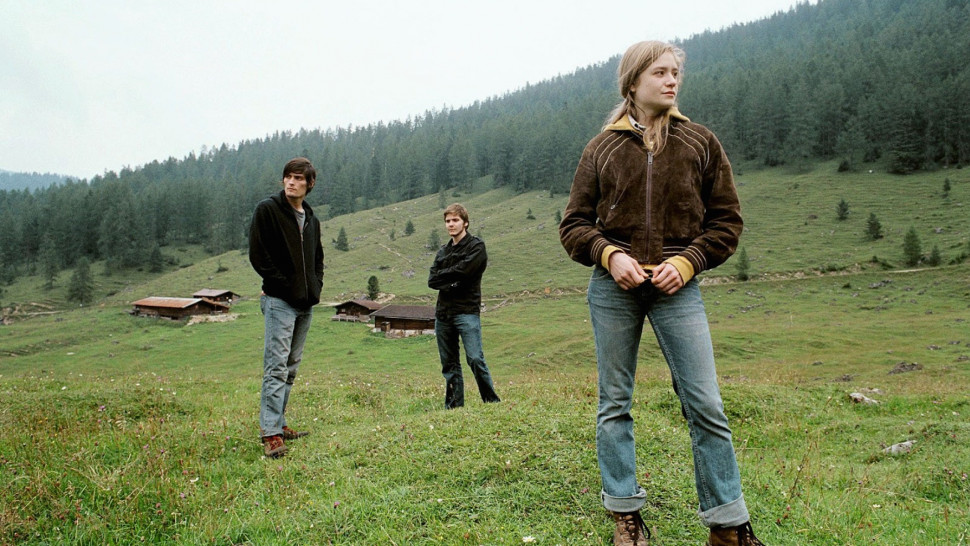
Julia Jentsch, Stipe Erceg, and Daniel Brühl

I find it hard to talk about The Edukators because I feel like I am somehow still undecided on my opinions of the film. I have a love-hate relationship with its characters and I feel like I am always going to be torn on whether it delivered its political commentaries well.

I want to start with the things that I like about the movie. I feel like deep down, despite my acceptance of how society is already, the ideas that Jan, Jule, and Peter have are thoughts that I also have. The truth in what they say is heartbreaking especially when you know it yourself and when you completely agree. But not having the same will and courage to fight for that chance of change in society makes me admire the characters. Even the complexity of Hardenberg’s character, who was swallowed by the system but had the same idealogies before deliver an important, powerful, revolutionary message. The movie fully encapsulates what it’s like to live in an era of frustration and seeing things that are deeply dysfunctional in society but the inadequacy of being able to do anything about it.

The film also looks as if it’s been filmed using a phone camera, but it works so well on how unvarnished the film feels just like how its characters and their understanding of their ideologies and decisions to act are also underdone. The camera feels like a voyeur or a documentation of kids running around revolutionizing organically. I love that the film is able to capture that.

But despite the brilliant message and cinematography, there’s something about how the characters deliver their messages that feels so banal. They do not feel as natural as the messages that were delivered in Goodbye, Lenin! The movie also lacks the sophistication and the elegance of delivering a political statement subtly.

Moreover, and this is where I feel guilty and would like to apologize to Daniel Brühl for, despite the characters’ admirable valor and boldness, they become more and more scattered, disastrous, and annoying at best as the movie progresses. By the end of the film I couldn’t care less about the characters getting in trouble, or who’s gonna get with who, since they managed to infuriate me time and time again. The shift to the petty teen drama of the film that started so strongly with a great political message confused me, and it was hard to watch the characters go over and over the same stupid drama. They also began showing how incapable they are of creating stable decisions on their own without being catastrophic. So much of the movie’s political notes could still be expounded on, if the movie hadn’t so gleefully jumped into teen drama conflicts instead.

But despite my dislike of the petty disputes, I can’t help but think that what if, that is supposed to strengthen the whole point of the movie. The characters’ overindulgence of themselves is the film’s way of saying, these individuals are only a bunch of kids. They are a bunch of kids because no one is brave enough to take a stand and demand for change than a bunch of kids. The movie even goes as far as the characters saying, “We screwed up, we did it to save our own asses” acknowledging their vulnerability and susceptibility to mistakes that may have been caused by their age and ignorance. The film magnifies the truth that revolutionaries all over the world are only being led by the youth who are the only ones willing to recognize the defects of society. That is why tendencies such as extremity of decisions leading to catastrophic consequences are happening because, these kids aren’t being guided, aren’t being heard, aren’t being supported. Significant change can only be attained if the adults are willing to wake up as well and want these changes too. The same way Hardenberg was able to recognize by the end of the film that the characters are in need of his support too.
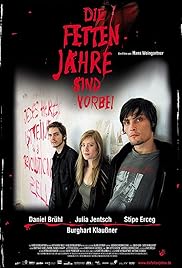
The Edukators

The Edukators is a crime-drama film by Hans Weingartner. The film centers around three friends who invade the houses of rich people to rearrange furniture and leave notes as a form of activism.

I did not enjoy this film because of its flimsy characters. I expected this film to be political, yet these so-called “anarchists” did not fulfill what their goals properly. Aside from being faux anarchists, these characters annoyed me so much that at some point I was rooting for them to lose. I felt bad for the guy they kidnapped because he had to sit through these characters babbling for numerous days. I felt some sort of relief when the film ended.

The film’s structure was pretty easy to follow, and there was nothing objectively wrong with the film. However, these characters were so annoying that I would definitely not watch this film again. I would not recommend it to anyone.

The Edukators (2004)

The Edukators (2004) is a German-Austrian crime drama following three young activists who break into homes to rearrange the furniture of wealthy homeowners for the purpose of leaving political messages. The film is left-leaning through and through, brimming with themes of the lower class versus the elite class, with the youth representing the lower class struggling to make ends meet while the apathetic elite lives it up in mansions with their designer vehicles. The Edukators as they called themselves thus targeted certain members of the elite class who were shown to be completely ignorant towards the plight they perpetuate. This dissatisfaction with capitalism is by and large the entire point of the film, and this frustration is made palpable in almost all its aspects.

Yet, this is not another leftist or propagandist film pushing for armed struggle, even though the film does go there at one point. Rather, Hans Weingartner chooses a plot and characters that are wholly nonviolent to make viewers think about where they stand in the political spectrum. Audiences also perceive a certain conflict of ideals between past and present (one example being the ideals of Hidenberg) in the film and are invited to consider both sides of the spectrum. This is something I particularly appreciated about the film: it didn’t sway too much to either side, and instead simply encouraged its audience to think.

Audiences receptive to these ideals will find much of value to watch. I personally found the three protagonists’ impassioned soliloquies on the state of society and the state of their individual lives to be quite moving. Jule, for example, was a waitress working off a debt she incurred because of a freak accident that led to a wealthy businessman taking advantage of her. These stories serve to give these ideologies as well their own human faces: viewers are put face to face with the realities of the systems they themselves unknowingly perpetuate in society. Social justice is perhaps the clearest theme, and this is something any viewer would relate to regardless of their political leanings.

To an extent, I felt like the romance story arc was placed there solely to provide a bit of fan service as well as to make the movie a little more desirable and accessible to Western or mainstream audiences. While it did lend the film a more human face for viewers who may not be completely on board with the ideologies presented, it ultimately felt unnecessary not to mention half-baked in its overall execution. Not only was its contribution and effect on the plot very meager and unsubstantial, it was also very stressful to watch as it only served to make the protagonist a little unlikeable.

Admittedly, the love triangle was certainly central to the film’s story; viewers cannot help but feel disappointed towards one protagonist as he commits infidelity and betrays the trust of his best friend. However, this only serves to emphasize that as the film closes, there’s a sense that these three are working towards something bigger than themselves, whether that is the fight for a more just society, or simply their unshakable bond as friends.

Get ‘schooled’

The Edukators‘ premise was actually very interesting to me. It was summarized as a narrative about three teenagers who break into the rich’s houses to “scare” them out of their privileged ways and mindsets. It attacks the issues of capitalism and how, even though it is advantageous to some, it is not beneficial to many. The rich get richer, the poor get poorer (and the edukators want to do away with this reality). Even though I found the plot interesting, the element of the film that caught my attention the most was actually the characters of the movie. The characters were very complex and different from one another. I believe the film had a character-driven story because of each of their traits and complexities. Peter, Jan, and Jules all had different strengths and weaknesses which contributed to driving the story forward. Out of the three of them, I liked Peter the most. I found him the most decent character because of his choices throughout the movie. As an edukator, he was more of the leader figure. He was who Jan turned to whenever he did not know what to do because Peter seemed more calm and collected then him. As a boyfriend, he was just trying his best to be good for Jules. He just acted like a typical boyfriend. As a friend, he always had Jan’s back, no matter what Jan did. He seemed like a well-rounded character despite his flaws. Jan, on the other hand, was more flawed than Peter. As an edukator, he often knew what he was doing, but he still depended on Peter to fall back on. As a friend to Peter, I felt like he was not as good a friend as Peter was since he kind of “stole” Peter’s girlfriend. He started falling for Jules (for some weird reason — I honestly do not know what they saw in her) behind Peter’s back even though Peter was dating Jules. What kind of a best friend would do that? It did not help that he tried to justify what he had done to Peter, which cause their big fight in the latter part of the film.

From the three edukators, Jules was the character I hated the most. I mean, the entirety of the plot of the film was her fault. None of the events would have transpired if she had not incurred the debt she owed to Hardi, or if she did not leave her phone stupidly in his house when they broke in, or if she did not cheat on her boyfriend with his best friend. She made so much mistakes and still got away with it in the end. She was able to escape paying her debt, got out of going to prison for everything she had done, and even managed to keep both Jan and Peter in her life.

I guess I understood what the edukators were fighting for but I got pissed that they got away with so much things even though they did not deserve it (especially Jules). I feel like they should have gotten what they deserved since they did cause a lot of problems for someone else even if he was merely living his life with the money and name he created for himself.

Edukators: WOKE


Youths can change the world. That’s what the Edukators thought as they tried to rally against capitalism of the world. Angered with the situations of rich abusing the poor, Jan, Julie, and Peter came together to pursue their goals for world change. The movie itself is juvenile, more emotive in the sense of how the youth protests win against the bad guys – which were the corporations or the adults. The ways of getting back to them are breaking into their villas or houses and warping and defacing their furniture, and then later leaving a calling card. Jan begins to influence Julie with the ideas of their movement and push her into joining him along with Peter after his trip. The movie is really a ­think piece of how the youths fantasize their ideal world, despite the irony of depending on these structures of capitalism when they ran out of supplies in the cabin. During the rising action, where they kidnap the homeowner when he found out about their identities, do the edukators give up or do they find a way to persevere? This movie, in itself, really is a story of solidarity between friends – coming to their goals and aspirations to the very end, despite the challenges within and outside them.

The story began with the Educkators doing their MO, breaking into houses and trashing their furniture. The dilemma began with a love connection between Jan and Julie, who was Peter’s girl. Despite them having the same vision-mission for world change against corporations, the find tension between themselves in finding out what to do in their hostage situation.

As anti-capitalist activists, the edukators wanted the world to see what they’ve done and their message against the systems of capitalism. As the movie started, their acts were unorganized and driven through emotion – frustrations against the capitalist world of today. Getting revenge against a boss who fired Julie, and Jan angry with the systems that undermine the poor for the sake of the rich 1%. They were driven but had no fuel to continue. As a small sign of rebellion against the system, things started to break down when they were caught by the owner of the house. Soon after, Peter finds out of Julia infidelity, straining the relationships within the group. Do they proceed for their movement, or was this the end of the Edukators right there?

From there, the film became more character-driven. Rather than the movement itself being a noble cause, it was the characters who found their way because of their affiliation for their movement. They settled their differences because of how the Edukators wanted to make a statement. Rather than adhering with the demands of the kidnapped, which was to release him quietly and he wouldn’t snitch, they outsmarted even the police together. As a group, they can do many things as long as they kept their wits with them and banded as one. This film was of how they learned their motivation for this movement and whatever it would take to get them out of this mess.

Ninth

The Edukators by Hans Weingartner

The movie was very interesting. Watching a more political driven and thought provoking movie was quite different from the weird and crazy that we have been seeing in class. It was nice to have an understanding of what Germany was going through during this time and having it so well named, The Edukators. With the plot revolving around 3 teenage activists who rearrange furniture and items from upper class homes yet never stealing anything but identifying themselves as “The Edukators”. There is some weird tension between the three as Jule and Peter are seeing each other yet Jan has feelings for Jule. The story begins when after Jule and Jan “edukating” (yes I will use that word now) the home of someone Jule had a debt to, a wealthy businessman named Hardenberg who catches them in the act of retrieving back Juel’s cellphone. They kidnap Hardenberg and then take him to a remote island to deal with the hostage.

The movie then shows us the different sides of how to act in the new modern capitalistic society. There are these 3 teenagers who are idealistic, dreaming of dismantling the system to create a whole new order as they have been exploited and cheated by society. What would it mean to be truly free? Should we be able to take a stand against those of the higher classes and fight for our rights for equality? or just be someone like Hardenberg who we learn was just like these teenagers who were hopeful, but has now changed his ways and followed what society deemed was the only way to move forward, to become corporate and somehow loose all the ideals you once fought for.

And from the movie, I truly did become in a way, educated. It made me think what does it truly mean to want to start change? To actually be a part of something that will be able to affect our society and somehow radically change it. Is that even still possible? Whether you may be one of the 3 teens or have turned into Hardenberg and rather just go with what society dictates of you they are both highly plausible and not something that should be taken against you. Everyone is entitled to their own beliefs and opinions and I think the main take away from this film for me was that we should be able to just coexist with whatever political ideologies you may stand for. To respect one another and be able to see each other as people who are more than just their political stances.

This movie was quite enjoyable and was a good movie to ponder and discuss on after watching. Although I did not really enjoy the relationship / love triangle aspect of the movie as it becomes a sort of cliche side story to an already interesting plot. Overall I found the relationship funny and not really something that I found value adding to the overall story. But the conversations between the teenagers and Hardenberg made the move so special.

The Passionate Youth: A Discussion on The Edukators

Daniel Brühl, Stipe Erceg, and Julia Jentsch in The Edukators

When we think about European cinema, visually striking, interesting, and artistically challenging films come to our mind. We view European cinema as a revolt against the entertainment films of Hollywood. It is no surprise, then, that films such as Godard’s A Woman is a Woman and Carax’s Holy Motors capture our attention because of the focus on aesthetics. Therefore, stumbling upon the 2004 German-Austrian drama film The Edukators was a surprise. Directed by Hans Weitgartner, the film revolves around three young anti-capitalists activists who invade wealthy houses in an attempt to open their eyes to their privileged lifestyles.

Rather than focusing on the visuals, the film highlights the script, specifically the storyline and the critiques on society. The style is minimalist, which prevents the audience from getting distracted from the characters and their situation. In examining the film, we realize that the focus on politics and social issues is another facet of European cinema that many students are not aware, but should be because by depicting reality and the effect of systems to common people, European films become a response to Hollywood films that only present happy endings and often romanticizes the violence and suffering when showing how a country deals with social issues. The Edukators was realistic in a sense that the youth had the courage to change things, which we also witnessed in our country in the past. The film also presents Hardenberg, who represents everything the young activists hated about society, but eventually revealed that he was just like them before. Hardenberg, then, becomes a cautionary tale to the audience to show how easy it is to lose our grip on our ideologies because of our experiences in life. He longed for security and in doing so, he embraced capitalism.

Young people standing up for their beliefs and lecturing an adult is not what others would consider entertainment and an avenue for pleasure; but in portraying strong, free-thinking individuals, Weingartner succeeds in provoking our ideologies. He does not push for a propaganda film, but provides equal opportunities for both sides to be heard and allows the audience to think for themselves. He opens up a room for discussion on issues we shy away from, such as capitalism versus socialism, instead of telling us too choose one side over the other.

Amidst the politics and social issues, the three young activists fall into a love triangle. In the past films we watched in our European Cinema class, romance was never really emphasized, in contrast to Hollywood films that usually revolve around romance plots. Surprisingly, we get to see romance as we know it in The Edukators, which created depth rather than ruining the film. Others may view it as unnecessary to the storyline, but I believe it adds another layer to the characters and makes them more real. They are not just caricatures with political statements or propaganda; rather, they are humans that have authentic relationships and emotions, who make mistakes. They are flawed, just like the society they live in. By shedding light on politics and social issues through the use of authentic characters, dialogues, and locations, The Edukators allows the audience to think about their about their beliefs and the society, instead of simply providing entertainment. Who would have thought that politics can become part of our roster of interesting, artistic films? European cinema is, indeed, a breeding ground for all sorts of storytelling and films.

The Edukators

I found the film entitled Edukators is a very interesting film because of how it brought out an important theme and problem in today’s society. The story is about three teenagers who break into the houses of the rich and privileged in order to make them snap out of their selfish ways and indifference to the less fortunate. The film brings a realization about progress and capitalism, which is that it does not benefit everyone equally. It is the rich who benefit from this society, while the poor are left to suffer, and the rich seem to be uncaring of these people suffering. The theme of this movie reminds me a lot of my Theology 141 lesson regarding the inequality between the rich and the poor. Thoughtlessness and greed are one of the main roots of this problem because many of the rich just care about improving their wealth and benefiting themselves. Another contributor to this is that majority of the rich do not share the same experiences as the people suffering, and so it leads to the mindset that “if I am not suffering or being affected then it is not my problem”. This division and isolation from the poor leads to a inability to empathise and relate. One example of this from the film is Hardenberg whom they kidnapped because Jan knocked him unconscious for attacking Jules. When they take refuge in cabin, it is revealed that Hardenberg was a radical as well before in the 1960s and even the leader of the Socialist German Student Union. After marrying and getting a good job he later lost his ideals. Then later in the film we see that Hardenberg character starts changing and going back to former self. He even forgives Jules and promises her that he will not make the police come after her. This new experience for Hardenberg made him realise that he is not entirely happy even with all his money. He was able to reflect and change his mindset that a life full of riches does not bring meaning.

This film teaches us what wealth and material objects can really influence our perspectives in the world. It can close us off from caring about other people and our relationships. We may think that we need more money and possessions to be happy, but in the end we will not find meaning here. The film also shows how changing society can really be a struggle and even seem impossible. We saw how Hardenberg was a radical as well in his youth, but as he got more successful he succumbed to the temptations of wealth and greed. It makes the quest of the three teenagers seem like just a dream because of how imperfect society is. This film sends us a message to really reflect on today’s society because it is not a task that only three teenagers can solve. We need the cooperation of everyone in society to wake up to these problems and make the resolve to change these unjust structures.

The Edukators

The Edukators (2005) is a heavily politicized film dominated by themes such as the bourgeoisie-proletariat dichotomy, the current imbalance in wealth distribution and proposed reappropriation, and the excesses of the rulers of our highly economized world. With all the movies that we have watched in class so far, The Edukators is most similar to Good Bye, Lenin! not only because of Daniel Bruhl’s excellent acting in both films , but with the infusion of socio-political subject matter into the personal lives of the characters in the film. These cumbersome themes are interspersed within the trappings of daily human life depicted in the movie: complicated relationships, unfulfilling work, struggles to make ends meet. We see in the film that far larger forces are at play in our day-to-day, and they influence the trajectories of our lives immensely. These impose upon us a sense of passivity, a helplessness to the social behemoth that dictates how we progress in the world. The Edukators presents us with a portrait of a struggle against this passivity, how the human intersects with the ideal.

What drives this movie throughout its 127-minute running time are the central characters’ motivations and the execution of their actions. I enjoyed how knowledgeable the characters were of the various realities and injustices being committed by the upper 1% of society in order to retain the power and privilege that they possessed. The passion that they had in battling the oppressions faced by most of society emanated from the dialogues that they had with each other and with Hardenberg, the film’s figure of this 1%. Instilling fear in the minds of the upper class a la The Edukators–breaking into their houses, making a complete mess, and leaving an ominous note–was genius for me. It pushed forth a non-violent yet equally menacing approach to leaving a statement, one that would be imprinted in their minds forever. It was perfect, until Jule and Jan’s erroneous encounter, which completely shifted the progression of the movie. Here we begin to see the frailties of the human person interfering with the idealist actions of the characters.

The latter half of the film focused on the kidnapping of Hardenberg, and their encampment in a cabin situated in the beautiful Austrian Alps. In this part of the film, human responses take over as panic surges with the current situation, and tensions were high when Peter finds out about Jan and Jule’s budding romance. Character development is also prominent in the part of Hardenberg, as it is revealed that he was a radical in his youth and fought for the same things as the main characters. We see how these shape the succeeding events, still juxtaposed with discussions on political ideologies among Hardenberg and the three. Given the idealistic tendencies of the movie, we see how life is still shaped by human experiences and our responses to them. Despite political and economic forces ruling our lives, human interaction has the capability to influence our lives just as much. We see Hardenberg giving Jule a letter that waived her debt after that eye-opening second act. It is in interactions such as these where we witness the human in everyone, unadulterated by hegemonic forces.

The Edukators: Powerless in a System Designed to Oppress

Image result for the edukatorsBeautifully crafted with surprising hints of humor and entertainment, Hans Weingartner’s The Edukators (2004) has successfully painted a picture of how a personin the case of the film, Jan and Peter, “the Edukators”cannot single-handedly change a system that they, themselves, are parts of.

The theme of the film, being political by nature, makes it relevant to today’s times, and I find myself reflecting on the seemingly norm but tragic reality that we remain powerless against a system that is designed to oppress. But, a brilliant point of the film is showcased in the introduction of the film. With furnitures scattered around the house, in places where they are not supposed to be in, it was a message by Jan and Peter: if we cannot change the system instantly, then we’ll make sure to shake the establishment for now. That is what they certainly did, and they did so using humor—a Greek statue entangled by a rope, expensive relics thrown in the toilet. This is their way of educating the elites.

A conflict arises through the persona of Jule. She has been a victim of an economically unjust system where her tiny paycheck as a waitress has to pay off a debt she got from crashing an expensive car belonging to an already rich and wealthy businessman Hardenberg. She was able to convince Jan to target Hardenberg’s house next.

The point-of-view displayed by using handheld cameras brought out a lot of elements for the film. During the break-in, it allowed the film to showcase the acting. A sense of candidness is portrayed. When Jule and Jan are breaking into Hardenberg’s house, it feels as if the I, the viewer, am part of them. As the camera follows the characters, it created a lot of depth for reflection. It put myself in the shoes of the characters.

Why did Jan agree into this? This is where principles were tested. In my opinion, the moment Jan agreed to Jule, he compromised his ideals. A seemingly innocent act, one would even think routinary, is undermined by a flawed intention of revenge, to get back on someone, and quite ironically to feel a sense of power over that person. This is where we are slowly being introduced to the concept of compromise, to the reminder that one cannot fully stand against a system, one that is so established, and all-encompassing.

This was shown in full-swing in the character of Hardenberg, upon his kidnapping. They learned that Hardenberg was a radical as well, at least years ago before he succumbed to society’s requirements and necessities. He got himself a good job, married, and has abandoned his ideals since. The material of the film reflected a gravitating trend in today’s society where a lot of people, once soldiers of their beliefs who would blatantly resist the status quo, will simply fade into the society they once tried to change.

All in all, despite the laughs and gaggle caused by what might pass as light moments in the film, its message remains consistent and constant throughout the very long screening time; the beautiful but tragic showing of the challenges of being a principle-based self in a society this complex.